
vivo X Fold5 vs. Honor Magic V2 RSR Porsche Design: A Deep Dive Comparison
| Phones Images | |||||
|---|---|---|---|---|---|
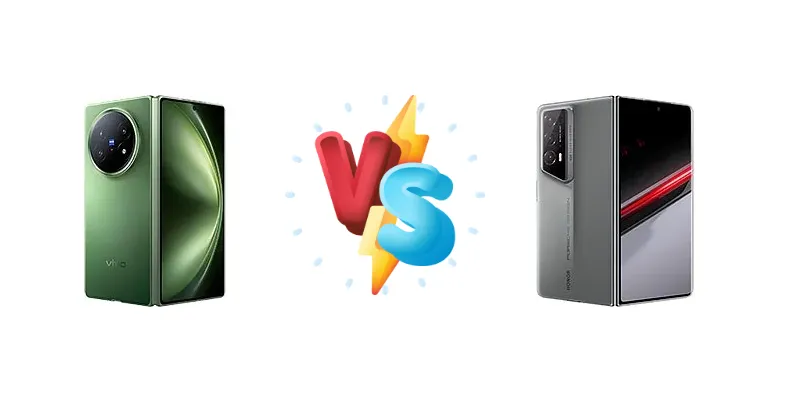
|
🏆 Quick Verdict
For users prioritizing raw performance and longer battery life, the vivo X Fold5 is the clear winner. Its Snapdragon 8 Gen 3 and superior active use battery score of 13:21h outweigh the Honor Magic V2 RSR's Porsche Design aesthetics and slightly faster wired charging.
| PHONES | ||
|---|---|---|
| Phone Names | vivo X Fold5 | Honor Magic V2 RSR Porsche Design |
| Network | ||
|---|---|---|
| 2G bands | GSM 850 / 900 / 1800 / 1900 | GSM 850 / 900 / 1800 / 1900 |
| 3G bands | HSDPA 800 / 850 / 900 / 1700(AWS) / 1900 / 2100 | HSDPA 800 / 850 / 900 / 1700(AWS) / 1900 / 2100 |
| 4G bands | 1, 2, 3, 4, 5, 7, 8, 12, 17, 18, 19, 20, 25, 26, 28, 34, 38, 39, 40, 41, 42, 43, 48, 66 | 1, 2, 3, 4, 5, 7, 8, 12, 17, 18, 19, 20, 26, 28, 34, 38, 39, 40, 41, 66 |
| 5G bands | 1, 2, 3, 5, 7, 8, 12, 18, 20, 25, 26, 28, 38, 40, 41, 48, 66, 77, 78 SA/NSA | 1, 3, 5, 8, 28, 38, 41, 77, 78 SA/NSA |
| Speed | HSPA, LTE, 5G | HSPA, LTE, 5G |
| Technology | GSM / CDMA / HSPA / CDMA2000 / LTE / 5G | GSM / CDMA / HSPA / CDMA2000 / LTE / 5G |
| Launch | ||
|---|---|---|
| Announced | 2025, June 25 | 2024, January 11 |
| Status | Available. Released 2025, July 02 | Available. Released 2024, January 12 |
| Body | ||
|---|---|---|
| Build | Glass front (closed), aluminum alloy frame, fiber-reinforced plastic back | Glass front, glass back, magnesium alloy frame, titanium alloy folding mechanism |
| Dimensions | Unfolded: 159.7 x 142.3 x 4.3 mmFolded: 159.7 x 72.6 x 9.2 mm | Unfolded: 156.7 x 145.4 x 4.7 mm or 4.8 mmFolded: 156.7 x 74 x 9.9 mm or 10.1 mm |
| SIM | Nano-SIM + Nano-SIM | · Nano-SIM + eSIM· Nano-SIM + Nano-SIM |
| Weight | 217 g or 226 g (7.65 oz) | 234 g (8.25 oz) |
| Display | ||
|---|---|---|
| Resolution | 2200 x 2480 pixels (~413 ppi density) | 2156 x 2344 pixels (~402 ppi density) |
| Size | 8.03 inches, 206.5 cm2 (~90.9% screen-to-body ratio) | 7.92 inches, 201.6 cm2 (~88.5% screen-to-body ratio) |
| Type | Foldable LTPO AMOLED, 1B colors, 120Hz, 5280Hz PWM, HDR10+, Dolby Vision, 4500 nits (peak) | Foldable LTPO OLED, 1B colors, 120Hz, HDR10+, 1600 nits (peak) |
| Platform | ||
|---|---|---|
| CPU | Octa-core (1x3.3 GHz Cortex-X4 & 3x3.2 GHz Cortex-A720 & 2x3.0 GHz Cortex-A720 & 2x2.3 GHz Cortex-A520) | Octa-core (1x3.36 GHz Cortex-X3 & 2x2.8 GHz Cortex-A715 & 2x2.8 GHz Cortex-A710 & 3x2.0 GHz Cortex-A510) |
| Chipset | Qualcomm SM8650-AB Snapdragon 8 Gen 3 (4 nm) | Qualcomm SM8550-AC Snapdragon 8 Gen 2 (4 nm) |
| GPU | Adreno 750 | Adreno 740 |
| OS | Android 15, up to 4 major Android upgrades, Funtouch 15 (International), OriginOS 5 (China) | Android 13, upgradable to Android 14, MagicOS 8 |
| Memory | ||
|---|---|---|
| Card slot | No | No |
| Internal | 256GB 12GB RAM, 512GB 12GB RAM, 512GB 16GB RAM, 1TB 16GB RAM | 1TB 16GB RAM |
| Main Camera | ||
|---|---|---|
| Features | Color spectrum sensor, Laser AF, Zeiss optics, Zeiss T* lens coating, Dual-LED flash, panorama | Multi-zone Laser AF (8x8 dToF), color spectrum sensor, LED flash, HDR, panorama |
| Triple | 50 MP, f/1.6, 23mm (wide), 1/1.56", 1.0µm, PDAF, OIS 50 MP, f/2.6, 70mm (periscope telephoto), 1/1.95", 0.8µm, PDAF, OIS, 3x optical zoom 50 MP, f/2.1, 15mm, 119˚ (ultrawide), 1/2.76", 0.64µm, PDAF | 50 MP, f/1.9, (wide), PDAF, OIS 20 MP, f/2.4, 62mm (telephoto), PDAF, 2.5x optical zoom, OIS 50 MP, f/2.0, 13mm (ultrawide), AF |
| Video | 8K@30fps, 4K@30/60fps, 1080p@30/60fps, gyro-EIS | 4K@30/60fps (10-bit), 1080p@30/60fps, gyro-EIS, HDR10+, OIS |
| Selfie camera | ||
|---|---|---|
| Features | HDR | HDR |
| Single | 20 MP, f/2.4, 21mm (wide), 1/3.6", 0.7µm Cover camera: 20 MP, f/2.4, 21mm (wide), 1/3.6", 0.7µm | 16 MP, f/2.2, (wide) |
| Video | 1080p@30fps | 4K@30fps, 1080p@30fps, gyro-EIS |
| Sound | ||
|---|---|---|
| 35mm jack | No | No |
| Loudspeaker | Yes, with stereo speakers | Yes, with stereo speakers |
| Comms | ||
|---|---|---|
| Bluetooth | 5.4, A2DP, LE, aptX HD, aptX Adaptive, aptX Lossless | 5.3, A2DP, LE, aptX HD |
| Infrared port | Yes | Yes |
| NFC | Yes | Yes |
| Positioning | GPS (L1+L5), BDS (B1I+B1c+B2a), GALILEO (E1+E5a), QZSS (L1+L5), GLONASS | GPS (L1+L5), GLONASS (L1), BDS (B1I+B1c+B2a), GALILEO (E1+E5a), QZSS (L1+L5) |
| Radio | No | No |
| USB | USB Type-C 3.2, OTG, Display Port | USB Type-C 3.1, OTG, Display Port 1.2 |
| WLAN | Wi-Fi 802.11 a/b/g/n/ac/6e/7, dual-band or tri-band, Wi-Fi Direct | Wi-Fi 802.11 a/b/g/n/ac/6e/7, dual-band, Wi-Fi Direct |
| Features | ||
|---|---|---|
| Sensors | Fingerprint (side-mounted), accelerometer, gyro, proximity, compass | Fingerprint (side-mounted), accelerometer, gyro, proximity, compass |
| Battery | ||
|---|---|---|
| Charging | 80W wired 40W wireless Reverse wired 5W reverse wireless | 66W wired 5W reverse wired |
| Type | Si/C Li-Ion 6000 mAh | Si/C Li-Ion 5000 mAh |
| Misc | ||
|---|---|---|
| Colors | Titanium Gray, Green, White | Agate Gray |
| Models | V2436A, V2429 | VER-AN10 |
| Price | ₹ 149,998 | About 2700 EUR |
| SAR | 0.86 W/kg (head) 0.85 W/kg (body) | - |
vivo X Fold5
- Superior performance with Snapdragon 8 Gen 3
- Longer battery life (13:21h active use)
- Faster wireless charging (40W)
- May lack the prestige of the Porsche Design branding
- Wired charging slightly slower than Honor (80W vs 66W)
Honor Magic V2 RSR Porsche Design
- Exclusive Porsche Design aesthetic
- Faster wired charging (66W)
- Potentially lighter and more compact design
- Older Snapdragon 8 Gen 2 chipset
- Shorter battery life compared to vivo X Fold5
Display Comparison
The vivo X Fold5 boasts a measured peak brightness of 1916 nits, suggesting a significantly more visible display in direct sunlight compared to the Honor Magic V2 RSR, though Honor's exact peak brightness isn't provided. Both likely utilize LTPO technology for adaptive refresh rates, conserving battery. The Porsche Design model may emphasize color accuracy tuned for professional use, but without specific data, the X Fold5's brightness advantage is a key differentiator for outdoor visibility. Bezels are likely comparable, given both phones target the premium segment.
Camera Comparison
Without detailed camera specifications, a direct comparison is limited. However, both phones likely feature multi-camera systems with OIS on the main sensor. The focus will be on image processing algorithms and sensor size. Given the price point, both will deliver excellent image quality in good lighting conditions. The X Fold5’s newer processor may offer advantages in computational photography, such as faster image processing and improved low-light performance. The Porsche Design model may emphasize a specific color science or aesthetic favored by Porsche enthusiasts.
Performance
The vivo X Fold5’s Snapdragon 8 Gen 3 (4nm) represents a substantial upgrade over the Honor Magic V2 RSR’s Snapdragon 8 Gen 2 (4nm). The Gen 3 features a new CPU architecture – Cortex-X4 prime core clocked at 3.3 GHz versus the Gen 2’s Cortex-X3 at 3.36 GHz – and improved GPU performance. While both are 4nm chips, the Gen 3’s architectural enhancements translate to faster processing and more efficient power consumption. The X Fold5’s CPU configuration (1x3.3 GHz X4, 3x3.2 GHz A720, 2x3.0 GHz A720, 2x2.3 GHz A520) is optimized for sustained performance, while the Honor’s (1x3.36 GHz X3, 2x2.8 GHz A715, 2x2.8 GHz A710, 3x2.0 GHz A510) prioritizes a balance of power and efficiency. This means the X Fold5 will excel in graphically intensive tasks and multitasking.
Battery Life
The vivo X Fold5 demonstrates a clear advantage in battery endurance with a 13:21h active use score. The Honor Magic V2 RSR offers 66W wired charging, faster than the X Fold5’s 80W, but the X Fold5 compensates with 40W wireless charging and reverse wireless charging capabilities. The difference in charging speed is unlikely to be significant in real-world usage. The X Fold5’s longer battery life, coupled with its wireless charging options, provides greater flexibility and convenience.
Buying Guide
Buy the vivo X Fold5 if you need uncompromising performance for demanding tasks like gaming or video editing, and value extended battery life for all-day use. Buy the Honor Magic V2 RSR Porsche Design if you prioritize a luxurious design aesthetic, brand prestige, and a slightly lighter overall package, accepting a performance trade-off and shorter battery runtime.