
vivo X Fold3 vs Xiaomi Mix Fold 3: A Deep Dive into Foldable Flagships
| Phones Images | |||||
|---|---|---|---|---|---|
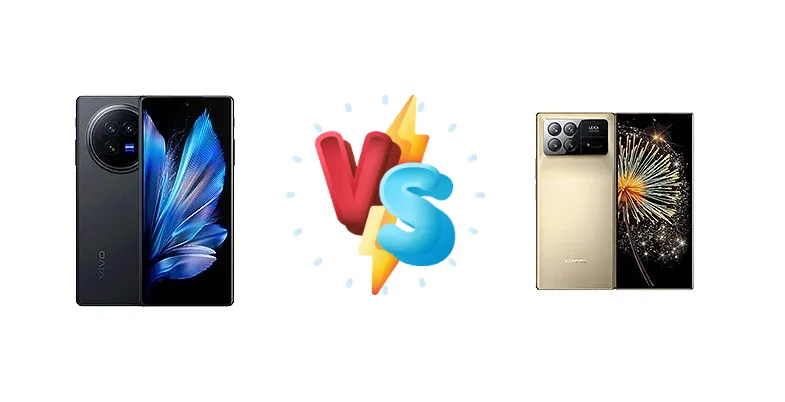
|
🏆 Quick Verdict
For most users, the vivo X Fold3 emerges as the slightly stronger choice. Its 80W wired charging provides a significant convenience advantage, and while the Xiaomi Mix Fold 3 boasts a brighter display, the overall package of performance and charging speed tips the scales in vivo's favor.
| PHONES | ||
|---|---|---|
| Phone Names | vivo X Fold3 | Xiaomi Mix Fold 3 |
| Network | ||
|---|---|---|
| 2G bands | GSM 850 / 900 / 1800 / 1900 | GSM 850 / 900 / 1800 / 1900 |
| 3G bands | HSDPA 800 / 850 / 900 / 1700(AWS) / 1900 / 2100 | HSDPA 800 / 850 / 900 / 1700(AWS) / 1900 / 2100 |
| 4G bands | 1, 2, 3, 4, 5, 7, 8, 12, 17, 18, 19, 20, 25, 26, 28, 34, 38, 39, 40, 41, 42, 66 | 1, 2, 3, 4, 5, 7, 8, 12, 17, 18, 19, 26, 34, 38, 39, 40, 41, 42 |
| 5G bands | 1, 2, 3, 5, 7, 8, 12, 20, 25, 26, 28, 38, 40, 41, 66, 77, 78 SA/NSA | 1, 3, 5, 8, 28, 38, 40, 41, 77, 78, 79 SA/NSA |
| Speed | HSPA, LTE, 5G | HSPA, LTE, 5G |
| Technology | GSM / CDMA / HSPA / CDMA2000 / LTE / 5G | GSM / CDMA / HSPA / EVDO / LTE / 5G |
| Launch | ||
|---|---|---|
| Announced | 2024, March 26 | 2023, August 14 |
| Status | Available. Released 2024, April 03 | Available. Released 2023, August 14 |
| Body | ||
|---|---|---|
| Build | Carbon fiber hinge | Glass front (folded), plastic front (unfolded), glass back or aramid fiber back, aluminum frame |
| Dimensions | Unfolded: 160 x 142.7 x 4.7 mmFolded: 160 x 72.7 x 10.2 mm | Unfolded: 161.2 x 143.3 x 5.3 mm Folded: 161.2 x 73.5 x 10.9 mm |
| SIM | Nano-SIM + Nano-SIM | Nano-SIM + Nano-SIM |
| Weight | 219 g (7.72 oz) | 255 g or 259 g (8.99 oz) |
| Display | ||
|---|---|---|
| Resolution | 2200 x 2480 pixels (~413 ppi density) | 1916 x 2160 pixels (~360 ppi density) |
| Size | 8.03 inches, 206.5 cm2 (~90.5% screen-to-body ratio) | 8.03 inches, 206.5 cm2 (~89.4% screen-to-body ratio) |
| Type | Foldable LTPO AMOLED, 1B colors, 120Hz, HDR10+, Dolby Vision, 4500 nits (peak) | Foldable LTPO OLED+, 1B colors, 120Hz, HDR10+, Dolby Vision, 1300 nits (peak) |
| Platform | ||
|---|---|---|
| CPU | Octa-core (1x3.2 GHz Cortex-X3 & 2x2.8 GHz Cortex-A715 & 2x2.8 GHz Cortex-A710 & 3x2.0 GHz Cortex-A510) | Octa-core (1x3.36 GHz Cortex-X3 & 2x2.8 GHz Cortex-A715 & 2x2.8 GHz Cortex-A710 & 3x2.0 GHz Cortex-A510) |
| Chipset | Qualcomm SM8550-AB Snapdragon 8 Gen 2 (4 nm) | Qualcomm SM8550-AC Snapdragon 8 Gen 2 (4 nm) |
| GPU | Adreno 740 | Adreno 740 |
| OS | Android 14, OriginOS 4 | Android 13, upgradable to Android 14, HyperOS |
| Memory | ||
|---|---|---|
| Card slot | No | No |
| Internal | 256GB 12GB RAM, 256GB 16GB RAM, 512GB 16GB RAM, 1TB 16GB RAM | 256GB 12GB RAM, 512GB 16GB RAM, 1TB 16GB RAM |
| Main Camera | ||
|---|---|---|
| Features | Laser AF, Zeiss optics, Zeiss T* lens coating, Dual-LED flash, panorama | Color spectrum sensor, LED flash, HDR, panorama, Leica lenses |
| Quad | - | 50 MP, f/1.8, 23mm (wide), 1/1.49", 1.0µm, PDAF, OIS 10 MP, f/2.0, 75mm (telephoto), 1/3.94", 1.0µm, PDAF, OIS, 3.2x optical zoom 10 MP, f/2.9, 115mm (telephoto), 1/3.94", 1.0µm, PDAF, OIS, 5x optical zoom 12 MP, f/2.2, 15mm, 120˚ (ultrawide), 1/3.1", 1.12µm |
| Triple | 50 MP, f/1.8, (wide), 1/1.49", PDAF, OIS 50 MP, f/1.9, (telephoto), 1/2.93", PDAF, 2x optical zoom 50 MP, f/2.0, 119˚ (ultrawide), 1/2.76", PDAF | - |
| Video | 8K@30fps, 4K@30/60fps, 1080p@30/60fps, gyro-EIS | 8K@24fps, 4K@24/30/60fps, 1080p@30/60/120/240/960/1920fps, Dolby Vision HDR |
| Selfie camera | ||
|---|---|---|
| Features | HDR | HDR, panorama |
| Single | 32 MP, f/2.4, (wide) Cover camera: 32 MP, f/2.4, (wide) | 20 MP, f/2.3, 23mm (wide), 1/4.0", 0.8µm Cover camera: 20 MP, f/2.3, 23mm (wide), 1/4.0", 0.8µm |
| Video | 1080p@30fps | 1080p@30/60fps |
| Sound | ||
|---|---|---|
| 35mm jack | No | No |
| Loudspeaker | Yes, with stereo speakers | Yes, with stereo speakers |
| Comms | ||
|---|---|---|
| Bluetooth | 5.3, A2DP, LE, aptX HD, aptX Adaptive, aptX Lossless | 5.3, A2DP, LE |
| Infrared port | Yes | Yes |
| NFC | Yes | Yes |
| Positioning | GPS (L1+L5), GLONASS (G1), BDS (B1I+B1c+B2a), GALILEO (E1+E5a), QZSS (L1+L5) | GPS (L1+L5), GLONASS (G1), BDS (B1I+B1c+B2a), GALILEO (E1+E5a), QZSS (L1+L5), NavIC (L5) |
| Radio | No | No |
| USB | USB Type-C 3.2 Gen 2, OTG | USB Type-C 3.2, OTG |
| WLAN | Wi-Fi 802.11 a/b/g/n/ac/6e/7, tri-band, Wi-Fi Direct | Wi-Fi 802.11 a/b/g/n/ac/6e/7, dual-band (tri-band after future SW update) |
| Features | ||
|---|---|---|
| Sensors | Fingerprint (side-mounted), accelerometer, gyro, proximity, compass | Fingerprint (side-mounted), accelerometer, gyro, proximity, compass, barometer |
| Battery | ||
|---|---|---|
| Charging | 80W wired Reverse wired | 67W wired, PD3.0, QC4, 100% in 40 min 50W wireless, 100% in 55 min |
| Type | Si/C Li-Ion 5500 mAh | Li-Po 4800 mAh |
| Misc | ||
|---|---|---|
| Colors | Black, White | Black, Gold |
| Models | V2337A, V2303A | 2308CPXD0C |
| Price | About 900 EUR | About 1150 EUR |
vivo X Fold3
- Faster 80W wired charging
- Potentially better thermal management due to slightly lower CPU clock
- Snapdragon 8 Gen 2 provides flagship performance
- Lacks wireless charging
- Limited display specifications available
Xiaomi Mix Fold 3
- Brighter 1277 nit display
- Wireless charging support (50W)
- Versatile charging options (PD3.0, QC4)
- Slower 67W wired charging
- Slightly higher CPU clock may lead to increased heat
Display Comparison
The Xiaomi Mix Fold 3 immediately stands out with its measured peak brightness of 1277 nits, offering superior visibility outdoors. However, the vivo X Fold3’s display specifications are not provided, so we can assume it’s competitive, likely utilizing LTPO technology for adaptive refresh rates to conserve battery. The absence of detailed display specs for the vivo X Fold3 makes a direct comparison difficult, but the Xiaomi’s brightness is a clear advantage for outdoor use. Bezels and color accuracy will be key differentiators, but require hands-on testing to assess.
Camera Comparison
Detailed camera specifications are lacking for both devices. Without sensor size, aperture, or OIS details, a meaningful comparison is limited. We can assume both phones offer a multi-camera system, but the image processing style and low-light performance will be key differentiators. The absence of information regarding the Xiaomi Mix Fold 3’s camera capabilities prevents a thorough assessment. The vivo X Fold3’s camera performance remains unknown without further details.
Performance
Both the vivo X Fold3 and Xiaomi Mix Fold 3 are powered by the Qualcomm SM8550-AB/AC Snapdragon 8 Gen 2 (4nm). The Xiaomi Mix Fold 3’s CPU clocks slightly higher at 3.36 GHz versus the vivo’s 3.2 GHz, potentially offering a marginal performance boost in CPU-intensive tasks. However, this difference is unlikely to be noticeable in everyday use. Both devices utilize the same core configuration (1x Cortex-X3, 2x Cortex-A715, 2x Cortex-A710, 3x Cortex-A510). Thermal management will be crucial; the 4nm process node helps mitigate throttling, but the foldable form factor presents unique cooling challenges. The inclusion of LPDDR5x RAM in both devices ensures fast memory access.
Battery Life
The Xiaomi Mix Fold 3 offers a more versatile charging solution with 67W wired, PD3.0, QC4, and 50W wireless charging, reaching 100% in 40 and 55 minutes respectively. The vivo X Fold3 counters with a faster 80W wired charging solution, but lacks wireless charging. The Xiaomi Mix Fold 3’s reported endurance rating of 117 hours suggests a larger battery capacity, but without knowing the exact mAh, it’s difficult to assess the real-world impact. The faster wired charging of the vivo X Fold3 provides a significant convenience advantage for users who frequently need to recharge.
Buying Guide
Buy the vivo X Fold3 if you prioritize fast charging and a consistently smooth experience. Its 80W charging is ideal for users who need to quickly top up their battery throughout the day. Buy the Xiaomi Mix Fold 3 if you value maximum display brightness and wireless charging capabilities, and are willing to trade some charging speed for those features. It's a better fit for media consumption in bright environments.