
vivo X Fold3 vs. Samsung Galaxy Z Fold5: A Deep Dive into Foldable Supremacy
| Phones Images | |||||
|---|---|---|---|---|---|
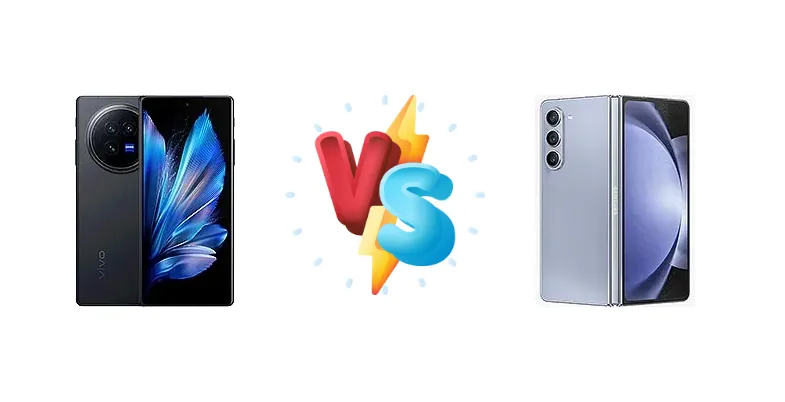
|
🏆 Quick Verdict
For the average user prioritizing rapid charging and potentially a more aggressive price point, the vivo X Fold3 emerges as the winner. However, Samsung’s Galaxy Z Fold5 maintains a strong position with its refined software and proven durability, making it ideal for those deeply embedded in the Samsung ecosystem.
| PHONES | ||
|---|---|---|
| Phone Names | vivo X Fold3 | Samsung Galaxy Z Fold5 |
| Network | ||
|---|---|---|
| 2G bands | GSM 850 / 900 / 1800 / 1900 | GSM 850 / 900 / 1800 / 1900 |
| 3G bands | HSDPA 800 / 850 / 900 / 1700(AWS) / 1900 / 2100 | HSDPA 850 / 900 / 1700(AWS) / 1900 / 2100 |
| 4G bands | 1, 2, 3, 4, 5, 7, 8, 12, 17, 18, 19, 20, 25, 26, 28, 34, 38, 39, 40, 41, 42, 66 | 1, 2, 3, 4, 5, 7, 8, 12, 13, 17, 18, 19, 20, 25, 26, 28, 38, 39, 40, 41, 66 - International |
| 5G bands | 1, 2, 3, 5, 7, 8, 12, 20, 25, 26, 28, 38, 40, 41, 66, 77, 78 SA/NSA | 1, 2, 3, 5, 7, 8, 12, 20, 25, 28, 38, 40, 41, 66, 77, 78 SA/NSA/Sub6 - International |
| Speed | HSPA, LTE, 5G | HSPA, LTE, 5G |
| Technology | GSM / CDMA / HSPA / CDMA2000 / LTE / 5G | GSM / CDMA / HSPA / EVDO / LTE / 5G |
| Launch | ||
|---|---|---|
| Announced | 2024, March 26 | 2023, July 26 |
| Status | Available. Released 2024, April 03 | Available. Released 2023, August 11 |
| Body | ||
|---|---|---|
| Build | Carbon fiber hinge | Glass front (Gorilla Glass Victus 2) (folded), plastic front (unfolded), glass back (Gorilla Glass Victus 2), aluminum frame |
| Dimensions | Unfolded: 160 x 142.7 x 4.7 mmFolded: 160 x 72.7 x 10.2 mm | Unfolded: 154.9 x 129.9 x 6.1 mmFolded: 154.9 x 67.1 x 13.4 mm |
| SIM | Nano-SIM + Nano-SIM | · Nano-SIM + eSIM· Nano-SIM + Nano-SIM + eSIM (max 2 at a time) |
| Weight | 219 g (7.72 oz) | 253 g (8.92 oz) |
| Display | ||
|---|---|---|
| Resolution | 2200 x 2480 pixels (~413 ppi density) | 1812 x 2176 pixels (~373 ppi density) |
| Size | 8.03 inches, 206.5 cm2 (~90.5% screen-to-body ratio) | 7.6 inches, 183.2 cm2 (~91.1% screen-to-body ratio) |
| Type | Foldable LTPO AMOLED, 1B colors, 120Hz, HDR10+, Dolby Vision, 4500 nits (peak) | Foldable Dynamic AMOLED 2X, 120Hz, HDR10+ |
| Platform | ||
|---|---|---|
| CPU | Octa-core (1x3.2 GHz Cortex-X3 & 2x2.8 GHz Cortex-A715 & 2x2.8 GHz Cortex-A710 & 3x2.0 GHz Cortex-A510) | Octa-core (1x3.36 GHz Cortex-X3 & 2x2.8 GHz Cortex-A715 & 2x2.8 GHz Cortex-A710 & 3x2.0 GHz Cortex-A510) |
| Chipset | Qualcomm SM8550-AB Snapdragon 8 Gen 2 (4 nm) | Qualcomm SM8550-AC Snapdragon 8 Gen 2 (4 nm) |
| GPU | Adreno 740 | Adreno 740 |
| OS | Android 14, OriginOS 4 | Android 13, up to 4 major Android upgrades, One UI 6.1.1 |
| Memory | ||
|---|---|---|
| Card slot | No | No |
| Internal | 256GB 12GB RAM, 256GB 16GB RAM, 512GB 16GB RAM, 1TB 16GB RAM | 256GB 12GB RAM, 512GB 12GB RAM, 1TB 12GB RAM |
| Main Camera | ||
|---|---|---|
| Features | Laser AF, Zeiss optics, Zeiss T* lens coating, Dual-LED flash, panorama | LED flash, HDR, panorama |
| Triple | 50 MP, f/1.8, (wide), 1/1.49", PDAF, OIS 50 MP, f/1.9, (telephoto), 1/2.93", PDAF, 2x optical zoom 50 MP, f/2.0, 119˚ (ultrawide), 1/2.76", PDAF | 50 MP, f/1.8, 23mm (wide), 1/1.56", 1.0µm, dual pixel PDAF, OIS 10 MP, f/2.4, 66mm (telephoto), 1/3.94", 1.0µm, PDAF, OIS, 3x optical zoom 12 MP, f/2.2, 12mm, 123˚ (ultrawide), 1/3.06", 1.12µm |
| Video | 8K@30fps, 4K@30/60fps, 1080p@30/60fps, gyro-EIS | 8K@30fps, 4K@60fps, 1080p@60/240fps (gyro-EIS), HDR10+ |
| Selfie camera | ||
|---|---|---|
| Features | HDR | HDR |
| Single | 32 MP, f/2.4, (wide) Cover camera: 32 MP, f/2.4, (wide) | 4 MP, f/1.8, 26mm (wide), 1/3.0", 2.0µm, under display Cover camera: 10 MP, f/2.2, 24mm (wide), 1/3.0", 1.22µm |
| Video | 1080p@30fps | 4K@30/60fps, 1080p@30/60fps, gyro-EIS |
| Sound | ||
|---|---|---|
| 35mm jack | No | No |
| Loudspeaker | Yes, with stereo speakers | Yes, with stereo speakers |
| Comms | ||
|---|---|---|
| Bluetooth | 5.3, A2DP, LE, aptX HD, aptX Adaptive, aptX Lossless | 5.3, A2DP, LE, aptX HD |
| Infrared port | Yes | - |
| NFC | Yes | Yes |
| Positioning | GPS (L1+L5), GLONASS (G1), BDS (B1I+B1c+B2a), GALILEO (E1+E5a), QZSS (L1+L5) | GPS, GLONASS, GALILEO, BDS |
| Radio | No | No |
| USB | USB Type-C 3.2 Gen 2, OTG | USB Type-C 3.2, OTG |
| WLAN | Wi-Fi 802.11 a/b/g/n/ac/6e/7, tri-band, Wi-Fi Direct | Wi-Fi 802.11 a/b/g/n/ac/6e, tri-band, Wi-Fi Direct |
| Features | ||
|---|---|---|
| Sensors | Fingerprint (side-mounted), accelerometer, gyro, proximity, compass | Fingerprint (side-mounted), accelerometer, gyro, proximity, compass, barometer |
| Battery | ||
|---|---|---|
| Charging | 80W wired Reverse wired | 25W wired, 50% in 30 min 15W wireless 4.5W reverse wireless |
| Type | Si/C Li-Ion 5500 mAh | Li-Po 4400 mAh |
| Misc | ||
|---|---|---|
| Colors | Black, White | Icy Blue, Phantom Black, Cream, Gray, Blue |
| Models | V2337A, V2303A | SM-F946B, SM-F946B/DS, SM-F946U, SM-F946U1, SM-F946N, SM-F946W, SM-F9460 |
| Price | About 900 EUR | € 660.00 / $ 607.00 / £ 520.69 / ₹ 86,000 |
| SAR | - | 1.16 W/kg (head) |
| SAR EU | - | 1.24 W/kg (head) 1.19 W/kg (body) |
vivo X Fold3
- Significantly faster 80W wired charging
- Potential for more aggressive pricing
- Reverse wired charging capability
- Camera specs currently unknown
- Software experience may be less refined than Samsung
Samsung Galaxy Z Fold5
- Proven durability and hinge design
- Refined software experience and ecosystem integration
- Excellent battery life (12:01h active use)
- Slower 25W wired charging
- Higher price point
- Under-display camera image quality compromise
Display Comparison
The Samsung Galaxy Z Fold5 boasts a measured peak brightness of 1257 nits, a strong figure for outdoor visibility. While the vivo X Fold3’s peak brightness isn’t specified, it’s likely competitive given the flagship positioning. Both utilize foldable LTPO displays, crucial for adaptive refresh rates and power efficiency. The real difference will likely lie in color calibration and hinge design, areas where Samsung has a significant lead in refinement. The Z Fold5’s under-display camera is also a factor, though image quality remains a compromise.
Camera Comparison
Detailed camera specs are limited for the vivo X Fold3. The Samsung Galaxy Z Fold5’s camera system is well-documented, offering versatile photo and video capabilities. The focus should be on image processing differences. Samsung typically favors vibrant, saturated colors, while vivo often aims for a more natural look. Sensor size and OIS performance will be critical differentiators, but without specific details for the X Fold3, a direct comparison is difficult. The inclusion of a 2MP macro camera on either device is largely a marketing feature with limited practical benefit.
Performance
Both the vivo X Fold3 and the Samsung Galaxy Z Fold5 are powered by the Qualcomm SM8550-AB/AC Snapdragon 8 Gen 2 (4nm). The Z Fold5’s variant (AC) has a slightly higher peak CPU clock speed (3.36 GHz vs 3.2 GHz on the X Fold3’s AB), but this difference is unlikely to be noticeable in most real-world scenarios. Both devices will benefit from the 4nm process node, offering excellent thermal efficiency. The Z Fold5’s cooling system and software optimization will be key to sustained performance under heavy load. RAM configurations are not specified, but both are expected to utilize LPDDR5x for fast memory access.
Battery Life
The Samsung Galaxy Z Fold5 achieves an impressive 12:01h active use score and a 95h endurance rating, demonstrating strong battery life. The vivo X Fold3’s battery capacity is unknown, but its 80W wired charging is a significant advantage. This allows for a 50% charge in under 30 minutes, a substantial improvement over the Z Fold5’s 25W charging (50% in 30 minutes). The X Fold3 also offers reverse wired charging, a feature present on the Z Fold5 but at a slower 4.5W rate. The faster charging of the X Fold3 effectively mitigates any potential disadvantage from a smaller battery capacity.
Buying Guide
Buy the vivo X Fold3 if you need blazing-fast 80W wired charging, minimizing downtime and maximizing usability throughout your day. This is especially beneficial for power users who frequently drain their battery. Buy the Samsung Galaxy Z Fold5 if you prefer a more polished software experience, a longer track record of durability, and seamless integration with other Samsung devices and services, valuing ecosystem lock-in over raw charging speed.