
vivo X Fold3 vs. Honor Magic V2 RSR Porsche Design: A Deep Dive into Foldable Power
| Phones Images | |||||
|---|---|---|---|---|---|
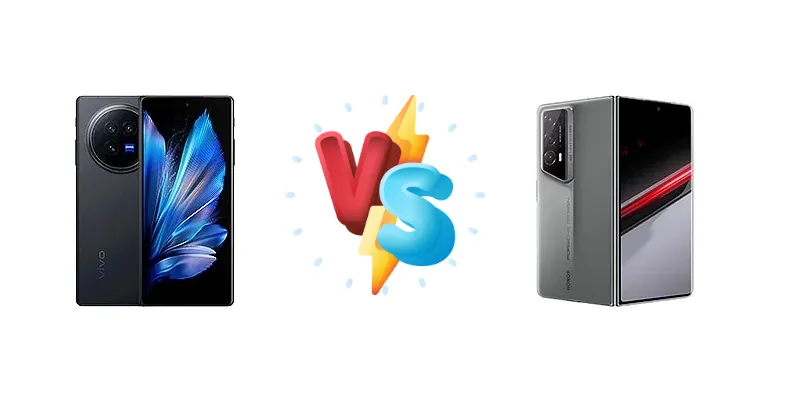
|
🏆 Quick Verdict
For the average power user prioritizing raw performance and charging speed, the vivo X Fold3 emerges as the winner. While the Honor Magic V2 RSR Porsche Design boasts a striking aesthetic, the X Fold3’s slightly faster processor and 80W charging provide a tangible edge in daily use.
| PHONES | ||
|---|---|---|
| Phone Names | vivo X Fold3 | Honor Magic V2 RSR Porsche Design |
| Network | ||
|---|---|---|
| 2G bands | GSM 850 / 900 / 1800 / 1900 | GSM 850 / 900 / 1800 / 1900 |
| 3G bands | HSDPA 800 / 850 / 900 / 1700(AWS) / 1900 / 2100 | HSDPA 800 / 850 / 900 / 1700(AWS) / 1900 / 2100 |
| 4G bands | 1, 2, 3, 4, 5, 7, 8, 12, 17, 18, 19, 20, 25, 26, 28, 34, 38, 39, 40, 41, 42, 66 | 1, 2, 3, 4, 5, 7, 8, 12, 17, 18, 19, 20, 26, 28, 34, 38, 39, 40, 41, 66 |
| 5G bands | 1, 2, 3, 5, 7, 8, 12, 20, 25, 26, 28, 38, 40, 41, 66, 77, 78 SA/NSA | 1, 3, 5, 8, 28, 38, 41, 77, 78 SA/NSA |
| Speed | HSPA, LTE, 5G | HSPA, LTE, 5G |
| Technology | GSM / CDMA / HSPA / CDMA2000 / LTE / 5G | GSM / CDMA / HSPA / CDMA2000 / LTE / 5G |
| Launch | ||
|---|---|---|
| Announced | 2024, March 26 | 2024, January 11 |
| Status | Available. Released 2024, April 03 | Available. Released 2024, January 12 |
| Body | ||
|---|---|---|
| Build | Carbon fiber hinge | Glass front, glass back, magnesium alloy frame, titanium alloy folding mechanism |
| Dimensions | Unfolded: 160 x 142.7 x 4.7 mmFolded: 160 x 72.7 x 10.2 mm | Unfolded: 156.7 x 145.4 x 4.7 mm or 4.8 mmFolded: 156.7 x 74 x 9.9 mm or 10.1 mm |
| SIM | Nano-SIM + Nano-SIM | · Nano-SIM + eSIM· Nano-SIM + Nano-SIM |
| Weight | 219 g (7.72 oz) | 234 g (8.25 oz) |
| Display | ||
|---|---|---|
| Resolution | 2200 x 2480 pixels (~413 ppi density) | 2156 x 2344 pixels (~402 ppi density) |
| Size | 8.03 inches, 206.5 cm2 (~90.5% screen-to-body ratio) | 7.92 inches, 201.6 cm2 (~88.5% screen-to-body ratio) |
| Type | Foldable LTPO AMOLED, 1B colors, 120Hz, HDR10+, Dolby Vision, 4500 nits (peak) | Foldable LTPO OLED, 1B colors, 120Hz, HDR10+, 1600 nits (peak) |
| Platform | ||
|---|---|---|
| CPU | Octa-core (1x3.2 GHz Cortex-X3 & 2x2.8 GHz Cortex-A715 & 2x2.8 GHz Cortex-A710 & 3x2.0 GHz Cortex-A510) | Octa-core (1x3.36 GHz Cortex-X3 & 2x2.8 GHz Cortex-A715 & 2x2.8 GHz Cortex-A710 & 3x2.0 GHz Cortex-A510) |
| Chipset | Qualcomm SM8550-AB Snapdragon 8 Gen 2 (4 nm) | Qualcomm SM8550-AC Snapdragon 8 Gen 2 (4 nm) |
| GPU | Adreno 740 | Adreno 740 |
| OS | Android 14, OriginOS 4 | Android 13, upgradable to Android 14, MagicOS 8 |
| Memory | ||
|---|---|---|
| Card slot | No | No |
| Internal | 256GB 12GB RAM, 256GB 16GB RAM, 512GB 16GB RAM, 1TB 16GB RAM | 1TB 16GB RAM |
| Main Camera | ||
|---|---|---|
| Features | Laser AF, Zeiss optics, Zeiss T* lens coating, Dual-LED flash, panorama | Multi-zone Laser AF (8x8 dToF), color spectrum sensor, LED flash, HDR, panorama |
| Triple | 50 MP, f/1.8, (wide), 1/1.49", PDAF, OIS 50 MP, f/1.9, (telephoto), 1/2.93", PDAF, 2x optical zoom 50 MP, f/2.0, 119˚ (ultrawide), 1/2.76", PDAF | 50 MP, f/1.9, (wide), PDAF, OIS 20 MP, f/2.4, 62mm (telephoto), PDAF, 2.5x optical zoom, OIS 50 MP, f/2.0, 13mm (ultrawide), AF |
| Video | 8K@30fps, 4K@30/60fps, 1080p@30/60fps, gyro-EIS | 4K@30/60fps (10-bit), 1080p@30/60fps, gyro-EIS, HDR10+, OIS |
| Selfie camera | ||
|---|---|---|
| Features | HDR | HDR |
| Single | 32 MP, f/2.4, (wide) Cover camera: 32 MP, f/2.4, (wide) | 16 MP, f/2.2, (wide) |
| Video | 1080p@30fps | 4K@30fps, 1080p@30fps, gyro-EIS |
| Sound | ||
|---|---|---|
| 35mm jack | No | No |
| Loudspeaker | Yes, with stereo speakers | Yes, with stereo speakers |
| Comms | ||
|---|---|---|
| Bluetooth | 5.3, A2DP, LE, aptX HD, aptX Adaptive, aptX Lossless | 5.3, A2DP, LE, aptX HD |
| Infrared port | Yes | Yes |
| NFC | Yes | Yes |
| Positioning | GPS (L1+L5), GLONASS (G1), BDS (B1I+B1c+B2a), GALILEO (E1+E5a), QZSS (L1+L5) | GPS (L1+L5), GLONASS (L1), BDS (B1I+B1c+B2a), GALILEO (E1+E5a), QZSS (L1+L5) |
| Radio | No | No |
| USB | USB Type-C 3.2 Gen 2, OTG | USB Type-C 3.1, OTG, Display Port 1.2 |
| WLAN | Wi-Fi 802.11 a/b/g/n/ac/6e/7, tri-band, Wi-Fi Direct | Wi-Fi 802.11 a/b/g/n/ac/6e/7, dual-band, Wi-Fi Direct |
| Features | ||
|---|---|---|
| Sensors | Fingerprint (side-mounted), accelerometer, gyro, proximity, compass | Fingerprint (side-mounted), accelerometer, gyro, proximity, compass |
| Battery | ||
|---|---|---|
| Charging | 80W wired Reverse wired | 66W wired 5W reverse wired |
| Type | Si/C Li-Ion 5500 mAh | Si/C Li-Ion 5000 mAh |
| Misc | ||
|---|---|---|
| Colors | Black, White | Agate Gray |
| Models | V2337A, V2303A | VER-AN10 |
| Price | About 900 EUR | About 2700 EUR |
vivo X Fold3
- Faster 80W wired charging for quicker top-ups.
- Potentially better thermal management due to larger chassis.
- Slightly more affordable price point (likely).
- Less luxurious design compared to the Porsche Design model.
- Slightly lower CPU clock speed.
Honor Magic V2 RSR Porsche Design
- Premium Porsche Design aesthetic and build quality.
- Slightly higher CPU clock speed for marginal performance gains.
- Ultra-thin profile for enhanced portability.
- Slower 66W wired charging.
- Potentially more prone to thermal throttling due to thinner design.
- Higher price tag.
Display Comparison
Both devices utilize the Snapdragon 8 Gen 2, meaning display quality will be a key differentiator. While specific panel details (peak brightness, color gamut coverage) are unavailable, the foldable form factor inherently presents challenges in maintaining consistent brightness across the unfolded display. The Honor Magic V2 RSR is known for its incredibly thin profile, suggesting a focus on minimizing bezel size, potentially impacting structural integrity. The X Fold3’s display likely prioritizes durability alongside visual fidelity. The absence of detailed display specs necessitates relying on real-world user reports for a complete picture.
Camera Comparison
Without detailed camera specifications, a direct comparison is limited. However, both brands are known for their image processing capabilities. The Snapdragon 8 Gen 2’s ISP (Image Signal Processor) is capable of handling complex computational photography tasks. The Honor Magic V2 RSR Porsche Design, given its positioning, likely emphasizes a refined and accurate color profile, appealing to photography enthusiasts. The X Fold3 may lean towards a more vibrant and social media-friendly aesthetic. The absence of sensor size and aperture information makes it difficult to assess low-light performance or depth-of-field capabilities.
Performance
Both foldables are powered by the Qualcomm SM8550-AB/AC Snapdragon 8 Gen 2 (4nm). However, the Honor Magic V2 RSR features a slightly higher clocked Cortex-X3 core at 3.36 GHz versus the vivo X Fold3’s 3.2 GHz. This marginal clock speed difference translates to a potentially small performance advantage in CPU-bound tasks for the Honor device. Both utilize the same GPU architecture, so graphical performance should be comparable. The 4nm process node ensures excellent thermal efficiency, but sustained performance will depend on the effectiveness of each device’s cooling solution. The X Fold3’s larger size *could* allow for a more robust cooling system, mitigating potential throttling during extended gaming sessions.
Battery Life
The vivo X Fold3 boasts 80W wired charging, significantly faster than the Honor Magic V2 RSR’s 66W. This translates to a quicker 0-100% charge time, a crucial advantage for users who need to rapidly replenish their battery. While battery capacity isn’t specified, the faster charging speed of the X Fold3 effectively mitigates any potential disadvantage from a slightly smaller battery. Both devices offer reverse wired charging, but the X Fold3’s 80W output is considerably more powerful than the Honor’s 5W, allowing it to charge other devices much faster.
Buying Guide
Buy the vivo X Fold3 if you need a foldable that prioritizes sustained performance for gaming and demanding applications, coupled with the fastest possible charging speeds. Buy the Honor Magic V2 RSR Porsche Design if you prefer a more luxurious design aesthetic and are willing to trade a small amount of processing power and charging speed for a premium, head-turning device.