
vivo X Fold3 vs Google Pixel Fold: A Deep Dive into Foldable Power and Features
| Phones Images | |||||
|---|---|---|---|---|---|
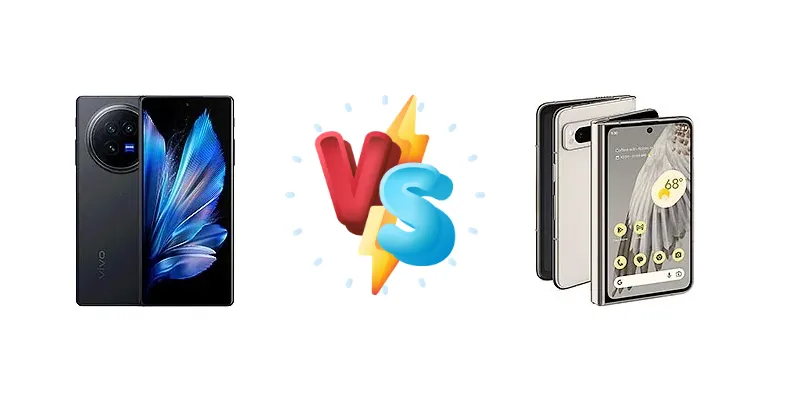
|
🏆 Quick Verdict
For users prioritizing peak performance and fast charging, the vivo X Fold3 is the clear winner. Its Snapdragon 8 Gen 2 chipset delivers superior processing power and efficiency. However, the Pixel Fold’s software integration and unique form factor appeal to those deeply invested in the Google ecosystem.
| PHONES | ||
|---|---|---|
| Phone Names | vivo X Fold3 | Google Pixel Fold |
| Network | ||
|---|---|---|
| 2G bands | GSM 850 / 900 / 1800 / 1900 | GSM 850 / 900 / 1800 / 1900 |
| 3G bands | HSDPA 800 / 850 / 900 / 1700(AWS) / 1900 / 2100 | HSDPA 800 / 850 / 900 / 1700(AWS) / 1900 / 2100 |
| 4G bands | 1, 2, 3, 4, 5, 7, 8, 12, 17, 18, 19, 20, 25, 26, 28, 34, 38, 39, 40, 41, 42, 66 | 1, 2, 3, 4, 5, 7, 8, 12, 13, 14, 17, 18, 19, 20, 21, 25, 26, 28, 29, 30, 32, 38, 39, 40, 41, 42, 46, 48, 66, 71 |
| 5G bands | 1, 2, 3, 5, 7, 8, 12, 20, 25, 26, 28, 38, 40, 41, 66, 77, 78 SA/NSA | 1, 2, 3, 5, 7, 8, 12, 14, 20, 25, 28, 30, 38, 40, 41, 48, 66, 71, 75, 76, 77, 78, 79, 257, 258, 260, 261 SA/NSA/Sub6/mmWave |
| Speed | HSPA, LTE, 5G | HSPA, LTE, 5G |
| Technology | GSM / CDMA / HSPA / CDMA2000 / LTE / 5G | GSM / CDMA / HSPA / EVDO / LTE / 5G |
| - | CDMA2000 1xEV-DO | |
| Launch | ||
|---|---|---|
| Announced | 2024, March 26 | 2023, May 10 |
| Status | Available. Released 2024, April 03 | Available. Released 2023, June 27 |
| Body | ||
|---|---|---|
| Build | Carbon fiber hinge | Glass front (Gorilla Glass Victus) (folded), plastic front (unfolded), glass back (Gorilla Glass Victus), aluminum frame |
| Dimensions | Unfolded: 160 x 142.7 x 4.7 mmFolded: 160 x 72.7 x 10.2 mm | Unfolded: 139.7 x 158.7 x 5.8 mmFolded: 139.7 x 79.5 x 12.1 mm |
| SIM | Nano-SIM + Nano-SIM | Nano-SIM + eSIM |
| Weight | 219 g (7.72 oz) | 283 g (9.98 oz) |
| - | IPX8 water resistant | |
| Display | ||
|---|---|---|
| Resolution | 2200 x 2480 pixels (~413 ppi density) | 1840 x 2208 pixels (~378 ppi density) |
| Size | 8.03 inches, 206.5 cm2 (~90.5% screen-to-body ratio) | 7.6 inches, 183.3 cm2 (~82.7% screen-to-body ratio) |
| Type | Foldable LTPO AMOLED, 1B colors, 120Hz, HDR10+, Dolby Vision, 4500 nits (peak) | Foldable OLED, 120Hz, HDR10+, 1000 nits (HBM), 1450 nits (peak) |
| - | Cover display: OLED, 120Hz, HDR, Corning Gorilla Glass Victus 5.8 inches, 1080 x 2092 pixels, 17.4:9 ratio, 408 ppi 1200 nits (HBM), 1550 nits (peak) | |
| Platform | ||
|---|---|---|
| CPU | Octa-core (1x3.2 GHz Cortex-X3 & 2x2.8 GHz Cortex-A715 & 2x2.8 GHz Cortex-A710 & 3x2.0 GHz Cortex-A510) | Octa-core (2x2.85 GHz Cortex-X1 & 2x2.35 GHz Cortex-A78 & 4x1.80 GHz Cortex-A55) |
| Chipset | Qualcomm SM8550-AB Snapdragon 8 Gen 2 (4 nm) | Google Tensor G2 (5 nm) |
| GPU | Adreno 740 | Mali-G710 MP7 |
| OS | Android 14, OriginOS 4 | Android 13, upgradable to Android 15, up to 5 major Android upgrades |
| Memory | ||
|---|---|---|
| Card slot | No | No |
| Internal | 256GB 12GB RAM, 256GB 16GB RAM, 512GB 16GB RAM, 1TB 16GB RAM | 256GB 12GB RAM, 512GB 12GB RAM |
| - | UFS 3.1 | |
| Main Camera | ||
|---|---|---|
| Features | Laser AF, Zeiss optics, Zeiss T* lens coating, Dual-LED flash, panorama | Laser AF, Dual-LED flash, HDR, panorama |
| Triple | 50 MP, f/1.8, (wide), 1/1.49", PDAF, OIS 50 MP, f/1.9, (telephoto), 1/2.93", PDAF, 2x optical zoom 50 MP, f/2.0, 119˚ (ultrawide), 1/2.76", PDAF | 48 MP, f/1.7, 25mm (wide), 1/2.0", 0.8µm, dual pixel PDAF, OIS 10.8 MP, f/3.1, 112mm (telephoto), 1/3.1", 1.22µm, dual pixel PDAF, OIS, 5x optical zoom 10.8 MP, f/2.2, 121˚, (ultrawide), 1/3.0", 1.25µm |
| Video | 8K@30fps, 4K@30/60fps, 1080p@30/60fps, gyro-EIS | 4K@30/60fps, 1080p@30/60/120/240fps, 10-bit HDR |
| Selfie camera | ||
|---|---|---|
| Features | HDR | HDR, panorama |
| Single | 32 MP, f/2.4, (wide) Cover camera: 32 MP, f/2.4, (wide) | 8 MP, f/2.0, 24mm (wide), 1/4.0", 1.12µm Cover camera: 9.5 MP, f/2.2, 24mm (wide), 1.22µm, dual pixel PDAF |
| Video | 1080p@30fps | 4K@30/60fps, 1080p@30/60fps |
| Sound | ||
|---|---|---|
| 3.5mm jack | - | No |
| 35mm jack | No | No |
| Loudspeaker | Yes, with stereo speakers | Yes, with stereo speakers |
| Comms | ||
|---|---|---|
| Bluetooth | 5.3, A2DP, LE, aptX HD, aptX Adaptive, aptX Lossless | 5.2, A2DP, LE, aptX HD |
| Infrared port | Yes | - |
| NFC | Yes | Yes |
| Positioning | GPS (L1+L5), GLONASS (G1), BDS (B1I+B1c+B2a), GALILEO (E1+E5a), QZSS (L1+L5) | GPS, GLONASS, GALILEO, BDS |
| Radio | No | No |
| USB | USB Type-C 3.2 Gen 2, OTG | USB Type-C 3.2, OTG |
| WLAN | Wi-Fi 802.11 a/b/g/n/ac/6e/7, tri-band, Wi-Fi Direct | Wi-Fi 802.11 a/b/g/n/ac/6e, tri-band, Wi-Fi Direct |
| Features | ||
|---|---|---|
| Sensors | Fingerprint (side-mounted), accelerometer, gyro, proximity, compass | Fingerprint (side-mounted), accelerometer, gyro, proximity, compass, barometer |
| - | Ultra Wideband (UWB) support | |
| Battery | ||
|---|---|---|
| Charging | 80W wired Reverse wired | Wired, PD3.0 Wireless |
| Type | Si/C Li-Ion 5500 mAh | Li-Po 4821 mAh |
| Misc | ||
|---|---|---|
| Colors | Black, White | Porcelain, Obsidian |
| Models | V2337A, V2303A | G9FPL |
| Price | About 900 EUR | € 670.87 / $ 389.26 / £ 899.99 |
vivo X Fold3
- Significantly faster charging (80W)
- Superior processing power with Snapdragon 8 Gen 2
- Potentially better thermal management
- Software experience may not be as polished as Pixel
- Design may be less refined than Pixel Fold
Google Pixel Fold
- Seamless Google software integration
- More compact outer display for one-handed use
- Excellent computational photography
- Slower charging speeds
- Less powerful Tensor G2 chipset
- Potential for throttling under heavy load
Display Comparison
While both devices feature foldable OLED displays, key differences exist. The vivo X Fold3 likely benefits from a higher refresh rate and potentially higher peak brightness, typical of vivo’s flagship displays, though specific nit values are unavailable. The Pixel Fold’s cover display is notably narrower, offering a more phone-like experience when folded, but potentially hindering multitasking. Both utilize LTPO technology for adaptive refresh rates, conserving battery, but the X Fold3’s panel is expected to be more color accurate due to vivo’s display calibration expertise.
Camera Comparison
Without detailed camera specs, analysis focuses on brand tendencies. Google’s Pixel phones are renowned for their computational photography, emphasizing dynamic range and realistic color reproduction. The Pixel Fold will likely excel in low-light scenarios and portrait mode. Vivo, on the other hand, often leans towards vibrant, saturated colors. The X Fold3’s image processing will likely prioritize detail and sharpness. Sensor size is crucial; if the X Fold3 features a larger main sensor (a common trend in vivo flagships), it will capture more light and detail, especially in challenging conditions. The Tensor G2’s image signal processor (ISP) is optimized for Google’s algorithms, but the Snapdragon 8 Gen 2’s ISP is more versatile and capable of handling higher resolution sensors.
Performance
The core difference lies in the chipsets. The vivo X Fold3’s Snapdragon 8 Gen 2 (4nm) is a powerhouse, boasting a Cortex-X3 prime core clocked at 3.2 GHz. This architecture provides a significant performance advantage over the Google Pixel Fold’s Tensor G2 (5nm). The Tensor G2, while optimized for AI tasks, features older Cortex-A78 cores and a less efficient manufacturing process. This translates to potentially noticeable throttling under sustained load on the Pixel Fold, while the X Fold3’s 4nm process and superior cooling (likely) will maintain higher sustained performance. The X Fold3 also benefits from faster LPDDR5x RAM, further enhancing responsiveness.
Battery Life
The vivo X Fold3’s 80W wired charging is a game-changer, allowing for a full charge in under 40 minutes. The Pixel Fold’s charging speeds are significantly slower, relying on PD3.0 and wireless charging. While battery capacity isn’t specified, the faster charging of the X Fold3 mitigates the impact of a potentially smaller battery. The Snapdragon 8 Gen 2’s superior power efficiency also contributes to longer battery life, especially during demanding tasks. The Pixel Fold’s Tensor G2, being less efficient, will likely require more frequent charging.
Buying Guide
Buy the vivo X Fold3 if you need uncompromising performance for gaming or demanding tasks, and value the fastest possible charging speeds. It’s ideal for power users and those who want a foldable that can handle anything. Buy the Google Pixel Fold if you prioritize a seamless Google software experience, a more compact outer display, and a unique camera processing style, even if it means sacrificing some raw processing power.