
vivo X Fold2 vs vivo X Fold+: The Ultimate Foldable Showdown
| Phones Images | |||||
|---|---|---|---|---|---|
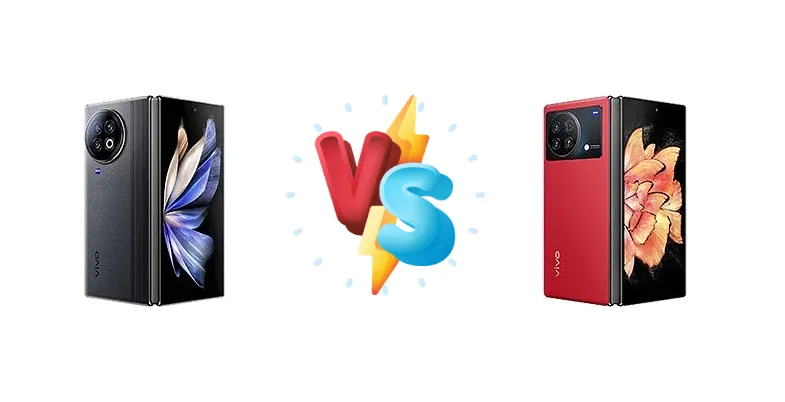
|
🏆 Quick Verdict
The vivo X Fold2 is the clear winner, boasting a significantly faster Snapdragon 8 Gen 2 chipset, a brighter display, and dramatically faster charging. While the X Fold+ remains a capable device, the X Fold2’s upgrades make it the superior choice for most users.
| PHONES | ||
|---|---|---|
| Phone Names | vivo X Fold2 | vivo X Fold+ |
| Network | ||
|---|---|---|
| 2G bands | GSM 850 / 900 / 1800 / 1900 | GSM 850 / 900 / 1800 / 1900 |
| 3G bands | HSDPA 800 / 850 / 900 / 1700(AWS) / 1900 / 2100 | HSDPA 800 / 850 / 900 / 1700(AWS) / 1900 / 2100 |
| 4G bands | 1, 2, 3, 4, 5, 7, 8, 12, 17, 18, 19, 20, 25, 26, 28, 32, 34, 38, 39, 40, 41, 42, 66 | 1, 2, 3, 4, 5, 7, 8, 12, 17, 18, 19, 20, 25, 26, 28, 32, 66 |
| 5G bands | 1, 2, 3, 5, 7, 8, 12, 20, 28, 38, 40, 41, 66, 77, 78 SA/NSA | 1, 2, 3, 5, 7, 8, 12, 20, 28, 66, 38, 40, 41, 77, 78, 79 SA/NSA |
| Speed | HSPA, LTE, 5G | HSPA, LTE-A, 5G |
| Technology | GSM / CDMA / HSPA / CDMA2000 / LTE / 5G | GSM / CDMA / HSPA / CDMA2000 / LTE / 5G |
| CDMA2000 1x | CDMA2000 1x | |
| Launch | ||
|---|---|---|
| Announced | 2023, April 20 | 2022, September 26 |
| Status | Available. Released 2023, April 28 | Available. Released 2022, September 29 |
| Body | ||
|---|---|---|
| Dimensions | Unfolded: 161.3 x 143.4 x 6 mmFolded: 161.3 x 73.4 x 12.9 mm | Unfolded: 162 x 144.9 x 6.3 mm Folded: 162 x 74.5 x 14.6 mm |
| SIM | Nano-SIM + Nano-SIM | Nano-SIM |
| Weight | 279 g (9.84 oz) | 311 g (10.97 oz) |
| Display | ||
|---|---|---|
| Resolution | 1916 x 2160 pixels (~360 ppi density) | 1916 x 2160 pixels (~360 ppi density) |
| Size | 8.03 inches, 206.5 cm2 (~89.3% screen-to-body ratio) | 8.03 inches, 206.5 cm2 (~88.0% screen-to-body ratio) |
| Type | Foldable LTPO4 AMOLED, 120Hz, HDR10+, Dolby Vision, 1800 nits (peak) | Foldable LTPO AMOLED, 120Hz, HDR10+ |
| Cover display: AMOLED, 120Hz, HDR10+, Dolby Vision, 1600 nits (peak) 6.53 inches, 1080 x 2520 pixels, 21:9 ratio | Cover display: AMOLED, 120Hz, 6.53 inches, 1080 x 2520 pixels, 21:9 ratio | |
| Platform | ||
|---|---|---|
| CPU | Octa-core (1x3.2 GHz Cortex-X3 & 2x2.8 GHz Cortex-A715 & 2x2.8 GHz Cortex-A710 & 3x2.0 GHz Cortex-A510) | Octa-core (1x3.19 GHz Cortex-X2 & 3x2.75 GHz Cortex-A710 & 4x2.0 GHz Cortex-A510) |
| Chipset | Qualcomm SM8550-AB Snapdragon 8 Gen 2 (4 nm) | Qualcomm SM8475 Snapdragon 8+ Gen 1 (4 nm) |
| GPU | Adreno 740 | Adreno 730 |
| OS | Android 13, OriginOS 3 | Android 12, Origin OS Ocean |
| Memory | ||
|---|---|---|
| Card slot | No | No |
| Internal | 256GB 12GB RAM, 512GB 12GB RAM | 256GB 12GB RAM, 512GB 12GB RAM |
| UFS 4.0 | UFS 3.1 | |
| Main Camera | ||
|---|---|---|
| Features | Laser AF, Zeiss optics, Zeiss T* lens coating, Dual-LED flash, panorama | Zeiss optics, Zeiss T* lens coating, Dual-LED flash, panorama |
| Quad | - | 50 MP, f/1.8, (wide), 1/1.57", 1.0µm, Dual Pixel PDAF, Laser AF, OIS 8 MP, f/3.4, 125mm (periscope telephoto), PDAF, OIS, 5x optical zoom 12 MP, f/2.0, 47mm (telephoto), PDAF, 2x optical zoom 48 MP, f/2.2, 14mm, 114˚ (ultrawide) |
| Single | - | 16 MP, f/2.5, (wide) Cover camera: 16 MP, f/2.5, (wide) |
| Triple | 50 MP, f/1.8, (wide), 1/1.49", 1.0µm, dual pixel PDAF, OIS 12 MP, f/2.0, 47mm (telephoto), 1/2.93", 1.22µm, dual pixel PDAF, 2x optical zoom 12 MP, f/2.0, 16mm, 108˚ (ultrawide), 1/2.93", 1.22µm, dual pixel PDAF | - |
| Video | 8K@30fps, 4K@30/60fps, 1080p@30/60fps, gyro-EIS | 8K@30fps, 4K@30/60fps, 1080p@30/60fps, gyro-EIS |
| Selfie camera | ||
|---|---|---|
| Features | HDR | HDR |
| Single | 16 MP, f/2.5, (wide) Cover camera: 16 MP, f/2.5, (wide) | 16 MP, f/2.5, (wide) Cover camera: 16 MP, f/2.5, (wide) |
| Video | 1080p@30fps | 1080p@30fps |
| Sound | ||
|---|---|---|
| 3.5mm jack | No | No |
| 35mm jack | No | - |
| Loudspeaker | Yes, with stereo speakers | Yes, with stereo speakers |
| 24-bit/192kHz audio | 24-bit/192kHz audio | |
| Comms | ||
|---|---|---|
| Bluetooth | 5.3, A2DP, LE, aptX HD, aptX Adaptive, aptX Lossless | 5.2, A2DP, LE, aptX HD |
| NFC | Yes | Yes |
| Positioning | GPS (L1+L5), GLONASS (G1), BDS (B1I+B1c+B2a+B2b), GALILEO (E1+E5a), QZSS (L1+L5) | GPS, GLONASS, BDS, GALILEO, QZSS, NavIC |
| Radio | No | No |
| USB | USB Type-C 2.0, OTG | USB Type-C 3.2, OTG |
| WLAN | Wi-Fi 802.11 a/b/g/n/ac/6e/7, tri-band, Wi-Fi Direct | Wi-Fi 802.11 a/b/g/n/ac/6, dual-band, Wi-Fi Direct |
| Features | ||
|---|---|---|
| Sensors | Dual screen fingerprint (under display, ultrasonic), accelerometer, gyro, proximity, compass, barometer | Fingerprint (under display, optical), accelerometer, gyro, proximity, compass, barometer |
| Battery | ||
|---|---|---|
| Charging | 120W wired, 100% in 26 min 50W wireless, 100% in 40 min 10W reverse wireless | 80W wired, 100% in 35 min (advertised) 50W wireless 10W reverse wireless |
| Type | 4800 mAh | Li-Po 4730 mAh, non-removable |
| Misc | ||
|---|---|---|
| Colors | Black, Blue, Red | Black, Blue, Red |
| Models | V2266A | V2229A |
| Price | About 1330 EUR | About 1450 EUR |
vivo X Fold2
- Significantly faster Snapdragon 8 Gen 2
- Brighter display (1308 nits)
- Blazing-fast 120W wired charging
- Excellent endurance rating (96h)
- Premium build quality
- Potentially higher price
- Foldable phones are inherently more fragile
vivo X Fold+
- Still powerful Snapdragon 8+ Gen 1
- Good camera system
- Foldable design offers versatility
- Wireless charging support
- Slower 80W wired charging
- Less bright display
- Older chipset compared to X Fold2
- Lower endurance rating (estimated)
Display Comparison
The vivo X Fold2 takes a noticeable lead in display brightness, reaching a measured 1308 nits compared to the X Fold+'s likely lower peak brightness (spec not provided, but generally lower than Gen 2 devices). Both feature excellent AMOLED panels with high refresh rates, but the X Fold2's extra brightness will be beneficial in outdoor conditions. Both offer similar foldable screen sizes and resolutions.
Camera Comparison
While both phones offer impressive camera systems, detailed camera comparisons require more in-depth testing. Both likely feature a versatile multi-lens setup including a primary wide, ultrawide, and telephoto lens. The X Fold2's newer chipset may offer slightly improved image processing capabilities. Expect excellent image quality from both devices.
Performance
The Snapdragon 8 Gen 2 in the vivo X Fold2 is a substantial upgrade over the Snapdragon 8+ Gen 1 in the X Fold+. Expect smoother multitasking, faster app loading times, and better performance in demanding games. The X Fold+ is still powerful, but the Gen 2 chip provides a noticeable edge in raw processing power and efficiency.
Battery Life
The vivo X Fold2's 120W wired charging is a game-changer, fully charging the phone in just 26 minutes. The X Fold+'s 80W wired charging takes considerably longer (advertised 35 minutes). Both offer 50W wireless charging and 10W reverse wireless charging. The X Fold2 also boasts a superior endurance rating of 96h, suggesting better overall battery life.
Buying Guide
The vivo X Fold2 is ideal for power users who demand top-tier performance, a vibrant display, and rapid charging. The vivo X Fold+ is a good option for those seeking a slightly more affordable foldable with a still-powerful Snapdragon 8+ Gen 1, but are less concerned about the absolute latest specs and fastest charging.