
vivo X Fold2 vs Huawei Mate X3: The Ultimate Foldable Face-Off
| Phones Images | |||||
|---|---|---|---|---|---|
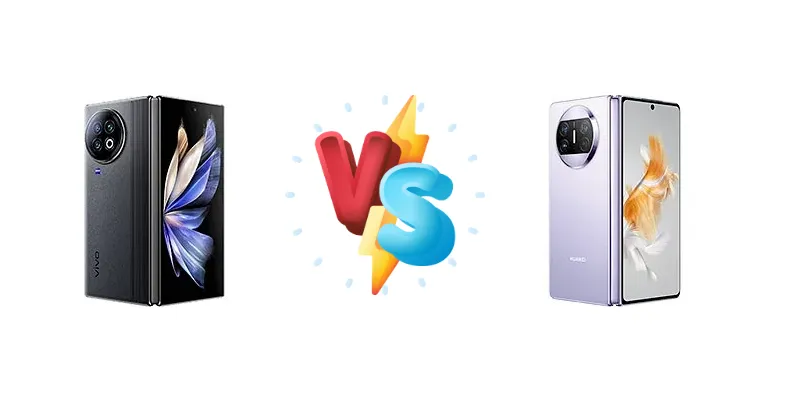
|
🏆 Quick Verdict
The vivo X Fold2 takes the crown with its significantly brighter display, faster charging, and the more powerful Snapdragon 8 Gen 2 chipset. While the Mate X3 offers a premium design and excellent build quality, the X Fold2's performance and display advantages make it the overall winner.
| PHONES | ||
|---|---|---|
| Phone Names | vivo X Fold2 | Huawei Mate X3 |
| Network | ||
|---|---|---|
| 2G bands | GSM 850 / 900 / 1800 / 1900 | GSM 850 / 900 / 1800 / 1900 |
| 3G bands | HSDPA 800 / 850 / 900 / 1700(AWS) / 1900 / 2100 | HSDPA 800 / 850 / 900 / 1700(AWS) / 1900 / 2100 |
| 4G bands | 1, 2, 3, 4, 5, 7, 8, 12, 17, 18, 19, 20, 25, 26, 28, 32, 34, 38, 39, 40, 41, 42, 66 | 1, 2, 3, 4, 5, 7, 8, 12, 17, 18, 19, 20, 26, 28, 34, 38, 39, 40, 41 |
| 5G bands | 1, 2, 3, 5, 7, 8, 12, 20, 28, 38, 40, 41, 66, 77, 78 SA/NSA | - |
| Speed | HSPA, LTE, 5G | HSPA, LTE |
| Technology | GSM / CDMA / HSPA / CDMA2000 / LTE / 5G | GSM / CDMA / HSPA / EVDO / LTE |
| CDMA2000 1x | CDMA2000 1xEV-DO | |
| Launch | ||
|---|---|---|
| Announced | 2023, April 20 | 2023, March 23 |
| Status | Available. Released 2023, April 28 | Available. Released 2023, April 08 |
| Body | ||
|---|---|---|
| Build | - | Glass front, glass back or eco leather back, aluminum frame |
| Dimensions | Unfolded: 161.3 x 143.4 x 6 mmFolded: 161.3 x 73.4 x 12.9 mm | Unfolded: 156.9 x 141.5 x 5.3 mmFolded: 156.9 x 72.4 x 11.1 mm |
| SIM | Nano-SIM + Nano-SIM | Nano-SIM + Nano-SIM |
| Weight | 279 g (9.84 oz) | 239 g or 241 g (8.43 oz) |
| - | IPX8 dust/water resistant (up to 1.5m for 30 min) | |
| Display | ||
|---|---|---|
| Protection | - | Kunlun Glass (cover display only) |
| Resolution | 1916 x 2160 pixels (~360 ppi density) | 2224 x 2496 pixels (~426 ppi density) |
| Size | 8.03 inches, 206.5 cm2 (~89.3% screen-to-body ratio) | 7.85 inches, 197.5 cm2 (~88.9% screen-to-body ratio) |
| Type | Foldable LTPO4 AMOLED, 120Hz, HDR10+, Dolby Vision, 1800 nits (peak) | Foldable OLED, 1B colors, 120Hz |
| Cover display: AMOLED, 120Hz, HDR10+, Dolby Vision, 1600 nits (peak) 6.53 inches, 1080 x 2520 pixels, 21:9 ratio | Cover display: OLED, 120Hz, 6.4 inches, 1080 x 2504 pixels | |
| Platform | ||
|---|---|---|
| CPU | Octa-core (1x3.2 GHz Cortex-X3 & 2x2.8 GHz Cortex-A715 & 2x2.8 GHz Cortex-A710 & 3x2.0 GHz Cortex-A510) | Octa-core (1x3.19 GHz Cortex-X2 & 3x2.75 GHz Cortex-A710 & 4x2.0 GHz Cortex-A510) |
| Chipset | Qualcomm SM8550-AB Snapdragon 8 Gen 2 (4 nm) | Qualcomm SM8475 Snapdragon 8+ Gen 1 4G (4 nm) |
| GPU | Adreno 740 | Adreno 730 |
| OS | Android 13, OriginOS 3 | HarmonyOS 3.1 (China), EMUI 13.1 (Europe), no Google Play Services |
| Memory | ||
|---|---|---|
| Card slot | No | Nano Memory (uses shared SIM slot) |
| Internal | 256GB 12GB RAM, 512GB 12GB RAM | 256GB 12GB RAM, 512GB 12GB RAM, 1TB 12GB RAM |
| UFS 4.0 | UFS | |
| Main Camera | ||
|---|---|---|
| Features | Laser AF, Zeiss optics, Zeiss T* lens coating, Dual-LED flash, panorama | Laser AF, color spectrum sensor, LED flash, panorama, HDR |
| Triple | 50 MP, f/1.8, (wide), 1/1.49", 1.0µm, dual pixel PDAF, OIS 12 MP, f/2.0, 47mm (telephoto), 1/2.93", 1.22µm, dual pixel PDAF, 2x optical zoom 12 MP, f/2.0, 16mm, 108˚ (ultrawide), 1/2.93", 1.22µm, dual pixel PDAF | 50 MP, f/1.8, 23mm (wide), PDAF, OIS 12 MP, f/3.4, 125mm (periscope telephoto), PDAF, OIS, 5x optical zoom 13 MP, f/2.2, 13mm (ultrawide), AF |
| Video | 8K@30fps, 4K@30/60fps, 1080p@30/60fps, gyro-EIS | 4K@30/60fps, 1080p@30/60fps, gyro-EIS |
| Selfie camera | ||
|---|---|---|
| Features | HDR | HDR, panorama |
| Single | 16 MP, f/2.5, (wide) Cover camera: 16 MP, f/2.5, (wide) | 8 MP, f/2.4, (wide) Cover camera: 8 MP, f/2.4, (wide) |
| Video | 1080p@30fps | 4K@30fps, 1080p@30fps |
| Sound | ||
|---|---|---|
| 3.5mm jack | No | No |
| 35mm jack | No | No |
| Loudspeaker | Yes, with stereo speakers | Yes, with stereo speakers |
| 24-bit/192kHz audio | - | |
| Comms | ||
|---|---|---|
| Bluetooth | 5.3, A2DP, LE, aptX HD, aptX Adaptive, aptX Lossless | 5.2, A2DP, LE |
| Infrared port | - | Yes |
| NFC | Yes | Yes |
| Positioning | GPS (L1+L5), GLONASS (G1), BDS (B1I+B1c+B2a+B2b), GALILEO (E1+E5a), QZSS (L1+L5) | GPS (L1+L5), GLONASS (B1I+B1c+B2a), BDS (B1I+B1c+B2a), GALILEO (E1+E5a), QZSS (L1+L5), NavIC |
| Radio | No | No |
| USB | USB Type-C 2.0, OTG | USB Type-C 3.1, DisplayPort 1.2, OTG |
| WLAN | Wi-Fi 802.11 a/b/g/n/ac/6e/7, tri-band, Wi-Fi Direct | Wi-Fi 802.11 a/b/g/n/ac/6, dual-band, Wi-Fi Direct |
| Features | ||
|---|---|---|
| Sensors | Dual screen fingerprint (under display, ultrasonic), accelerometer, gyro, proximity, compass, barometer | Fingerprint (side-mounted), accelerometer, gyro, proximity, compass, barometer, altimeter |
| - | BDS Satellite Message | |
| Battery | ||
|---|---|---|
| Charging | 120W wired, 100% in 26 min 50W wireless, 100% in 40 min 10W reverse wireless | 66W wired 50W wireless 7.5W reverse wireless |
| Type | 4800 mAh | Market-dependent versions:· Li-Po 4800 mAh (Global)· Si/C Li-Ion 5060 mAh (China only) |
| Misc | ||
|---|---|---|
| Colors | Black, Blue, Red | Black, White, Violet, Dark Green, Gold |
| Models | V2266A | ALT-AL00, ALT-L29 |
| Price | About 1330 EUR | About 1500 EUR |
| Tests | ||
|---|---|---|
| Battery life | - | Endurance rating 81h |
| Camera | - | Photo / Video |
| Display | - | Contrast ratio: Infinite (nominal) |
| Loudspeaker | - | -26.3 LUFS (Good) |
| Performance | - | AnTuTu: 993592 (v9) GeekBench: 4283 (v5.5), 4512 (v6) GFXBench: 41fps (ES 3.1 onscreen) |
vivo X Fold2
- Significantly brighter display
- Faster charging (120W wired)
- More powerful Snapdragon 8 Gen 2 chipset
- Longer battery life (96h endurance)
- Reverse wireless charging
- Potentially higher price
- Software experience may vary depending on region
Huawei Mate X3
- Premium design and build quality
- Seamless integration within the Huawei ecosystem
- Compact folded form factor
- Excellent display contrast
- Less powerful Snapdragon 8+ Gen 1 chipset
- Slower charging (66W wired)
- Shorter battery life (81h endurance)
- Limited availability in some regions
Display Comparison
The vivo X Fold2's display shines with a measured peak brightness of 1308 nits, significantly outperforming the Mate X3's 926 nits. Both offer excellent contrast, with the Mate X3 boasting a nominal 'infinite' contrast ratio. The X Fold2's superior brightness makes it more usable outdoors and provides a more immersive viewing experience. Both devices feature vibrant AMOLED panels with smooth refresh rates.
Camera Comparison
Both phones offer capable camera systems, but detailed comparisons require in-depth testing. Generally, both offer versatile setups with wide, ultrawide, and telephoto lenses. The X Fold2 is expected to leverage the 8 Gen 2's image processing capabilities for slightly better results, particularly in low light. Huawei's camera processing often leans towards vibrant colors, while vivo tends to offer more natural tones.
Performance
The vivo X Fold2 holds a clear advantage here, powered by the Snapdragon 8 Gen 2. This chipset offers a noticeable performance boost over the Mate X3's Snapdragon 8+ Gen 1. Expect smoother multitasking, faster app loading times, and better gaming performance on the X Fold2. Both phones handle everyday tasks with ease, but the X Fold2 is the clear winner for demanding applications.
Battery Life
The vivo X Fold2 boasts a substantial advantage in battery life, with an endurance rating of 96 hours compared to the Mate X3's 81 hours. Furthermore, the X Fold2's 120W wired charging is incredibly fast, reaching 100% in just 26 minutes, while the Mate X3's 66W charging takes longer. The X Fold2 also offers faster wireless charging (50W vs 50W) and reverse wireless charging (10W vs 7.5W).
Buying Guide
The vivo X Fold2 is ideal for power users who demand top-tier performance, a vibrant display, and rapid charging. The Huawei Mate X3 is a great choice for those prioritizing a refined design, seamless software experience (especially within the Huawei ecosystem), and a more compact form factor when folded.