
vivo X Fold vs Xiaomi Mix Fold 3: A Deep Dive into Foldable Flagships
| Phones Images | |||||
|---|---|---|---|---|---|
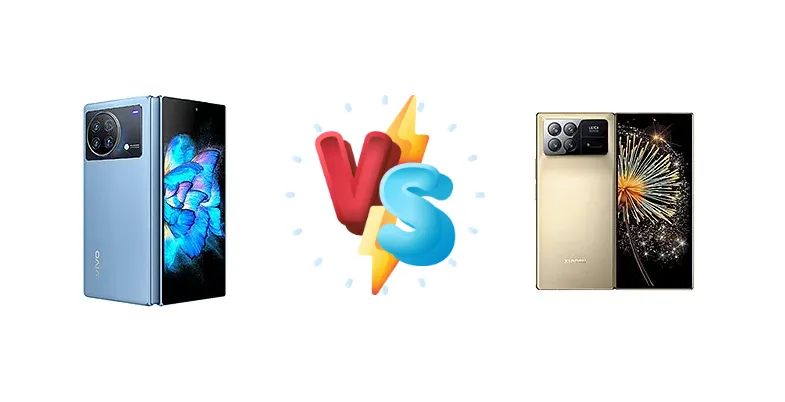
|
🏆 Quick Verdict
For most users, the Xiaomi Mix Fold 3 emerges as the superior choice. The Snapdragon 8 Gen 2 provides a noticeable performance uplift, and its brighter display enhances outdoor visibility. While the vivo X Fold remains a capable device, the Mix Fold 3’s advancements justify the price difference.
| PHONES | ||
|---|---|---|
| Phone Names | vivo X Fold | Xiaomi Mix Fold 3 |
| Network | ||
|---|---|---|
| 2G bands | GSM 850 / 900 / 1800 / 1900 | GSM 850 / 900 / 1800 / 1900 |
| 3G bands | HSDPA 800 / 850 / 900 / 1700(AWS) / 1900 / 2100 | HSDPA 800 / 850 / 900 / 1700(AWS) / 1900 / 2100 |
| 4G bands | 1, 2, 3, 4, 5, 7, 8, 12, 17, 18, 19, 20, 25, 26, 28, 32, 66 | 1, 2, 3, 4, 5, 7, 8, 12, 17, 18, 19, 26, 34, 38, 39, 40, 41, 42 |
| 5G bands | 1, 2, 3, 5, 7, 8, 12, 20, 28, 38, 40, 41, 66, 77, 78, 79 SA/NSA | 1, 3, 5, 8, 28, 38, 40, 41, 77, 78, 79 SA/NSA |
| Speed | HSPA, LTE, 5G | HSPA, LTE, 5G |
| Technology | GSM / CDMA / HSPA / CDMA2000 / LTE / 5G | GSM / CDMA / HSPA / EVDO / LTE / 5G |
| Launch | ||
|---|---|---|
| Announced | 2022, April 11 | 2023, August 14 |
| Status | Available. Released 2022, April 22 | Available. Released 2023, August 14 |
| Body | ||
|---|---|---|
| Build | - | Glass front (folded), plastic front (unfolded), glass back or aramid fiber back, aluminum frame |
| Dimensions | Unfolded: 162 x 144.9 x 6.3 mm Folded: 162 x 74.5 x 14.6 mm | Unfolded: 161.2 x 143.3 x 5.3 mm Folded: 161.2 x 73.5 x 10.9 mm |
| SIM | Nano-SIM | Nano-SIM + Nano-SIM |
| Weight | 311 g (10.97 oz) | 255 g or 259 g (8.99 oz) |
| Display | ||
|---|---|---|
| Resolution | 1916 x 2160 pixels (~360 ppi density) | 1916 x 2160 pixels (~360 ppi density) |
| Size | 8.03 inches, 206.5 cm2 (~88.0% screen-to-body ratio) | 8.03 inches, 206.5 cm2 (~89.4% screen-to-body ratio) |
| Type | Foldable LTPO AMOLED, 120Hz, HDR10+ | Foldable LTPO OLED+, 1B colors, 120Hz, HDR10+, Dolby Vision, 1300 nits (peak) |
| Platform | ||
|---|---|---|
| CPU | Octa-core (1x3.00 GHz Cortex-X2 & 3x2.50 GHz Cortex-A710 & 4x1.80 GHz Cortex-A510) | Octa-core (1x3.36 GHz Cortex-X3 & 2x2.8 GHz Cortex-A715 & 2x2.8 GHz Cortex-A710 & 3x2.0 GHz Cortex-A510) |
| Chipset | Qualcomm SM8450 Snapdragon 8 Gen 1 (4 nm) | Qualcomm SM8550-AC Snapdragon 8 Gen 2 (4 nm) |
| GPU | Adreno 730 | Adreno 740 |
| OS | Android 12, OriginOS Ocean | Android 13, upgradable to Android 14, HyperOS |
| Memory | ||
|---|---|---|
| Card slot | No | No |
| Internal | 256GB 12GB RAM, 512GB 12GB RAM | 256GB 12GB RAM, 512GB 16GB RAM, 1TB 16GB RAM |
| Main Camera | ||
|---|---|---|
| Features | Laser AF, Zeiss optics, Zeiss T* lens coating, Dual-LED flash, panorama | Color spectrum sensor, LED flash, HDR, panorama, Leica lenses |
| Quad | 50 MP, f/1.8, (wide), 1/1.57", 1.0µm, dual pixel PDAF, OIS 8 MP, f/3.4, 125mm (periscope telephoto), PDAF, OIS, 5x optical zoom 12 MP, f/2.0, 47mm (telephoto), PDAF, 2x optical zoom 48 MP, f/2.2, 14mm, 114˚ (ultrawide) | 50 MP, f/1.8, 23mm (wide), 1/1.49", 1.0µm, PDAF, OIS 10 MP, f/2.0, 75mm (telephoto), 1/3.94", 1.0µm, PDAF, OIS, 3.2x optical zoom 10 MP, f/2.9, 115mm (telephoto), 1/3.94", 1.0µm, PDAF, OIS, 5x optical zoom 12 MP, f/2.2, 15mm, 120˚ (ultrawide), 1/3.1", 1.12µm |
| Video | 8K@30fps, 4K@30/60fps, 1080p@30/60fps, gyro-EIS | 8K@24fps, 4K@24/30/60fps, 1080p@30/60/120/240/960/1920fps, Dolby Vision HDR |
| Selfie camera | ||
|---|---|---|
| Features | HDR | HDR, panorama |
| Single | 16 MP, f/2.5, (wide) Cover camera: 16 MP, f/2.5, (wide) | 20 MP, f/2.3, 23mm (wide), 1/4.0", 0.8µm Cover camera: 20 MP, f/2.3, 23mm (wide), 1/4.0", 0.8µm |
| Video | 1080p@30fps | 1080p@30/60fps |
| Sound | ||
|---|---|---|
| 3.5mm jack | No | - |
| 35mm jack | No | No |
| Loudspeaker | Yes, with stereo speakers | Yes, with stereo speakers |
| Comms | ||
|---|---|---|
| Bluetooth | 5.2, A2DP, LE, aptX HD, aptX Adaptive, aptX Lossless | 5.3, A2DP, LE |
| Infrared port | - | Yes |
| NFC | Yes | Yes |
| Positioning | GPS, GLONASS, BDS, GALILEO, QZSS, NavIC | GPS (L1+L5), GLONASS (G1), BDS (B1I+B1c+B2a), GALILEO (E1+E5a), QZSS (L1+L5), NavIC (L5) |
| Radio | No | No |
| USB | USB Type-C 3.2, OTG | USB Type-C 3.2, OTG |
| WLAN | Wi-Fi 802.11 a/b/g/n/ac/6, dual-band, Wi-Fi Direct | Wi-Fi 802.11 a/b/g/n/ac/6e/7, dual-band (tri-band after future SW update) |
| Features | ||
|---|---|---|
| Sensors | Fingerprint (under display, optical), accelerometer, gyro, proximity, compass, barometer | Fingerprint (side-mounted), accelerometer, gyro, proximity, compass, barometer |
| Battery | ||
|---|---|---|
| Charging | 66W wired, 100% in 37 min 50W wireless 10W reverse wireless | 67W wired, PD3.0, QC4, 100% in 40 min 50W wireless, 100% in 55 min |
| Type | 4600 mAh | Li-Po 4800 mAh |
| Misc | ||
|---|---|---|
| Colors | Black, Blue | Black, Gold |
| Models | V2178A | 2308CPXD0C |
| Price | About 1300 EUR | About 1150 EUR |
vivo X Fold
- Potentially lower price point
- Reliable Snapdragon 8 Gen 1 performance
- 66W fast wired charging
- Older Snapdragon 8 Gen 1 chipset
- Likely dimmer display compared to Mix Fold 3
- Less advanced thermal management
Xiaomi Mix Fold 3
- Superior Snapdragon 8 Gen 2 performance
- Brighter 1277 nit display
- Faster 67W wired charging
- Higher price tag
- Slightly longer wireless charging time (55 mins)
- Potential for software bloat (Xiaomi)
Display Comparison
The Xiaomi Mix Fold 3 boasts a significantly brighter display, reaching a measured peak of 1277 nits, compared to an unspecified peak brightness for the vivo X Fold. This translates to superior visibility in direct sunlight. Both devices likely utilize LTPO technology for adaptive refresh rates, conserving battery life, but Xiaomi’s higher peak brightness is a clear advantage. Bezels are a critical aspect of foldable design, and while specific measurements aren’t provided, Xiaomi’s focus on minimizing these is evident in its marketing, suggesting a more immersive viewing experience.
Camera Comparison
Detailed camera specifications are limited, but the focus should be on the main sensors and image processing. While both phones likely feature multi-camera systems, the quality of the primary sensor and the sophistication of the image processing algorithms are paramount. Without specific sensor size or aperture data, it’s difficult to definitively declare a winner. However, Xiaomi’s history of incorporating advanced camera technology suggests a potential edge in image quality and features. We can safely assume both phones will offer capable photography, but the Mix Fold 3 likely benefits from the improved ISP within the Snapdragon 8 Gen 2.
Performance
The core difference lies in the chipsets. The Xiaomi Mix Fold 3’s Snapdragon 8 Gen 2 (SM8550-AC) represents a substantial upgrade over the vivo X Fold’s Snapdragon 8 Gen 1 (SM8450). The Gen 2 features a newer Cortex-X3 prime core clocked at 3.36 GHz versus the X Fold’s 3.00 GHz Cortex-X2. Furthermore, the Gen 2’s CPU configuration (1x3.36GHz, 2x2.8GHz, 2x2.8GHz, 3x2.0GHz) is more efficient than the X Fold’s (1x3.00 GHz, 3x2.50 GHz, 4x1.80 GHz). The 4nm process node used by both chips contributes to efficiency, but the architectural improvements in the Gen 2 deliver a tangible performance boost in demanding tasks and gaming. The Mix Fold 3 will exhibit less throttling under sustained load.
Battery Life
The Xiaomi Mix Fold 3’s endurance rating of 117 hours provides a baseline for real-world battery performance. While the vivo X Fold’s battery capacity is unknown, the Mix Fold 3’s 67W wired charging (PD3.0, QC4) is slightly faster than the X Fold’s 66W, completing a full charge in 40 minutes versus 37 minutes. Both offer 50W wireless charging, with the Mix Fold 3 taking 55 minutes to fully charge wirelessly. The faster wired charging of the Mix Fold 3 is a convenience advantage, offsetting any potential capacity difference.
Buying Guide
Buy the vivo X Fold if you prioritize a potentially lower price point and a well-rounded, if slightly less cutting-edge, foldable experience. It’s ideal for users who want a reliable foldable without needing the absolute latest in processing power. Buy the Xiaomi Mix Fold 3 if you demand the best possible performance, a brighter and more vibrant display, and are willing to pay a premium for the latest Snapdragon technology. This is the phone for power users and multimedia enthusiasts.