
vivo X Fold vs. Samsung Galaxy Z Fold5: A Deep Dive into Foldable Flagships
| Phones Images | |||||
|---|---|---|---|---|---|
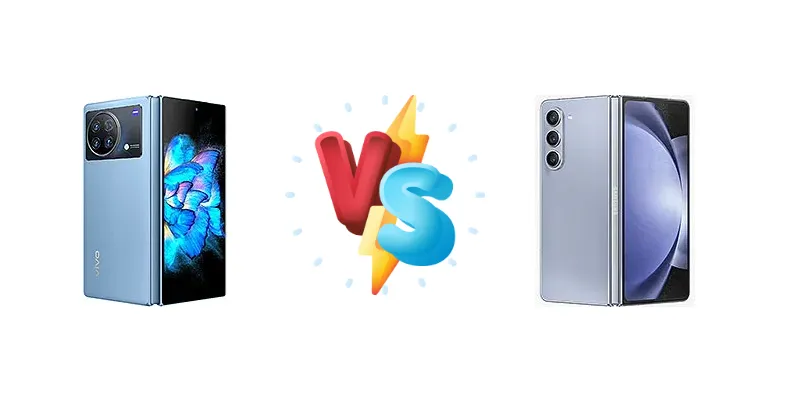
|
🏆 Quick Verdict
For the average user prioritizing longevity and a polished software experience, the Samsung Galaxy Z Fold5 is the safer bet. Its Snapdragon 8 Gen 2 chipset and measured 12:01h active use battery life provide a smoother, more efficient experience. However, the vivo X Fold’s 66W charging offers a significant convenience advantage.
| PHONES | ||
|---|---|---|
| Phone Names | vivo X Fold | Samsung Galaxy Z Fold5 |
| Network | ||
|---|---|---|
| 2G bands | GSM 850 / 900 / 1800 / 1900 | GSM 850 / 900 / 1800 / 1900 |
| 3G bands | HSDPA 800 / 850 / 900 / 1700(AWS) / 1900 / 2100 | HSDPA 850 / 900 / 1700(AWS) / 1900 / 2100 |
| 4G bands | 1, 2, 3, 4, 5, 7, 8, 12, 17, 18, 19, 20, 25, 26, 28, 32, 66 | 1, 2, 3, 4, 5, 7, 8, 12, 13, 17, 18, 19, 20, 25, 26, 28, 38, 39, 40, 41, 66 - International |
| 5G bands | 1, 2, 3, 5, 7, 8, 12, 20, 28, 38, 40, 41, 66, 77, 78, 79 SA/NSA | 1, 2, 3, 5, 7, 8, 12, 20, 25, 28, 38, 40, 41, 66, 77, 78 SA/NSA/Sub6 - International |
| Speed | HSPA, LTE, 5G | HSPA, LTE, 5G |
| Technology | GSM / CDMA / HSPA / CDMA2000 / LTE / 5G | GSM / CDMA / HSPA / EVDO / LTE / 5G |
| Launch | ||
|---|---|---|
| Announced | 2022, April 11 | 2023, July 26 |
| Status | Available. Released 2022, April 22 | Available. Released 2023, August 11 |
| Body | ||
|---|---|---|
| Build | - | Glass front (Gorilla Glass Victus 2) (folded), plastic front (unfolded), glass back (Gorilla Glass Victus 2), aluminum frame |
| Dimensions | Unfolded: 162 x 144.9 x 6.3 mm Folded: 162 x 74.5 x 14.6 mm | Unfolded: 154.9 x 129.9 x 6.1 mmFolded: 154.9 x 67.1 x 13.4 mm |
| SIM | Nano-SIM | · Nano-SIM + eSIM· Nano-SIM + Nano-SIM + eSIM (max 2 at a time) |
| Weight | 311 g (10.97 oz) | 253 g (8.92 oz) |
| Display | ||
|---|---|---|
| Resolution | 1916 x 2160 pixels (~360 ppi density) | 1812 x 2176 pixels (~373 ppi density) |
| Size | 8.03 inches, 206.5 cm2 (~88.0% screen-to-body ratio) | 7.6 inches, 183.2 cm2 (~91.1% screen-to-body ratio) |
| Type | Foldable LTPO AMOLED, 120Hz, HDR10+ | Foldable Dynamic AMOLED 2X, 120Hz, HDR10+ |
| Platform | ||
|---|---|---|
| CPU | Octa-core (1x3.00 GHz Cortex-X2 & 3x2.50 GHz Cortex-A710 & 4x1.80 GHz Cortex-A510) | Octa-core (1x3.36 GHz Cortex-X3 & 2x2.8 GHz Cortex-A715 & 2x2.8 GHz Cortex-A710 & 3x2.0 GHz Cortex-A510) |
| Chipset | Qualcomm SM8450 Snapdragon 8 Gen 1 (4 nm) | Qualcomm SM8550-AC Snapdragon 8 Gen 2 (4 nm) |
| GPU | Adreno 730 | Adreno 740 |
| OS | Android 12, OriginOS Ocean | Android 13, up to 4 major Android upgrades, One UI 6.1.1 |
| Memory | ||
|---|---|---|
| Card slot | No | No |
| Internal | 256GB 12GB RAM, 512GB 12GB RAM | 256GB 12GB RAM, 512GB 12GB RAM, 1TB 12GB RAM |
| Main Camera | ||
|---|---|---|
| Features | Laser AF, Zeiss optics, Zeiss T* lens coating, Dual-LED flash, panorama | LED flash, HDR, panorama |
| Quad | 50 MP, f/1.8, (wide), 1/1.57", 1.0µm, dual pixel PDAF, OIS 8 MP, f/3.4, 125mm (periscope telephoto), PDAF, OIS, 5x optical zoom 12 MP, f/2.0, 47mm (telephoto), PDAF, 2x optical zoom 48 MP, f/2.2, 14mm, 114˚ (ultrawide) | - |
| Triple | - | 50 MP, f/1.8, 23mm (wide), 1/1.56", 1.0µm, dual pixel PDAF, OIS 10 MP, f/2.4, 66mm (telephoto), 1/3.94", 1.0µm, PDAF, OIS, 3x optical zoom 12 MP, f/2.2, 12mm, 123˚ (ultrawide), 1/3.06", 1.12µm |
| Video | 8K@30fps, 4K@30/60fps, 1080p@30/60fps, gyro-EIS | 8K@30fps, 4K@60fps, 1080p@60/240fps (gyro-EIS), HDR10+ |
| Selfie camera | ||
|---|---|---|
| Features | HDR | HDR |
| Single | 16 MP, f/2.5, (wide) Cover camera: 16 MP, f/2.5, (wide) | 4 MP, f/1.8, 26mm (wide), 1/3.0", 2.0µm, under display Cover camera: 10 MP, f/2.2, 24mm (wide), 1/3.0", 1.22µm |
| Video | 1080p@30fps | 4K@30/60fps, 1080p@30/60fps, gyro-EIS |
| Sound | ||
|---|---|---|
| 3.5mm jack | No | - |
| 35mm jack | No | No |
| Loudspeaker | Yes, with stereo speakers | Yes, with stereo speakers |
| Comms | ||
|---|---|---|
| Bluetooth | 5.2, A2DP, LE, aptX HD, aptX Adaptive, aptX Lossless | 5.3, A2DP, LE, aptX HD |
| NFC | Yes | Yes |
| Positioning | GPS, GLONASS, BDS, GALILEO, QZSS, NavIC | GPS, GLONASS, GALILEO, BDS |
| Radio | No | No |
| USB | USB Type-C 3.2, OTG | USB Type-C 3.2, OTG |
| WLAN | Wi-Fi 802.11 a/b/g/n/ac/6, dual-band, Wi-Fi Direct | Wi-Fi 802.11 a/b/g/n/ac/6e, tri-band, Wi-Fi Direct |
| Features | ||
|---|---|---|
| Sensors | Fingerprint (under display, optical), accelerometer, gyro, proximity, compass, barometer | Fingerprint (side-mounted), accelerometer, gyro, proximity, compass, barometer |
| Battery | ||
|---|---|---|
| Charging | 66W wired, 100% in 37 min 50W wireless 10W reverse wireless | 25W wired, 50% in 30 min 15W wireless 4.5W reverse wireless |
| Type | 4600 mAh | Li-Po 4400 mAh |
| Misc | ||
|---|---|---|
| Colors | Black, Blue | Icy Blue, Phantom Black, Cream, Gray, Blue |
| Models | V2178A | SM-F946B, SM-F946B/DS, SM-F946U, SM-F946U1, SM-F946N, SM-F946W, SM-F9460 |
| Price | About 1300 EUR | € 660.00 / $ 607.00 / £ 520.69 / ₹ 86,000 |
| SAR | - | 1.16 W/kg (head) |
| SAR EU | - | 1.24 W/kg (head) 1.19 W/kg (body) |
vivo X Fold
- Significantly faster 66W wired charging
- Potentially more aggressive pricing
- 50W wireless charging and 10W reverse wireless charging
- Older Snapdragon 8 Gen 1 chipset
- Limited camera information available
- Software support may be less consistent than Samsung
Samsung Galaxy Z Fold5
- More powerful Snapdragon 8 Gen 2 chipset
- Brighter and more color-accurate display
- Proven software experience and long-term support
- Slower 25W wired charging
- Higher price point
- Less impressive wireless charging speeds
Display Comparison
The Samsung Galaxy Z Fold5 boasts a measured peak brightness of 1257 nits, offering superior visibility in direct sunlight compared to the vivo X Fold (brightness data unavailable). Both utilize foldable LTPO displays, crucial for adaptive refresh rates and power efficiency. However, Samsung’s display technology is more mature, likely resulting in better color accuracy and reduced crease visibility. The Z Fold5’s cover display also benefits from a more conventional aspect ratio, enhancing usability as a standard smartphone.
Camera Comparison
Detailed camera specs for the vivo X Fold are unavailable, making a direct comparison challenging. However, Samsung typically excels in image processing and offers a more versatile camera system. The Z Fold5’s camera benefits from Samsung’s computational photography expertise, delivering consistent results across various lighting conditions. While the X Fold may offer competitive hardware, Samsung’s software optimization is a key differentiator. We can assume the Z Fold5 will have better video stabilization and more refined portrait modes.
Performance
The core difference lies in the chipsets: the vivo X Fold utilizes the Qualcomm SM8450 Snapdragon 8 Gen 1, while the Z Fold5 features the newer SM8550-AC Snapdragon 8 Gen 2. This generational leap translates to a significant performance advantage for the Z Fold5. The Gen 2’s Cortex-X3 core, clocked at 3.36 GHz, outperforms the Gen 1’s X2 core (3.00 GHz). Furthermore, the Gen 2’s improved 4nm process offers better thermal efficiency, minimizing throttling during sustained workloads. The Z Fold5’s LPDDR5x RAM also contributes to faster data transfer speeds.
Battery Life
The Samsung Galaxy Z Fold5 demonstrates superior battery endurance with a measured active use score of 12:01h and an endurance rating of 95h. While the vivo X Fold’s battery capacity is unknown, its 66W wired charging is a standout feature, achieving a 100% charge in just 37 minutes. The Z Fold5’s 25W charging, taking 30 minutes to reach 50%, feels comparatively slow. The X Fold also offers 50W wireless and 10W reverse wireless charging, exceeding the Z Fold5’s 15W wireless and 4.5W reverse wireless capabilities.
Buying Guide
Buy the vivo X Fold if you prioritize incredibly fast charging – 66W is a game-changer for foldable convenience – and are comfortable with a potentially less refined software experience. Buy the Samsung Galaxy Z Fold5 if you value a proven track record of software updates, a brighter and more color-accurate display, and the peace of mind that comes with Samsung’s established foldable technology.