
vivo X Fold vs. Motorola Razr+ 2025: A Deep Dive into Foldable Performance and Battery Life
| Phones Images | |||||
|---|---|---|---|---|---|
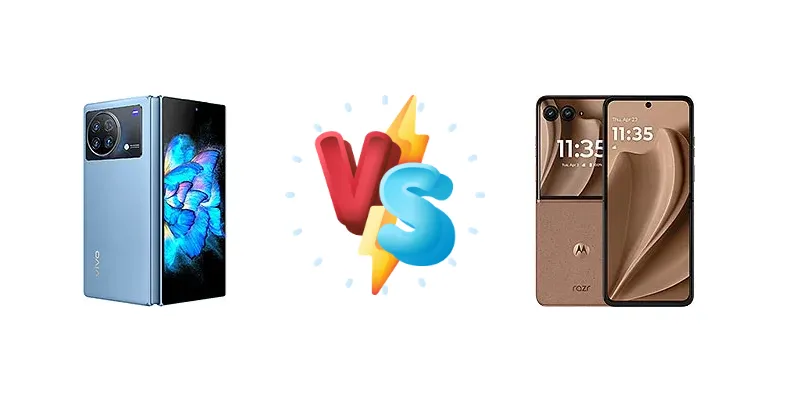
|
🏆 Quick Verdict
For the average user prioritizing all-day battery life and a more efficient processor, the Motorola Razr+ 2025 emerges as the winner. Its 10:12 active use score significantly surpasses what's expected from the X Fold, despite the latter's faster wired charging. However, the X Fold remains a compelling option for those seeking a proven foldable design and potentially lower pricing.
| PHONES | ||
|---|---|---|
| Phone Names | vivo X Fold | Motorola Razr+ 2025 |
| Network | ||
|---|---|---|
| 2G bands | GSM 850 / 900 / 1800 / 1900 | GSM 900 / 1800 / 1900 |
| 3G bands | HSDPA 800 / 850 / 900 / 1700(AWS) / 1900 / 2100 | HSDPA 850 / 900 / 1700(AWS) / 1900 / 2100 |
| 4G bands | 1, 2, 3, 4, 5, 7, 8, 12, 17, 18, 19, 20, 25, 26, 28, 32, 66 | 1, 2, 3, 4, 5, 7, 8, 12, 13, 14, 17, 18, 19, 20, 25, 26, 28, 29, 30, 38, 39, 40, 41, 46, 48, 66, 71 |
| 5G bands | 1, 2, 3, 5, 7, 8, 12, 20, 28, 38, 40, 41, 66, 77, 78, 79 SA/NSA | 1, 2, 3, 5, 7, 12, 14, 20, 25, 26, 28, 29, 30, 38, 40, 41, 48, 66, 70, 71, 77, 78 SA/NSA/Sub6 |
| Speed | HSPA, LTE, 5G | HSPA, LTE, 5G |
| Technology | GSM / CDMA / HSPA / CDMA2000 / LTE / 5G | GSM / HSPA / LTE / 5G |
| Launch | ||
|---|---|---|
| Announced | 2022, April 11 | 2025, April 24 |
| Status | Available. Released 2022, April 22 | Available. Released 2025, June 03 |
| Body | ||
|---|---|---|
| Build | - | Plastic front (unfolded), glass front (folded, Gorilla Glass Victus), silicone polymer back (eco leather), aluminum frame (6000 series), hinge (titanium) |
| Dimensions | Unfolded: 162 x 144.9 x 6.3 mm Folded: 162 x 74.5 x 14.6 mm | Unfolded: 171.4 x 74 x 7.1 mmFolded: 88.1 x 74 x 15.3 mm |
| SIM | Nano-SIM | Nano-SIM + eSIM |
| Weight | 311 g (10.97 oz) | 189 g (6.67 oz) |
| Display | ||
|---|---|---|
| Resolution | 1916 x 2160 pixels (~360 ppi density) | 1080 x 2640 pixels (~413 ppi density) |
| Size | 8.03 inches, 206.5 cm2 (~88.0% screen-to-body ratio) | 6.9 inches, 107.6 cm2 (~84.9% screen-to-body ratio) |
| Type | Foldable LTPO AMOLED, 120Hz, HDR10+ | Foldable LTPO AMOLED, 1B colors, Dolby Vision, 165Hz, HDR10+, 3000 nits (peak) |
| Platform | ||
|---|---|---|
| CPU | Octa-core (1x3.00 GHz Cortex-X2 & 3x2.50 GHz Cortex-A710 & 4x1.80 GHz Cortex-A510) | Octa-core (1x3.0 GHz Cortex-X4 & 4x2.8 GHz Cortex-A720 & 3x2.0 GHz Cortex-A520) |
| Chipset | Qualcomm SM8450 Snapdragon 8 Gen 1 (4 nm) | Qualcomm SM8635 Snapdragon 8s Gen 3 (4 nm) |
| GPU | Adreno 730 | Adreno 735 |
| OS | Android 12, OriginOS Ocean | Android 15 |
| Memory | ||
|---|---|---|
| Card slot | No | No |
| Internal | 256GB 12GB RAM, 512GB 12GB RAM | 256GB 12GB RAM |
| Main Camera | ||
|---|---|---|
| Dual | - | 50 MP, f/1.7, 24mm (wide), 1/1.95", 0.8µm, dual pixel PDAF, OIS 50 MP, f/2.0, 47mm (telephoto), 1/2.76", 0.64µm, PDAF, 2x optical zoom |
| Features | Laser AF, Zeiss optics, Zeiss T* lens coating, Dual-LED flash, panorama | LED flash, panorama, HDR |
| Quad | 50 MP, f/1.8, (wide), 1/1.57", 1.0µm, dual pixel PDAF, OIS 8 MP, f/3.4, 125mm (periscope telephoto), PDAF, OIS, 5x optical zoom 12 MP, f/2.0, 47mm (telephoto), PDAF, 2x optical zoom 48 MP, f/2.2, 14mm, 114˚ (ultrawide) | - |
| Video | 8K@30fps, 4K@30/60fps, 1080p@30/60fps, gyro-EIS | 4K@30/60fps, 1080p@30/60/120/240/960fps, HDR10+, gyro-EIS |
| Selfie camera | ||
|---|---|---|
| Features | HDR | HDR |
| Single | 16 MP, f/2.5, (wide) Cover camera: 16 MP, f/2.5, (wide) | 32 MP, f/2.4, 25mm (wide), 1/3.14", 0.7µm |
| Video | 1080p@30fps | 4K@30/60fps, 1080p@30/60fps |
| Sound | ||
|---|---|---|
| 3.5mm jack | No | - |
| 35mm jack | No | No |
| Loudspeaker | Yes, with stereo speakers | Yes, with stereo speakers (with Dolby Atmos) |
| Comms | ||
|---|---|---|
| Bluetooth | 5.2, A2DP, LE, aptX HD, aptX Adaptive, aptX Lossless | 5.4, A2DP, LE, aptX HD, aptX Adaptive, aptX Lossless |
| NFC | Yes | Yes |
| Positioning | GPS, GLONASS, BDS, GALILEO, QZSS, NavIC | GPS (L1+L5), GLONASS (L1), BDS (B1I+B1c+B2a), GALILEO (E1+E5a), QZSS (L1+L5) |
| Radio | No | No |
| USB | USB Type-C 3.2, OTG | USB Type-C 2.0, OTG |
| WLAN | Wi-Fi 802.11 a/b/g/n/ac/6, dual-band, Wi-Fi Direct | Wi-Fi 802.11 a/b/g/n/ac/6e/7, tri-band |
| Features | ||
|---|---|---|
| Sensors | Fingerprint (under display, optical), accelerometer, gyro, proximity, compass, barometer | Fingerprint (side-mounted), accelerometer, gyro, proximity, compass, barometer |
| Battery | ||
|---|---|---|
| Charging | 66W wired, 100% in 37 min 50W wireless 10W reverse wireless | 45W wired 15W wireless 5W reverse wired |
| Type | 4600 mAh | 4000 mAh |
| Misc | ||
|---|---|---|
| Colors | Black, Blue | Pantone: Mocha Mousse, Midnight Blue, Hot Pink |
| Models | V2178A | XT2451-1 |
| Price | About 1300 EUR | $ 500.00 |
vivo X Fold
- Faster 66W wired charging for quick top-ups.
- Established foldable design with potentially refined software.
- Wireless and reverse wireless charging capabilities.
- Older Snapdragon 8 Gen 1 chipset may exhibit more thermal throttling.
- Likely shorter battery life compared to the Razr+ 2025.
- Potentially higher price point due to earlier release.
Motorola Razr+ 2025
- Superior battery life with 10:12 hours of active use.
- More efficient Snapdragon 8s Gen 3 processor.
- Modern architecture for improved performance and thermal management.
- Slower 45W wired charging.
- Potentially less refined software experience (being a newer model).
- Lower reverse wireless charging wattage.
Display Comparison
While both devices are foldables, specifics on panel technology (LTPO, refresh rates) are missing. However, the X Fold's position as a flagship suggests a high-quality display. The Razr+ 2025's focus on battery life implies a potentially more power-efficient display panel. Bezels and color accuracy are unknown, but crucial for the foldable experience. The external display size and aspect ratio will also be key differentiators, impacting usability.
Camera Comparison
Without detailed camera specs, a direct comparison is difficult. However, the market positioning suggests the Razr+ 2025 will likely feature a more modern image processing pipeline. The X Fold, being an earlier model, may rely on older algorithms. Sensor size and aperture are critical; a larger sensor generally captures more light, improving low-light performance. Optical Image Stabilization (OIS) is essential for sharp photos and stable videos on both devices. We can assume both will have multi-camera setups, but the quality of those secondary lenses will be a key differentiator.
Performance
The Motorola Razr+ 2025’s Snapdragon 8s Gen 3 (4nm) represents a significant architectural leap over the vivo X Fold’s Snapdragon 8 Gen 1 (4nm). The 8s Gen 3 utilizes the newer Cortex-X4 prime core clocked at 3.0 GHz, alongside Cortex-A720 performance cores at 2.8 GHz, offering improved single-core and multi-core performance compared to the X Fold’s X2 and A710 cores. The 4nm process node on both chips contributes to efficiency, but the newer architecture of the 8s Gen 3 should result in less thermal throttling during sustained workloads. The Razr+ 2025 is likely to deliver a smoother experience in demanding games and applications.
Battery Life
The Motorola Razr+ 2025’s 10:12 hours of active use is a standout feature, indicating excellent battery optimization. While the vivo X Fold’s battery capacity is unknown, its 66W wired charging is significantly faster than the Razr+ 2025’s 45W. However, faster charging doesn’t negate the benefit of longer battery life. The X Fold’s 50W wireless and 10W reverse wireless charging offer convenience, but the Razr+ 2025’s 15W wireless and 5W reverse wireless are adequate. The Razr+ 2025 prioritizes longevity, while the X Fold focuses on quick power-ups.
Buying Guide
Buy the vivo X Fold if you need a well-established foldable design with fast 66W wired charging and are comfortable managing battery life with potentially more frequent top-ups. Buy the Motorola Razr+ 2025 if you prioritize all-day battery life, a more modern and efficient processor, and are willing to trade some charging speed for extended usage.