
vivo X Fold vs. Honor Magic V2 RSR Porsche Design: A Foldable Flagship Face-Off
| Phones Images | |||||
|---|---|---|---|---|---|
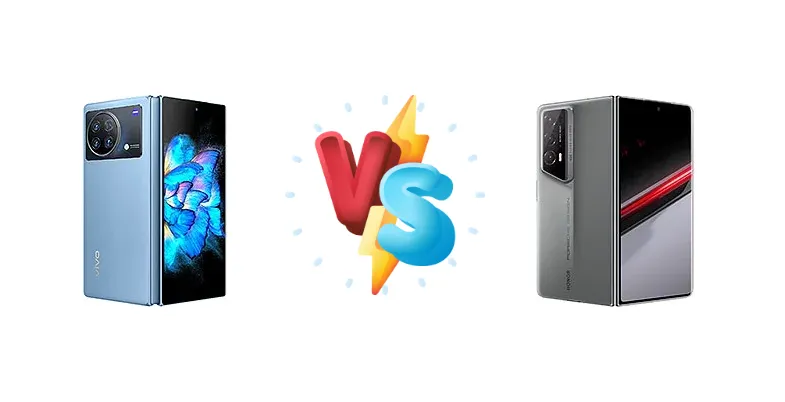
|
🏆 Quick Verdict
For most users, the Honor Magic V2 RSR Porsche Design is the superior choice. Its Snapdragon 8 Gen 2 chipset delivers a significant performance uplift and improved efficiency compared to the vivo X Fold’s Snapdragon 8 Gen 1. While the vivo offers a more affordable entry point, the Honor justifies its price with a demonstrably faster and smoother experience.
| PHONES | ||
|---|---|---|
| Phone Names | vivo X Fold | Honor Magic V2 RSR Porsche Design |
| Network | ||
|---|---|---|
| 2G bands | GSM 850 / 900 / 1800 / 1900 | GSM 850 / 900 / 1800 / 1900 |
| 3G bands | HSDPA 800 / 850 / 900 / 1700(AWS) / 1900 / 2100 | HSDPA 800 / 850 / 900 / 1700(AWS) / 1900 / 2100 |
| 4G bands | 1, 2, 3, 4, 5, 7, 8, 12, 17, 18, 19, 20, 25, 26, 28, 32, 66 | 1, 2, 3, 4, 5, 7, 8, 12, 17, 18, 19, 20, 26, 28, 34, 38, 39, 40, 41, 66 |
| 5G bands | 1, 2, 3, 5, 7, 8, 12, 20, 28, 38, 40, 41, 66, 77, 78, 79 SA/NSA | 1, 3, 5, 8, 28, 38, 41, 77, 78 SA/NSA |
| Speed | HSPA, LTE, 5G | HSPA, LTE, 5G |
| Technology | GSM / CDMA / HSPA / CDMA2000 / LTE / 5G | GSM / CDMA / HSPA / CDMA2000 / LTE / 5G |
| Launch | ||
|---|---|---|
| Announced | 2022, April 11 | 2024, January 11 |
| Status | Available. Released 2022, April 22 | Available. Released 2024, January 12 |
| Body | ||
|---|---|---|
| Build | - | Glass front, glass back, magnesium alloy frame, titanium alloy folding mechanism |
| Dimensions | Unfolded: 162 x 144.9 x 6.3 mm Folded: 162 x 74.5 x 14.6 mm | Unfolded: 156.7 x 145.4 x 4.7 mm or 4.8 mmFolded: 156.7 x 74 x 9.9 mm or 10.1 mm |
| SIM | Nano-SIM | · Nano-SIM + eSIM· Nano-SIM + Nano-SIM |
| Weight | 311 g (10.97 oz) | 234 g (8.25 oz) |
| Display | ||
|---|---|---|
| Resolution | 1916 x 2160 pixels (~360 ppi density) | 2156 x 2344 pixels (~402 ppi density) |
| Size | 8.03 inches, 206.5 cm2 (~88.0% screen-to-body ratio) | 7.92 inches, 201.6 cm2 (~88.5% screen-to-body ratio) |
| Type | Foldable LTPO AMOLED, 120Hz, HDR10+ | Foldable LTPO OLED, 1B colors, 120Hz, HDR10+, 1600 nits (peak) |
| Platform | ||
|---|---|---|
| CPU | Octa-core (1x3.00 GHz Cortex-X2 & 3x2.50 GHz Cortex-A710 & 4x1.80 GHz Cortex-A510) | Octa-core (1x3.36 GHz Cortex-X3 & 2x2.8 GHz Cortex-A715 & 2x2.8 GHz Cortex-A710 & 3x2.0 GHz Cortex-A510) |
| Chipset | Qualcomm SM8450 Snapdragon 8 Gen 1 (4 nm) | Qualcomm SM8550-AC Snapdragon 8 Gen 2 (4 nm) |
| GPU | Adreno 730 | Adreno 740 |
| OS | Android 12, OriginOS Ocean | Android 13, upgradable to Android 14, MagicOS 8 |
| Memory | ||
|---|---|---|
| Card slot | No | No |
| Internal | 256GB 12GB RAM, 512GB 12GB RAM | 1TB 16GB RAM |
| Main Camera | ||
|---|---|---|
| Features | Laser AF, Zeiss optics, Zeiss T* lens coating, Dual-LED flash, panorama | Multi-zone Laser AF (8x8 dToF), color spectrum sensor, LED flash, HDR, panorama |
| Quad | 50 MP, f/1.8, (wide), 1/1.57", 1.0µm, dual pixel PDAF, OIS 8 MP, f/3.4, 125mm (periscope telephoto), PDAF, OIS, 5x optical zoom 12 MP, f/2.0, 47mm (telephoto), PDAF, 2x optical zoom 48 MP, f/2.2, 14mm, 114˚ (ultrawide) | - |
| Triple | - | 50 MP, f/1.9, (wide), PDAF, OIS 20 MP, f/2.4, 62mm (telephoto), PDAF, 2.5x optical zoom, OIS 50 MP, f/2.0, 13mm (ultrawide), AF |
| Video | 8K@30fps, 4K@30/60fps, 1080p@30/60fps, gyro-EIS | 4K@30/60fps (10-bit), 1080p@30/60fps, gyro-EIS, HDR10+, OIS |
| Selfie camera | ||
|---|---|---|
| Features | HDR | HDR |
| Single | 16 MP, f/2.5, (wide) Cover camera: 16 MP, f/2.5, (wide) | 16 MP, f/2.2, (wide) |
| Video | 1080p@30fps | 4K@30fps, 1080p@30fps, gyro-EIS |
| Sound | ||
|---|---|---|
| 3.5mm jack | No | - |
| 35mm jack | No | No |
| Loudspeaker | Yes, with stereo speakers | Yes, with stereo speakers |
| Comms | ||
|---|---|---|
| Bluetooth | 5.2, A2DP, LE, aptX HD, aptX Adaptive, aptX Lossless | 5.3, A2DP, LE, aptX HD |
| Infrared port | - | Yes |
| NFC | Yes | Yes |
| Positioning | GPS, GLONASS, BDS, GALILEO, QZSS, NavIC | GPS (L1+L5), GLONASS (L1), BDS (B1I+B1c+B2a), GALILEO (E1+E5a), QZSS (L1+L5) |
| Radio | No | No |
| USB | USB Type-C 3.2, OTG | USB Type-C 3.1, OTG, Display Port 1.2 |
| WLAN | Wi-Fi 802.11 a/b/g/n/ac/6, dual-band, Wi-Fi Direct | Wi-Fi 802.11 a/b/g/n/ac/6e/7, dual-band, Wi-Fi Direct |
| Features | ||
|---|---|---|
| Sensors | Fingerprint (under display, optical), accelerometer, gyro, proximity, compass, barometer | Fingerprint (side-mounted), accelerometer, gyro, proximity, compass |
| Battery | ||
|---|---|---|
| Charging | 66W wired, 100% in 37 min 50W wireless 10W reverse wireless | 66W wired 5W reverse wired |
| Type | 4600 mAh | Si/C Li-Ion 5000 mAh |
| Misc | ||
|---|---|---|
| Colors | Black, Blue | Agate Gray |
| Models | V2178A | VER-AN10 |
| Price | About 1300 EUR | About 2700 EUR |
vivo X Fold
- More affordable price point
- 50W wireless charging support
- 10W reverse wireless charging
- Older Snapdragon 8 Gen 1 chipset
- Potentially less efficient battery life
- May exhibit wider bezels
Honor Magic V2 RSR Porsche Design
- Significantly faster Snapdragon 8 Gen 2 chipset
- Improved power efficiency and thermal management
- Porsche Design aesthetic
- Higher price tag
- No wireless charging support
- Limited reverse charging (5W wired only)
Display Comparison
Both devices feature foldable displays, but specifics beyond resolution are unavailable. However, the Honor Magic V2 RSR benefits from the newer chipset’s improved image signal processor, potentially leading to better display calibration and color accuracy. The vivo X Fold, being an earlier model, may exhibit slightly wider bezels. The impact of panel technology (LTPO) is likely present in both, enabling variable refresh rates for power efficiency, but the Honor’s newer processor could optimize this more effectively.
Camera Comparison
Without detailed camera specs, a direct comparison is limited. However, the Snapdragon 8 Gen 2’s superior ISP in the Honor Magic V2 RSR will likely result in better image processing, dynamic range, and low-light performance. The Honor’s processor can handle more complex computational photography algorithms. While both phones likely feature multi-camera systems, the Honor’s chipset provides a stronger foundation for image quality. We can assume both will have capable main sensors, but the Honor’s processing pipeline will likely be more refined.
Performance
The core difference lies in the chipsets. The Honor Magic V2 RSR boasts the Snapdragon 8 Gen 2 (4nm), featuring a Cortex-X3 prime core clocked at 3.36 GHz, compared to the vivo X Fold’s Snapdragon 8 Gen 1 (4nm) with a Cortex-X2 at 3.00 GHz. This translates to a noticeable performance advantage for the Honor, particularly in demanding tasks like gaming and video editing. The Gen 2 also incorporates improved Cortex-A715 and A710 cores, offering better sustained performance and efficiency. The Honor’s architecture is more modern, leading to less thermal throttling under load. Both utilize LPDDR5x RAM, but the Gen 2’s optimized memory controller further enhances responsiveness.
Battery Life
The vivo X Fold offers 66W wired charging, reaching 100% in 37 minutes, alongside 50W wireless and 10W reverse wireless. The Honor Magic V2 RSR also supports 66W wired charging, but lacks wireless charging. While the wired charging speeds are identical, the Snapdragon 8 Gen 2’s improved power efficiency in the Honor means it will likely consume less battery during typical usage, potentially offsetting the lack of wireless charging. The 50W wireless charging on the vivo is a significant advantage for users who prefer cable-free top-ups.
Buying Guide
Buy the vivo X Fold if you prioritize value and are comfortable with a first-generation foldable experience. It’s a solid device for those wanting to explore the form factor without the premium price tag. Buy the Honor Magic V2 RSR Porsche Design if you demand top-tier performance, faster charging, and a more polished overall experience, and are willing to pay a premium for the Porsche Design aesthetic and cutting-edge hardware.