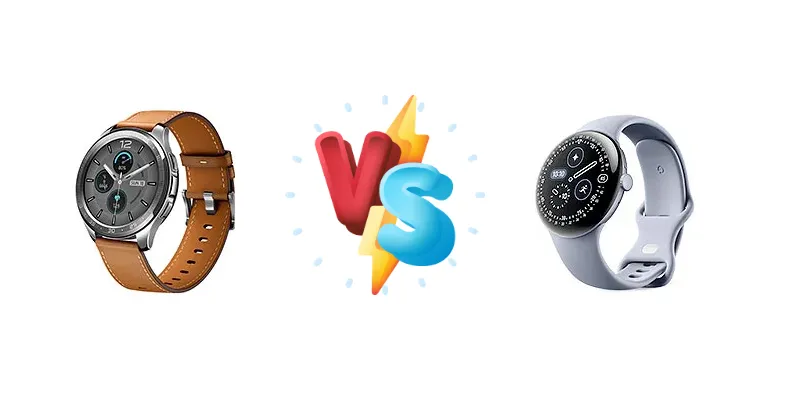
The smartwatch market is heating up, with Google’s latest Pixel Watch 4 aiming for performance leadership and vivo offering a more streamlined, wirelessly-charged experience. This comparison dissects the core differences between these two devices, focusing on the impact of the Pixel Watch 4’s new chipset and the vivo Watch’s charging approach.
🏆 Quick Verdict
For users prioritizing responsiveness and a feature-rich Wear OS experience, the Google Pixel Watch 4 is the clear winner. Its Snapdragon W5 Gen 2 chipset delivers a significant performance boost, and the fast-charging capabilities mitigate battery concerns. However, the vivo Watch remains a viable option for those who value wireless charging simplicity.
| Network |
|---|
| 2G bands | N/A | GSM 850 / 900 / 1800 / 1900 |
| 3G bands | N/A | HSDPA 850 / 900 / 1700(AWS) / 1900 / 2100 |
| 4G bands | N/A | LTE |
| EDGE | No | - |
| GPRS | No | - |
| Speed | No | HSPA, LTE |
| Technology | No cellular connectivity | GSM / HSPA / LTE |
| Launch |
|---|
| Announced | 2020, September 23. Released 2020, September 28 | 2025, August 20 |
| Status | Discontinued | Available. Released 2025, October 09 |
| Body |
|---|
| Build | Glass front, stainless steel frame 316L | Glass front (Gorilla Glass 5), aluminum frame |
| Dimensions | 46 x 46 x 10.6 mm (1.81 x 1.81 x 0.42 in) | 45 x 45 x 12.3 mm (1.77 x 1.77 x 0.48 in) |
| SIM | No | eSIM |
| Weight | 46.8 g (1.66 oz) | 31 g or 37 g (1.09 oz) |
| | 5ATM water resistant
50m water resistant
Compatible with standard 22mm straps | - |
| Display |
|---|
| Protection | - | Corning Gorilla Glass 5 |
| Resolution | 454 x 454 pixels (~326 ppi density) | 456 x 456 pixels (~320 ppi density) |
| Size | 1.39 inches | 1.4 inches |
| Type | AMOLED | LTPO AMOLED, 3000 nits (peak) |
| Platform |
|---|
| CPU | - | Quad-core (4x1.7 GHz Cortex-A53) |
| Chipset | - | Qualcomm Snapdragon W5 Gen 2 (4 nm) |
| GPU | - | Adreno A702 |
| OS | Proprietary OS | Android Wear OS 6 |
| Memory |
|---|
| Card slot | No | No |
| Internal | 2GB | 32GB 2GB RAM |
| | eMMC | - |
| Sound |
|---|
| 3.5mm jack | No | - |
| 35mm jack | No | No |
| Loudspeaker | Yes | Yes |
| Comms |
|---|
| Bluetooth | 5.0, A2DP, LE | 6.0, A2DP |
| NFC | Yes | Yes |
| Positioning | GPS, GLONASS, GALILEO, BDS | GPS (L1+L5), GLONASS, GALILEO (E1+E5a) |
| Radio | No | No |
| USB | No | No |
| WLAN | No | Wi-Fi 802.11 a/b/g/n/ac/6, dual-band |
| Features |
|---|
| Sensors | Accelerometer, gyro, heart rate, barometer, compass, altimeter, SpO2 | Accelerometer, gyro, heart rate, altimeter, compass, SpO2, thermometer (skin temperature), skin conductance |
| Battery |
|---|
| Charging | 10W wireless | Wired, 50% in 15 min, 80% in 30 min, 100% in 60 min - 45mm model
Wired, 50% in 15 min, 80% in 25 min, 100% in 45 min - 41mm model |
| Type | Li-Ion 478 mAh | Li-Ion 455 mAh |
| Misc |
|---|
| Colors | Black, Brown, Dark Brown, Orange | Matte Black, Polished Silver, Champagne Gold, Satin Moonstone |
| Price | About 200 EUR | € 353.94 |
vivo Watch
- Significantly faster processor with the Snapdragon W5 Gen 2.
- Rapid wired charging (50% in 15 minutes).
- Access to the full Wear OS ecosystem.
- Requires wired charging, less convenient than wireless.
- Battery life may be impacted by the powerful processor.
Google Pixel Watch 4
- Convenient 10W wireless charging.
- Potentially simpler user interface.
- May be more affordable.
- Likely slower performance due to an unspecified chipset.
- Slower charging speeds compared to the Pixel Watch 4.
Display Comparison
Display specifications are absent for the vivo Watch, making a direct comparison difficult. However, given its market positioning, it likely utilizes an AMOLED panel. The Pixel Watch 4, while details are missing, benefits from the efficiency gains of the Snapdragon W5 Gen 2, potentially allowing for a brighter, more vibrant display without significant battery drain. The Pixel Watch 4’s display technology will likely be a key differentiator, especially regarding outdoor visibility.
Camera Comparison
Neither device is marketed for its camera capabilities, and detailed camera specs are unavailable. Smartwatches generally prioritize functionality over photographic prowess. Any camera on either device is likely intended for basic quick capture and video calls, rather than serious photography.
Performance
The Google Pixel Watch 4’s Qualcomm Snapdragon W5 Gen 2 (4nm) chipset is the defining performance advantage. This quad-core processor, clocked at 1.7 GHz, represents a substantial leap over any chipset likely found in the vivo Watch. The 4nm process node is crucial, offering improved power efficiency and thermal management compared to older, larger-node chipsets. This translates to smoother animations, faster app loading times, and a more responsive user experience, particularly noticeable when using complex Wear OS features. The vivo Watch, lacking detailed specs, likely relies on a less powerful chipset, potentially leading to noticeable lag during demanding tasks.
Battery Life
The Pixel Watch 4 addresses a common smartwatch complaint with its fast-charging capabilities. Achieving 50% charge in 15 minutes (both 45mm and 41mm models) and a full charge within 60 minutes (45mm) or 45 minutes (41mm) is a significant advantage. The vivo Watch’s 10W wireless charging, while convenient, is considerably slower. While battery capacity isn’t specified for either device, the Snapdragon W5 Gen 2’s efficiency in the Pixel Watch 4 could offset a potentially smaller battery size, providing comparable or even superior real-world battery life despite the faster charging cycle.
Buying Guide
Buy the vivo Watch if you prioritize the convenience of wireless charging and a potentially simpler user experience. It’s ideal for users who don’t demand the highest performance from their smartwatch. Buy the Google Pixel Watch 4 if you need a responsive, powerful smartwatch with access to the full Wear OS ecosystem and appreciate the speed of its wired charging – especially if you’re already invested in the Google ecosystem.
Frequently Asked Questions
❓ How does the Snapdragon W5 Gen 2 in the Pixel Watch 4 impact real-world app performance compared to the vivo Watch?
The Snapdragon W5 Gen 2’s quad-core architecture and 4nm process node deliver a substantial performance boost. Expect significantly faster app loading times, smoother animations, and a more responsive experience when using apps like Google Maps, Google Assistant, and third-party fitness trackers on the Pixel Watch 4. The vivo Watch, lacking these specifications, will likely exhibit noticeable lag during similar tasks.
❓ Is the wired charging of the Pixel Watch 4 a significant drawback compared to the wireless charging of the vivo Watch?
While wireless charging is convenient, the Pixel Watch 4’s fast-charging capabilities (50% in 15 minutes) mitigate this drawback. The speed of the wired charging means you can quickly top up the battery when needed, minimizing downtime. The vivo Watch’s 10W wireless charging is considerably slower, requiring a longer charging period.
❓ Given the lack of detailed display specs for the vivo Watch, what can we reasonably expect in terms of visual quality?
Based on its market segment, the vivo Watch likely features an AMOLED display. However, it will likely lack the brightness and color accuracy optimizations found in higher-end smartwatches like the Pixel Watch 4, which benefits from the power efficiency of the Snapdragon W5 Gen 2 allowing for a more vibrant and visible screen.