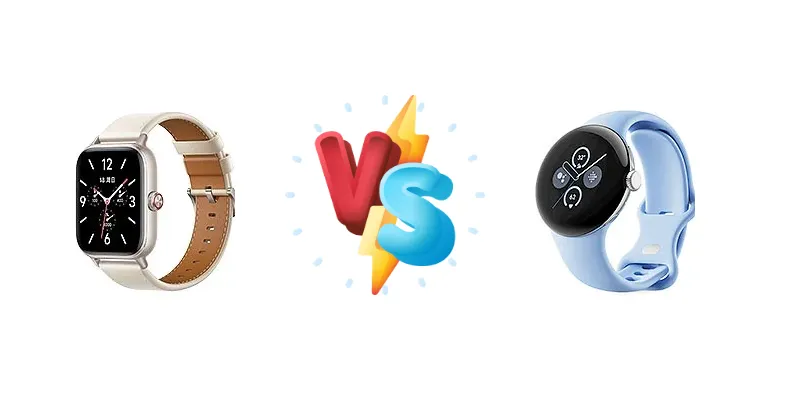
The smartwatch market is increasingly competitive, with options ranging from feature-rich Wear OS devices to those prioritizing extended battery life. This comparison pits the vivo Watch GT, a device likely focused on longevity and core fitness tracking, against the Google Pixel Watch 2, powered by the Qualcomm 5100 and deeply integrated with the Google ecosystem. We'll dissect their strengths and weaknesses to determine which smartwatch best suits your needs.
🏆 Quick Verdict
For the average user prioritizing seamless Google integration and a comprehensive app ecosystem, the Google Pixel Watch 2 is the superior choice. However, users who value extended battery life above all else, and are less reliant on third-party apps, may find the vivo Watch GT a more compelling option.
| Network |
|---|
| 2G bands | N/A | GSM 850 / 900 / 1800 / 1900 |
| 3G bands | HSDPA 850 / 900 / 2100 | HSDPA 850 / 900 / 1700(AWS) / 1900 / 2100 |
| 4G bands | LTE | LTE |
| Speed | HSPA, LTE | HSPA, LTE |
| Technology | HSPA / LTE | GSM / HSPA / LTE |
| Launch |
|---|
| Announced | 2024, May 30 | 2023, October 04 |
| Status | Available. Released 2024, May 30 | Available. Released 2023, October 12 |
| Body |
|---|
| Build | Glass front, aluminum frame, plastic back | Glass front (Gorilla Glass 5), aluminum frame |
| Dimensions | 45.8 x 39.6 x 11.2 mm (1.80 x 1.56 x 0.44 in) | 41 x 41 x 12.3 mm (1.61 x 1.61 x 0.48 in) |
| SIM | eSIM | eSIM |
| Weight | 33 g (1.16 oz) | 31 g (1.09 oz) |
| Display |
|---|
| Protection | - | Corning Gorilla Glass 5 |
| Resolution | 390 x 450 pixels (~322 ppi density) | 450 x 450 pixels (~320 ppi density) |
| Size | 1.85 inches | 1.2 inches |
| Type | AMOLED | AMOLED, 1000 nits (peak) |
| Platform |
|---|
| Chipset | - | Qualcomm 5100 |
| OS | Blue OS | Android Wear OS 4 |
| Memory |
|---|
| Card slot | No | No |
| Internal | Unspecified | 32GB 2GB RAM |
| Sound |
|---|
| 35mm jack | No | No |
| Loudspeaker | Yes | Yes |
| Comms |
|---|
| Bluetooth | 5.3, A2DP, LE | 5.0, A2DP, LE |
| NFC | Yes | Yes |
| Positioning | GPS, GLONASS, GALILEO, BDS, QZSS | GPS, GLONASS, GALILEO, BDS, QZSS |
| Radio | No | No |
| USB | No | No |
| WLAN | No | Wi-Fi 802.11 b/g/n |
| Features |
|---|
| Sensors | Accelerometer, gyro, heart rate, compass, SpO2 | Accelerometer, gyro, heart rate, altimeter, compass, SpO2, thermometer (skin temperature), skin conductance |
| Battery |
|---|
| Charging | - | Wired, 80% in 45 min |
| Type | 505 mAh | Li-Ion 306 mAh |
| Misc |
|---|
| Colors | Black, Silver | Polished Silver, Matte Black, Champagne Gold |
| Models | - | G4TSL, GC3G8, GD2WG |
| Price | About 100 EUR | About 160 EUR |
vivo Watch GT
- Potentially exceptional battery life based on brand reputation.
- Likely more affordable price point.
- Simplified user experience, potentially less bloatware.
- Limited app ecosystem compared to Wear OS.
- Unknown chipset performance and capabilities.
- Lack of detailed specifications makes a thorough assessment difficult.
Google Pixel Watch 2
- Seamless integration with the Google ecosystem.
- Access to the Google Play Store and a wide range of apps.
- Qualcomm 5100 chipset provides smooth performance.
- Battery life is a known weakness of Wear OS devices.
- Higher price point compared to the vivo Watch GT (likely).
- Relatively small display size may not appeal to all users.
Display Comparison
Given the lack of display specifications for the vivo Watch GT, a direct comparison is difficult. However, the Google Pixel Watch 2 features a circular AMOLED display, a design choice prioritizing aesthetics and readability. The Pixel Watch 2’s display likely benefits from OLED’s inherent contrast ratio, offering vibrant colors. Without knowing the vivo Watch GT’s panel type, it’s reasonable to assume it may prioritize power efficiency over peak brightness or color accuracy. The Pixel Watch 2’s smaller size (1.2 inches) may appeal to users with smaller wrists, while the bezel design will impact the perceived screen real estate.
Camera Comparison
Neither device is marketed for its camera capabilities, and neither is expected to have a camera. This section is therefore not applicable to this comparison.
Performance
The Google Pixel Watch 2’s Qualcomm 5100 chipset represents a significant upgrade over its predecessor, offering improved performance and efficiency. While the exact clock speed isn’t specified, the 5100 is designed for wearable devices, balancing power and battery consumption. The vivo Watch GT’s chipset remains unknown, but given its likely focus on battery life, it likely utilizes a less powerful, more efficient processor. This difference in processing power will be most noticeable when launching apps or performing complex tasks. The Pixel Watch 2’s access to the Google Play Store allows for a wider range of applications and features, a benefit the vivo Watch GT likely lacks.
Battery Life
The Google Pixel Watch 2 offers wired charging, reaching 80% charge in 45 minutes. This is a reasonable charging speed for a smartwatch, but the overall battery life is a known concern with Wear OS devices. The vivo Watch GT, lacking specific battery specifications, is likely positioned as a long-lasting alternative. Given vivo’s history with battery-focused smartphones, it’s reasonable to expect the Watch GT to offer several days of use on a single charge, potentially exceeding the Pixel Watch 2’s typical 24-hour lifespan. This difference in battery life is the most significant trade-off between the two devices.
Buying Guide
Buy the vivo Watch GT if you need a smartwatch that can consistently deliver multi-day battery life and prioritize core fitness tracking features without the need for constant charging. Buy the Google Pixel Watch 2 if you prefer a refined smartwatch experience with access to the Google Play Store, advanced health sensors, and tight integration with other Google services like Google Assistant and Google Wallet.
Frequently Asked Questions
❓ How does the Qualcomm 5100 chipset in the Pixel Watch 2 impact app loading times compared to the vivo Watch GT?
The Qualcomm 5100 is a dedicated wearable chipset designed for efficient performance. While the vivo Watch GT’s chipset is unknown, it’s likely less powerful to prioritize battery life. This means the Pixel Watch 2 will generally experience faster app loading times and smoother multitasking, especially when running demanding applications.
❓ Is the 80% charge in 45 minutes charging speed on the Pixel Watch 2 sufficient for all-day use, given its battery life concerns?
The 45-minute charge time is convenient for topping up the Pixel Watch 2, but it doesn’t address the underlying battery life limitations. Users may still need to charge the device daily, or even more frequently with heavy usage. The vivo Watch GT, potentially offering multi-day battery life, may require less frequent charging overall.
❓ What kind of health and fitness tracking features can I expect from the vivo Watch GT, given the limited information available?
While specific features are unknown, vivo typically focuses on core fitness tracking metrics like step counting, heart rate monitoring, and sleep tracking. It's unlikely to offer the advanced health sensors (like ECG) found on the Pixel Watch 2, but it should cover the basics for everyday fitness monitoring.