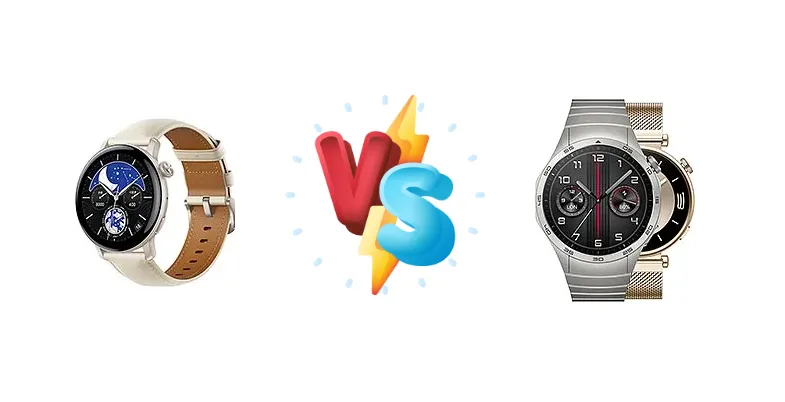
The smartwatch market is increasingly competitive, with both vivo and Huawei offering compelling options. The vivo Watch 3 aims to deliver a stylish and functional experience, while the Huawei Watch GT 4 focuses on extended battery life and convenient wireless charging. This comparison dives deep into the nuances of each device to help you determine which best suits your needs.
🏆 Quick Verdict
For the average user prioritizing convenience and established ecosystem integration, the Huawei Watch GT 4 emerges as the stronger choice. Its wireless charging capability and likely more mature software experience (based on Huawei's smartwatch history) provide a smoother, hassle-free experience, despite the lack of detailed specs for the vivo Watch 3.
| Network |
|---|
| 2G bands | N/A | N/A |
| 3G bands | HSDPA 850 / 900 / 2100 | N/A |
| 4G bands | LTE | N/A |
| EDGE | - | No |
| GPRS | - | No |
| Speed | HSPA, LTE | No |
| Technology | HSPA / LTE | No cellular connectivity |
| Launch |
|---|
| Announced | 2023, November 13 | 2023, September 14 |
| Status | Available. Released 2023, November 21 | Available. Released 2023, October 02 |
| Body |
|---|
| Build | - | Glass front, plastic back, stainless steel frame |
| Dimensions | 46.1 x 46.1 x 13.8 mm (1.81 x 1.81 x 0.54 in) | 46 x 46 x 10.9 mm (1.81 x 1.81 x 0.43 in) |
| SIM | eSIM | No |
| Weight | 36 g (1.27 oz) | 37 g (41mm) / 48 g (46mm) (1.31 oz) |
| Display |
|---|
| Resolution | 466 x 466 pixels (~326 ppi density) | 466 x 466 pixels (~326 ppi density) |
| Size | 1.43 inches | 1.43 inches |
| Type | AMOLED | AMOLED |
| Platform |
|---|
| OS | Blue OS | HarmonyOS 4.0 |
| Memory |
|---|
| Card slot | No | No |
| Internal | 4GB 64MB RAM | Unspecified |
| Sound |
|---|
| 35mm jack | No | No |
| Loudspeaker | Yes | Yes |
| Comms |
|---|
| Bluetooth | 5.2, A2DP, LE | 5.2, A2DP, LE |
| NFC | Yes | Yes |
| Positioning | GPS, GLONASS, GALILEO, BDS, QZSS | GPS (L1+L5), GLONASS, BDS, GALILEO, QZSS |
| Radio | No | No |
| USB | No | No |
| WLAN | No | No |
| Features |
|---|
| Sensors | Accelerometer, gyro, heart rate, barometer, compass, altimeter, SpO2 | Accelerometer, gyro, heart rate, barometer, compass, SpO2, thermometer (body temperature) |
| Battery |
|---|
| Charging | - | Wireless |
| Type | 505 mAh | Li-Ion 524 mAh |
| Misc |
|---|
| Colors | Black, Silver | Black, Steel, Silver, Gold |
| Models | - | ARA-B19, PNX-B19 |
| Price | About 150 EUR | About 270 EUR |
vivo Watch 3
- Potential for stylish design (based on vivo's aesthetic)
- Possible integration with vivo/OPPO ecosystem
- May offer a competitive price point
- Lack of detailed specifications
- Unknown chipset performance
- No wireless charging
Huawei Watch GT 4
- Wireless charging for added convenience
- Likely longer battery life (based on Huawei's history)
- Established smartwatch software experience
- May be more expensive than the vivo Watch 3
- Proprietary ecosystem may limit compatibility
- Charging speed may be slower than wired options
Display Comparison
Without specific display details for the vivo Watch 3, we can infer it will likely feature an AMOLED panel, common in this price segment. The Huawei Watch GT 4, given its positioning, likely boasts a high-resolution AMOLED display as well. The key differentiator will be brightness; Huawei typically prioritizes outdoor visibility. The absence of LTPO specification for the vivo Watch 3 suggests it may not have the same adaptive refresh rate capabilities as some higher-end competitors, potentially impacting battery life. Bezels will be a crucial visual element, and the design language will dictate the overall aesthetic appeal.
Camera Comparison
Neither the vivo Watch 3 nor the Huawei Watch GT 4 are expected to feature cameras. Smartwatches are primarily focused on health tracking and notifications, making a camera a less essential feature.
Performance
The vivo Watch 3's chipset remains unknown, but given its price point, it will likely utilize a low-power processor optimized for smartwatch functions. Huawei's Watch GT series historically focuses on efficiency rather than raw processing power. The GT 4 likely employs a proprietary chipset designed to maximize battery life. RAM capacity is also a critical factor; more RAM allows for smoother multitasking and faster app loading. Without specific RAM details for either device, it's difficult to assess performance differences. Thermal management is less of a concern in smartwatches compared to smartphones, but efficient chipsets are still vital for consistent performance.
Battery Life
The Huawei Watch GT 4's wireless charging is a significant advantage, offering a more convenient charging experience compared to traditional cable-based methods. While the mAh capacity of both devices is currently unknown, Huawei's history suggests a focus on maximizing battery life. The GT 4 likely offers several days of typical use on a single charge. The vivo Watch 3's battery performance will depend heavily on its chipset efficiency and display technology. Wireless charging, while convenient, is often less efficient than wired charging, so the GT 4's charging speed may be slightly slower despite the wireless capability.
Buying Guide
Buy the vivo Watch 3 if you prioritize a potentially more fashion-forward design and are deeply embedded within the vivo/OPPO ecosystem, hoping for seamless integration with other devices. Buy the Huawei Watch GT 4 if you value long battery life, the convenience of wireless charging, and a more established track record in smartwatch software and health tracking features. The GT 4 is ideal for users who want a 'set it and forget it' experience.
Frequently Asked Questions
❓ How does the wireless charging on the Huawei Watch GT 4 compare to traditional charging in terms of speed?
Wireless charging is generally slower than wired charging. While the Huawei Watch GT 4 offers the convenience of wireless charging, expect a slightly longer 0-100% charge time compared to using a wired charger. However, the convenience often outweighs the slight speed difference for many users.
❓ Is the vivo Watch 3 likely to receive regular software updates and feature additions?
Given vivo's relatively recent entry into the smartwatch market, the long-term software support for the Watch 3 is uncertain. Huawei, with its established smartwatch platform, typically provides more consistent software updates and feature additions to its Watch GT series. This is a key consideration for users who value ongoing software improvements.
❓ What health tracking features can I expect from the Huawei Watch GT 4?
Huawei's Watch GT series is known for its comprehensive health tracking capabilities. Expect features like continuous heart rate monitoring, SpO2 (blood oxygen) measurement, sleep tracking, stress monitoring, and potentially advanced metrics like VO2 Max estimation. Huawei also often includes specialized workout modes for various activities.