
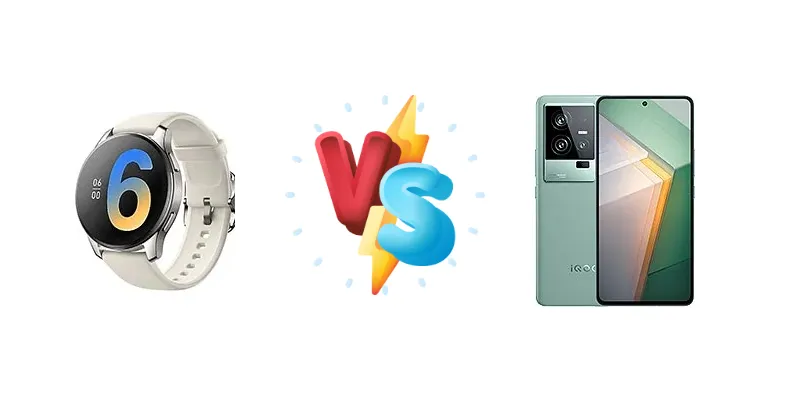
vivo Watch 2 vs. vivo iQOO 11: A Detailed Showdown
| Phones Images | |||||
|---|---|---|---|---|---|
|
🏆 Quick Verdict
The iQOO 11 is the clear winner for most users. Its flagship performance, stunning display, and blazing-fast charging outweigh the Watch 2's convenience. However, if you prioritize smartwatch features and health tracking, the Watch 2 remains a compelling option.
| PHONES | ||
|---|---|---|
| Phone Names | vivo Watch 2 | vivo iQOO 11 |
| Network | ||
|---|---|---|
| 2G bands | N/A | GSM 850 / 900 / 1800 / 1900 |
| 3G bands | HSDPA 850 / 900 / 2100 | HSDPA 800 / 850 / 900 / 1700(AWS) / 1900 / 2100 |
| 4G bands | 1, 3, 5, 8, 34, 38, 39, 40, 41 | 1, 2, 3, 4, 5, 7, 8, 12, 17, 18, 19, 20, 26, 28, 34, 38, 39, 40, 41 - International |
| 5G bands | - | 1, 3, 5, 8, 28, 40, 41, 77, 78 SA/NSA |
| Speed | HSPA, LTE | HSPA, LTE, 5G |
| Technology | HSPA / LTE | GSM / CDMA / HSPA / CDMA2000 / LTE / 5G |
| - | 1, 2, 3, 4, 5, 7, 8, 12, 17, 18, 19, 20, 25, 26, 28, 34, 38, 39, 40, 41, 66 - China | |
| Launch | ||
|---|---|---|
| Announced | 2021, December 22 | 2022, December 08 |
| Status | Available. Released 2021, December 29 | Available. Released 2022, December 08 |
| Body | ||
|---|---|---|
| Build | Glass front, stainless steel frame 316L | - |
| Dimensions | 46.4 x 46.4 x 11 mm (1.83 x 1.83 x 0.43 in) | 164.9 x 77.1 x 8.4 mm or 8.7 mm |
| SIM | eSIM | Nano-SIM + Nano-SIM |
| Weight | 47 g (1.66 oz) | 205 g or 208 g (7.23 oz) |
| 5ATM water resistant 50m water resistant | - | |
| Display | ||
|---|---|---|
| Protection | - | Corning Gorilla Glass Victus |
| Resolution | 466 x 466 pixels (~326 ppi density) | 1440 x 3200 pixels, 20:9 ratio (~518 ppi density) |
| Size | 1.43 inches | 6.78 inches, 111.0 cm2 (~87.3% screen-to-body ratio) |
| Type | AMOLED | LTPO4 AMOLED, 1B colors, 144Hz, HDR10+, 1800 nits (peak) |
| Platform | ||
|---|---|---|
| CPU | - | Octa-core (1x3.2 GHz Cortex-X3 & 2x2.8 GHz Cortex-A715 & 2x2.8 GHz Cortex-A710 & 3x2.0 GHz Cortex-A510) |
| Chipset | - | Qualcomm SM8550-AB Snapdragon 8 Gen 2 (4 nm) |
| GPU | - | Adreno 740 |
| OS | Proprietary OS | Android 13, upgradable to Android 14, Funtouch 14 (International), OriginOS 3 (China) |
| Memory | ||
|---|---|---|
| Card slot | No | No |
| Internal | 2GB | 128GB 8GB RAM, 256GB 8GB RAM, 256GB 12GB RAM, 256GB 16GB RAM, 512GB 16GB RAM |
| - | UFS 3.1 - 128GB UFS 4.0 - 256/512GB | |
| Main Camera | ||
|---|---|---|
| Features | - | Dual-LED flash, HDR, panorama |
| Single | - | 16 MP, f/2.5, (wide) |
| Triple | - | 50 MP, f/1.9, 23mm (wide), 1/1.57", 1.0µm, PDAF, OIS 13 MP, f/2.5, 47mm (telephoto), PDAF, 2x optical zoom 8 MP, f/2.2, 16mm (ultrawide) |
| Video | - | 8K@30fps, 4K@30/60fps, 1080p@30/60/120/240fps, gyro-EIS |
| Selfie camera | ||
|---|---|---|
| Features | - | HDR |
| Single | - | 16 MP, f/2.5, (wide) |
| Video | - | 1080p@30fps, gyro-EIS |
| Sound | ||
|---|---|---|
| 3.5mm jack | No | No |
| 35mm jack | No | No |
| Loudspeaker | Yes | Yes, with stereo speakers |
| - | 24-bit/192kHz audio | |
| Comms | ||
|---|---|---|
| Bluetooth | 5.2, A2DP, LE | 5.3, A2DP, LE, aptX HD, aptX Adaptive, aptX Lossless |
| Infrared port | - | Yes |
| NFC | Yes | Yes |
| Positioning | GPS, GLONASS, GALILEO, BDS | GPS, GLONASS, GALILEO, BDS, NavIC |
| Radio | No | No |
| USB | No | USB Type-C 2.0, OTG |
| WLAN | No | Wi-Fi 802.11 a/b/g/n/ac/6, dual-band, Wi-Fi Direct |
| Features | ||
|---|---|---|
| Sensors | Accelerometer, gyro, heart rate, barometer, compass, altimeter, SpO2 | Fingerprint (under display, optical), accelerometer, gyro, proximity, compass |
| Battery | ||
|---|---|---|
| Charging | 10W wireless | 120W wired, PD3.0, 100% in 25 min |
| Type | - | 5000 mAh |
| Misc | ||
|---|---|---|
| Colors | Black, Brown, Silver | Black, Green, White (BMW M branding) |
| Models | WA2156A | V2243A |
| Price | About 180 EUR | About 650 EUR |
| Tests | ||
|---|---|---|
| Battery life | - | Endurance rating 127h |
| Camera | - | Photo / Video |
| Display | - | Contrast ratio: Infinite (nominal) |
| Loudspeaker | - | -26.3 LUFS (Good) |
| Performance | - | AnTuTu: 1281665 (v9) GeekBench: 4803 (v5.1) GFXBench: 67fps (ES 3.1 onscreen) |
| Camera | ||
|---|---|---|
| No | - | |
vivo Watch 2
- Health tracking features (heart rate, SpO2, sleep monitoring)
- Convenient notifications on your wrist
- Wireless charging
- Stylish design
- Limited camera capabilities
- Smaller display
- Less powerful processor
- Higher price for a smartwatch
vivo iQOO 11
- Flagship performance with Snapdragon 8 Gen 2
- Stunning display with high brightness and contrast
- Blazing-fast 120W charging
- Excellent camera system
- Long battery life
- Larger size and weight
- Can be expensive
- Software experience may not appeal to everyone
Display Comparison
The iQOO 11 boasts a significantly superior display. Its 1147 nits peak brightness and infinite contrast ratio (nominal) offer exceptional visibility and vibrant colors, far surpassing the Watch 2's smaller, smartwatch-optimized screen. While the Watch 2's display is functional, it's primarily for glanceable information.
Camera Comparison
Both devices feature cameras, but their purposes differ. The iQOO 11 offers a versatile camera system for capturing high-quality photos and videos. The Watch 2's camera is primarily for quick snapshots and video calls, with limited capabilities compared to a flagship smartphone.
Performance
The iQOO 11's Snapdragon 8 Gen 2 chipset is a performance beast, easily handling demanding games and applications. The Watch 2, with its proprietary chipset, is adequate for its smartwatch functions but can't compete with the iQOO 11's raw power. The iQOO 11's CPU configuration (1x3.2 GHz Cortex-X3 & 2x2.8 GHz Cortex-A715 & 2x2.8 GHz Cortex-A710 & 3x2.0 GHz Cortex-A510) provides excellent multi-tasking capabilities.
Battery Life
The iQOO 11's endurance rating of 127h is impressive, and its 120W wired charging allows for incredibly fast top-ups (100% in 25 minutes). The Watch 2's battery life is respectable for a smartwatch, but charging is limited to 10W wireless. The iQOO 11 offers significantly faster charging and potentially longer overall usage time.
Buying Guide
The vivo Watch 2 is ideal for fitness enthusiasts and those seeking a convenient way to receive notifications and track health metrics on their wrist. The vivo iQOO 11 is perfect for gamers, power users, and anyone who demands top-tier performance, a vibrant display, and rapid charging in a smartphone.