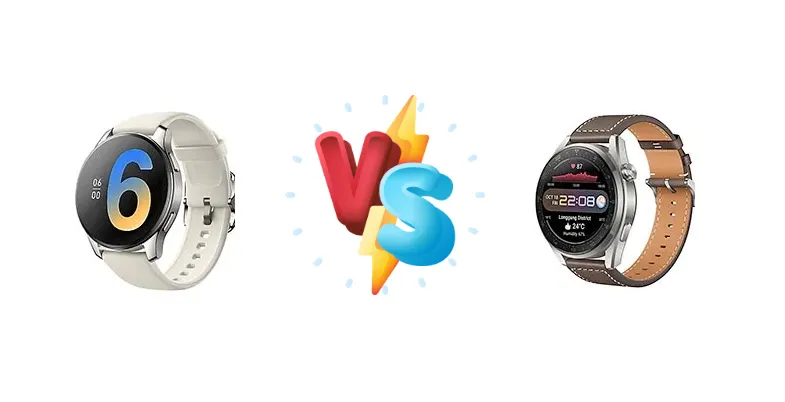
The smartwatch market offers a plethora of options, but narrowing down the field to two strong contenders – the vivo Watch 2 and the Huawei Watch 3 Pro – reveals a fascinating comparison. Both devices leverage the convenience of 10W wireless charging, but diverge in their broader feature sets and target audiences. This analysis will dissect their capabilities to determine which smartwatch delivers the best overall experience.
🏆 Quick Verdict
For the average user prioritizing a balance of features and potentially a more streamlined software experience, the Huawei Watch 3 Pro emerges as the slightly stronger choice. While both share 10W wireless charging, the Huawei Watch 3 Pro’s established ecosystem and broader feature set give it an edge.
| Network |
|---|
| 2G bands | N/A | N/A |
| 3G bands | HSDPA 850 / 900 / 2100 | HSDPA 850 / 900 / 1800 / 1900 / 2100 / 800 |
| 4G bands | 1, 3, 5, 8, 34, 38, 39, 40, 41 | 1, 3, 5, 6, 7, 8, 9, 18, 19, 20, 26, 38, 39, 40, 41 |
| Speed | HSPA, LTE | HSPA, LTE |
| Technology | HSPA / LTE | HSPA / LTE |
| Launch |
|---|
| Announced | 2021, December 22 | 2021, June 02 |
| Status | Available. Released 2021, December 29 | Available. Released 2021, June 11 |
| Body |
|---|
| Build | Glass front, stainless steel frame 316L | Glass front, ceramic back, titanium frame |
| Dimensions | 46.4 x 46.4 x 11 mm (1.83 x 1.83 x 0.43 in) | 48 x 49.6 x 14 mm (1.89 x 1.95 x 0.55 in) |
| SIM | eSIM | eSIM |
| Weight | 47 g (1.66 oz) | 63 g (2.22 oz) |
| | 5ATM water resistant
50m water resistant | 50m water resistant
5 ATM
Compatible with standard 22mm straps |
| Display |
|---|
| Resolution | 466 x 466 pixels (~326 ppi density) | 466 x 466 pixels (~326 ppi density) |
| Size | 1.43 inches | 1.43 inches |
| Type | AMOLED | AMOLED |
| Platform |
|---|
| OS | Proprietary OS | HarmonyOS 2.0, upgradable to 3.0 |
| Memory |
|---|
| Card slot | No | No |
| Internal | 2GB | 16GB 2GB RAM |
| | - | eMMC 5.1 |
| Sound |
|---|
| 3.5mm jack | No | No |
| 35mm jack | No | No |
| Loudspeaker | Yes | Yes |
| Comms |
|---|
| Bluetooth | 5.2, A2DP, LE | 5.2, A2DP, LE |
| NFC | Yes | Yes |
| Positioning | GPS, GLONASS, GALILEO, BDS | GPS (L1+L5), GLONASS, BDS, GALILEO, QZSS |
| Radio | No | No |
| USB | No | No |
| WLAN | No | Wi-Fi 802.11 b/g/n (market/region dependent) |
| Features |
|---|
| Sensors | Accelerometer, gyro, heart rate, barometer, compass, altimeter, SpO2 | Accelerometer, gyro, heart rate, barometer, compass, SpO2, thermometer (body temperature) |
| Battery |
|---|
| Charging | 10W wireless | 10W wireless |
| Type | - | Li-Ion |
| Misc |
|---|
| Colors | Black, Brown, Silver | Black, Silver |
| Models | WA2156A | - |
| Price | About 180 EUR | About 360 EUR |
vivo Watch 2
- Potentially more affordable price point
- Simple and straightforward user interface (assumed)
- Wireless charging convenience
- Limited information available on specifications
- Uncertainty regarding software support and updates
- Unknown battery capacity and performance
Huawei Watch 3 Pro
- Established ecosystem and app support
- Kirin 9000E chipset for optimized performance
- 450mAh battery for potentially longer runtime
- Reliance on Huawei ecosystem
- Potential concerns regarding Google Mobile Services compatibility
- Higher price point compared to potential vivo Watch 2 pricing
Display Comparison
Both the vivo Watch 2 and Huawei Watch 3 Pro feature AMOLED displays, a standard for vibrant colors and efficient power consumption. However, specific details like screen resolution, peak brightness, and the presence of LTPO technology (for variable refresh rates) are currently unavailable for the vivo Watch 2. The Huawei Watch 3 Pro boasts a 1.43-inch AMOLED display with a resolution of 466 x 466 pixels. The absence of LTPO on either device suggests a fixed refresh rate, potentially impacting battery life during always-on display usage. Bezels are a key aesthetic consideration, and without detailed specifications for the vivo Watch 2, it's difficult to assess relative screen-to-body ratios.
Camera Comparison
Neither the vivo Watch 2 nor the Huawei Watch 3 Pro are marketed for their camera capabilities. Smartwatch cameras are generally limited in resolution and image quality. Any camera functionality is primarily intended for quick scans or remote control features, rather than serious photography. Therefore, a detailed comparison of camera sensors and image processing is not relevant in this context.
Performance
The performance characteristics of these smartwatches are largely undefined by the provided data. The Huawei Watch 3 Pro utilizes a Kirin 9000E chipset, a proprietary processor designed for wearables. The vivo Watch 2’s chipset remains unspecified. The absence of RAM specifications for both devices hinders a direct comparison. However, the Kirin 9000E’s integration within the Huawei ecosystem suggests optimized software performance. Thermal management is also unknown, but the relatively low power draw of smartwatch components typically mitigates significant overheating concerns.
Battery Life
Both the vivo Watch 2 and Huawei Watch 3 Pro support 10W wireless charging, offering a convenient charging solution. However, the actual battery capacity of the vivo Watch 2 is unknown, while the Huawei Watch 3 Pro features a 450mAh battery. The 10W charging rate suggests similar charging times – approximately 2-3 hours for a full charge – regardless of battery capacity. Real-world battery life will depend heavily on usage patterns, including always-on display settings, GPS usage, and notification frequency. Without specific battery life claims for the vivo Watch 2, it’s difficult to predict its endurance relative to the Huawei Watch 3 Pro.
Buying Guide
Buy the vivo Watch 2 if you need a straightforward smartwatch experience with a focus on fitness tracking and basic notifications, potentially at a more competitive price point. Buy the Huawei Watch 3 Pro if you prefer a more fully-featured smartwatch with cellular connectivity options, a more robust app ecosystem, and a premium design, and are comfortable within the Huawei ecosystem.
Frequently Asked Questions
❓ Does the Huawei Watch 3 Pro's Kirin 9000E chipset offer noticeable performance improvements over standard smartwatch processors?
The Kirin 9000E is a dedicated wearable chipset designed by Huawei, optimized for power efficiency and responsiveness within the Huawei ecosystem. While a direct comparison to Qualcomm or Samsung chips is difficult without benchmarks, its integration suggests smoother animations and faster app loading times compared to generic smartwatch platforms.
❓ How does the lack of detailed specifications for the vivo Watch 2 impact its overall appeal?
The limited information surrounding the vivo Watch 2 creates uncertainty for potential buyers. Without knowing the chipset, RAM, battery capacity, or screen resolution, it's difficult to assess its performance and features relative to competitors like the Huawei Watch 3 Pro. This lack of transparency may deter users who prioritize detailed specifications.
❓ Is the 10W wireless charging speed sufficient for daily use on either device?
10W wireless charging is a reasonable speed for smartwatches, providing a full charge in approximately 2-3 hours. While faster charging technologies exist, 10W is generally sufficient for overnight charging or topping up the battery during the day. The convenience of wireless charging outweighs the relatively slow charging speed for most users.