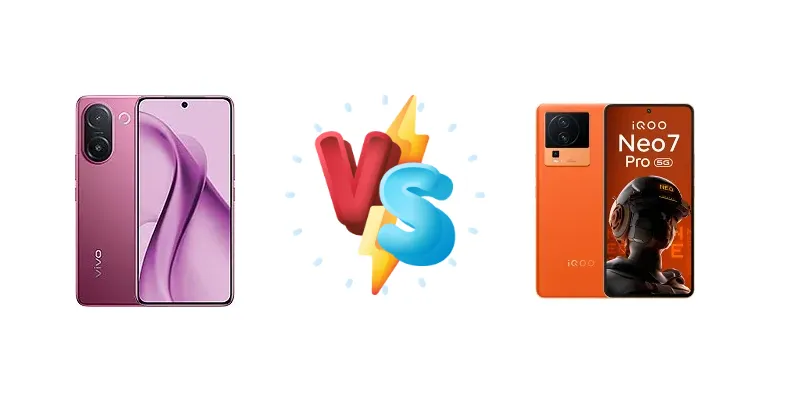
The vivo V60e and iQOO Neo 7 Pro represent distinct approaches to the mid-range smartphone market. The V60e focuses on a balanced experience with a newer Dimensity chipset, while the iQOO Neo 7 Pro leverages the proven power of the Snapdragon 8+ Gen 1. This comparison dissects their key differences to help you determine which device best suits your needs.
🏆 Quick Verdict
For most users prioritizing raw performance and faster charging, the iQOO Neo 7 Pro is the clear winner. Its Snapdragon 8+ Gen 1 delivers a significantly more powerful experience, especially in demanding tasks like gaming. However, the V60e offers a compelling alternative for those seeking a modern chipset and efficient power management.
| Network |
|---|
| 2G bands | GSM 850 / 900 / 1800 / 1900 | GSM 850 / 900 / 1800 / 1900 |
| 3G bands | HSDPA 850 / 900 / 2100 | HSDPA 800 / 850 / 900 / 1700(AWS) / 1900 / 2100 |
| 4G bands | 1, 3, 5, 8, 28, 38, 40, 41 | 1, 2, 3, 4, 5, 8, 28, 34, 38, 39, 40, 41 |
| 5G bands | 1, 3, 5, 8, 28, 38, 40, 41, 77, 78 SA/NSA | 1, 3, 5, 8, 28, 40, 77, 78 SA/NSA |
| Speed | HSPA, LTE, 5G | HSPA, LTE, 5G |
| Technology | GSM / HSPA / LTE / 5G | GSM / HSPA / LTE / 5G |
| Launch |
|---|
| Announced | 2025, October 07 | 2023, July 04 |
| Status | Available. Released 2025, October 10 | Available. Released 2023, July 15 |
| Body |
|---|
| Build | Glass front (Diamond Shield Glass), plastic back, plastic frame | Glass front, plastic frame, glass or leather back |
| Dimensions | 163.5 x 77 x 7.5 mm (6.44 x 3.03 x 0.30 in) | 164.8 x 76.9 x 8.5 mm or 8.9 mm |
| SIM | Nano-SIM + Nano-SIM | Nano-SIM + Nano-SIM |
| Weight | 190 g (6.70 oz) | 197 g or 202 g (6.95 oz) |
| Display |
|---|
| Protection | Diamond Shield Glass | - |
| Resolution | 1080 x 2392 pixels (~388 ppi density) | 1080 x 2400 pixels, 20:9 ratio (~388 ppi density) |
| Size | 6.77 inches, 110.9 cm2 (~88.1% screen-to-body ratio) | 6.78 inches, 111.0 cm2 (~87.6% screen-to-body ratio) |
| Type | AMOLED, 1B colors, 120Hz, HDR10+, 1600 nits (HBM), 5000 nits (peak) | AMOLED, 1B colors, 120Hz, HDR10+, 1300 nits (peak) |
| Platform |
|---|
| CPU | Octa-core (4x2.5 GHz Cortex-A78 & 4x2.0 GHz Cortex-A55) | Octa-core (1x3.19 GHz Cortex-X2 & 3x2.75 GHz Cortex-A710 & 4x2.0 GHz Cortex-A510) |
| Chipset | Mediatek Dimensity 7360 Turbo (4 nm) | Qualcomm SM8475 Snapdragon 8+ Gen 1 (4 nm) |
| GPU | Mali-G615 MC2 | Adreno 730 |
| OS | Android 15, up to 3 major Android upgrades, Funtouch 15 | Android 13, Funtouch 13 |
| Memory |
|---|
| Card slot | No | No |
| Internal | 128GB 8GB RAM, 256GB 8GB RAM, 256GB 12GB RAM | 128GB 8GB RAM, 256GB 12GB RAM |
| Main Camera |
|---|
| Dual | 200 MP, f/1.9, 23mm (wide), 1/1.56", PDAF, OIS
8 MP, f/2.2, 120˚ (ultrawide) | - |
| Features | Ring-LED flash, panorama, HDR | LED flash, HDR, panorama |
| Triple | - | 50 MP, f/1.9, 24mm (wide), 1/1.57", 1.0µm, PDAF, OIS
8 MP, f/2.2, 16mm (ultrawide), 1/4.0", 1.12µm
2 MP (macro) |
| Video | 4K, 1080p, HDR, gyro-EIS, OIS | 4K@30fps, 1080p@30fps |
| Selfie camera |
|---|
| Features | - | HDR |
| Single | 50 MP, f/2.0, 22mm (wide), 1/2.76", 0.64µm, AF | 16 MP, f/2.5, (wide), 1/3.1", 1.0µm |
| Video | 4K, 1080p | 1080p@30fps |
| Sound |
|---|
| 35mm jack | No | No |
| Loudspeaker | Yes, with stereo speakers | Yes, with stereo speakers |
| Comms |
|---|
| Bluetooth | 5.4, A2DP, LE | 5.3, A2DP, LE, aptX HD, aptX Adaptive |
| Infrared port | Yes | Yes |
| NFC | Yes | No |
| Positioning | GPS, GALILEO, GLONASS, BDS, QZSS | GPS, GLONASS, GALILEO, BDS, QZSS, NavIC |
| Radio | No | No |
| USB | USB Type-C 2.0, OTG | USB Type-C 2.0, OTG |
| WLAN | Wi-Fi 802.11 a/b/g/n/ac, dual-band | Wi-Fi 802.11 a/b/g/n/ac/6, dual-band, Wi-Fi Direct |
| Features |
|---|
| Sensors | Fingerprint (under display, optical), accelerometer, gyro, proximity, compass | Fingerprint (under display, optical), accelerometer, gyro, proximity, compass |
| Battery |
|---|
| Charging | 90W wired
Reverse wired
Bypass charging | 120W wired, 50% in 8 min |
| Type | Si/C Li-Ion 6500 mAh | 5000 mAh |
| Misc |
|---|
| Colors | Elite Purple, Noble Gold | Fearless Flame, Dark Storm |
| Models | - | I2217 |
| Price | ₹ 27,499 | About 380 EUR |
| SAR EU | 1.11 W/kg (head) 0.91 W/kg (body) | - |
vivo V60e
- Modern Dimensity 7360 Turbo chipset
- Efficient power management
- 90W fast charging with bypass charging
- Less powerful CPU and GPU compared to Snapdragon 8+ Gen 1
- Potentially slower app loading times
vivo iQOO Neo 7 Pro
- Powerful Snapdragon 8+ Gen 1 processor
- Ultra-fast 120W charging (50% in 8 minutes)
- Superior gaming performance
- Older chipset architecture
- Potentially higher power consumption
Display Comparison
While both devices likely feature AMOLED panels (based on vivo's typical offerings), specific details like peak brightness and refresh rates are missing. However, the focus here is on processing power, not display prowess. Both will likely offer a vibrant viewing experience, but the iQOO Neo 7 Pro's higher processing capability could translate to smoother animations and faster response times in graphically intensive applications displayed on the screen.
Camera Comparison
Without detailed camera specifications, a direct comparison is difficult. However, iQOO phones generally prioritize image processing for vibrant, social media-ready photos. The Snapdragon 8+ Gen 1’s ISP (Image Signal Processor) is more advanced, potentially offering better noise reduction and dynamic range. The V60e’s Dimensity 7360 Turbo ISP is capable, but likely won’t match the Snapdragon’s processing power. Expect the iQOO Neo 7 Pro to deliver more refined image quality, especially in challenging lighting conditions.
Performance
The core difference lies in the chipsets. The iQOO Neo 7 Pro’s Snapdragon 8+ Gen 1 (4nm) boasts a prime Cortex-X2 core clocked at 3.19 GHz, alongside three Cortex-A710 cores at 2.75 GHz and four Cortex-A510 cores at 2.0 GHz. This configuration provides a substantial performance advantage over the vivo V60e’s Dimensity 7360 Turbo (4nm), which features four Cortex-A78 cores at 2.5 GHz and four Cortex-A55 cores at 2.0 GHz. The Snapdragon’s architectural advantage – the X2 prime core and A710 performance cores – translates to significantly faster CPU and GPU performance, particularly noticeable in gaming and demanding applications. The iQOO Neo 7 Pro will exhibit less frame dropping and faster load times. Both chips are built on a 4nm process, suggesting comparable efficiency, but the Snapdragon’s superior architecture will still likely result in higher peak performance.
Battery Life
The iQOO Neo 7 Pro’s 120W wired charging is a significant advantage, promising a 50% charge in just 8 minutes. The vivo V60e’s 90W charging is still fast, but noticeably slower. While battery capacity isn’t specified, the faster charging of the iQOO Neo 7 Pro mitigates any potential disadvantage from a slightly smaller battery. The iQOO Neo 7 Pro’s charging speed is a game-changer for users who frequently need to top up their battery quickly.
Buying Guide
Buy the vivo V60e if you need a phone with a modern chipset for everyday tasks, appreciate efficient power consumption, and value a balanced feature set. Buy the vivo iQOO Neo 7 Pro if you prioritize gaming performance, demand the fastest possible charging speeds, and need a phone capable of handling intensive applications without throttling.
Frequently Asked Questions
❓ Will the Snapdragon 8+ Gen 1 in the iQOO Neo 7 Pro overheat during prolonged gaming sessions?
The Snapdragon 8+ Gen 1 is known for its thermal efficiency, especially compared to earlier Snapdragon 8 Gen 1 iterations. iQOO typically implements robust cooling solutions in their Neo series, mitigating the risk of significant throttling. However, sustained high-intensity gaming will inevitably generate heat, but the iQOO Neo 7 Pro is better equipped to handle it than the V60e.
❓ Does the Dimensity 7360 Turbo in the vivo V60e support advanced gaming features like frame interpolation?
The Dimensity 7360 Turbo supports many modern gaming features, but its implementation of frame interpolation may not be as refined as the Snapdragon 8+ Gen 1. While it can enhance visual smoothness, the iQOO Neo 7 Pro will likely offer a more consistent and responsive gaming experience due to its superior GPU and processing power.
❓ How does the 90W charging on the V60e compare to real-world charging times with a standard charger?
90W charging is still considerably faster than standard charging. While the iQOO Neo 7 Pro’s 120W is quicker, the V60e’s 90W will still provide a substantial charge in a relatively short period. Expect a full charge in approximately 45-60 minutes with the included 90W charger, compared to potentially several hours with a slower charger.