
vivo V60 vs Xiaomi 11 Lite 5G NE: A Deep Dive into Mid-Range Power
| Phones Images | |||||
|---|---|---|---|---|---|
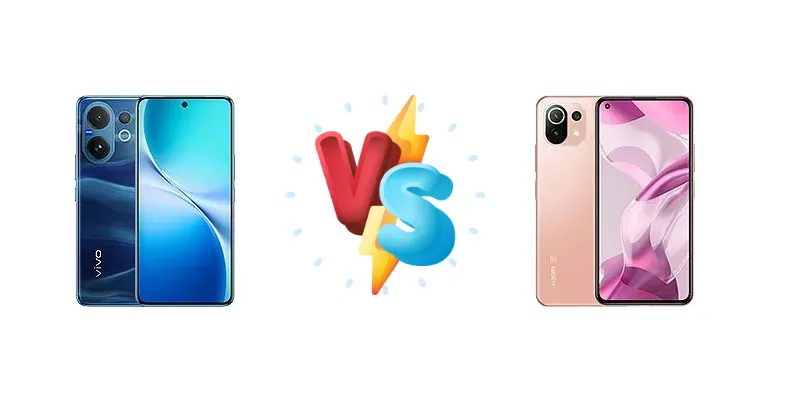
|
🏆 Quick Verdict
For most users, the vivo V60 emerges as the stronger contender. Its Snapdragon 7 Gen 4 chipset offers a noticeable performance advantage, coupled with significantly faster 90W charging. While the Xiaomi 11 Lite 5G NE remains a stylish and capable device, the V60’s modern hardware provides a more future-proof experience.
| PHONES | ||
|---|---|---|
| Phone Names | vivo V60 | Xiaomi 11 Lite 5G NE |
| Network | ||
|---|---|---|
| 2G bands | GSM 850 / 900 / 1800 / 1900 | GSM 850 / 900 / 1800 / 1900 |
| 3G bands | HSDPA 800 / 850 / 900 / 1700(AWS) / 1900 / 2100 | HSDPA 850 / 900 / 1700(AWS) / 1900 / 2100 |
| 4G bands | 1, 2, 3, 4, 5, 7, 8, 12, 17, 18, 19, 20, 26, 28, 38, 39, 40, 41, 42, 66 - International | 1, 2, 3, 4, 5, 7, 8, 12, 13, 17, 18, 19, 20, 26, 28, 32, 38, 40, 41, 42, 66 |
| 5G bands | 1, 3, 5, 7, 8, 20, 26, 28, 38, 40, 41, 66, 77, 78 SA/NSA - International | 1, 3, 5, 7, 8, 20, 26, 38, 41, 66, 77, 78 SA/NSA |
| Speed | HSPA, LTE, 5G | HSPA, LTE, 5G |
| Technology | GSM / HSPA / LTE / 5G | GSM / HSPA / LTE / 5G |
| Launch | ||
|---|---|---|
| Announced | 2025, August 12 | 2021, September 15 |
| Status | Available. Released 2025, August 19 | Available. Released 2021, October 02 |
| Body | ||
|---|---|---|
| Build | Glass front, plastic frame, plastic back or glass back | - |
| Dimensions | 163.5 x 77 x 7.5 mm or 7.8 mm | 160.5 x 75.7 x 6.8 mm (6.32 x 2.98 x 0.27 in) |
| SIM | Nano-SIM + Nano-SIM | Nano-SIM + Nano-SIM |
| Weight | 192 g or 201 g (6.77 oz) | 158 g (5.57 oz) |
| - | IP53, dust and splash resistant | |
| Display | ||
|---|---|---|
| Protection | Schott Xensation Core | Corning Gorilla Glass 5 |
| Resolution | 1080 x 2392 pixels (~388 ppi density) | 1080 x 2400 pixels, 20:9 ratio (~402 ppi density) |
| Size | 6.77 inches, 110.9 cm2 (~88.1% screen-to-body ratio) | 6.55 inches, 103.6 cm2 (~85.3% screen-to-body ratio) |
| Type | AMOLED, 1B colors, HDR10+, 120Hz, 1500 nits (HBM), 5000 nits (peak) | AMOLED, 1B colors, Dolby Vision, HDR10+, 90Hz, 500 nits (typ), 800 nits (HBM) |
| Platform | ||
|---|---|---|
| CPU | Octa-core (1x2.8 GHz Cortex-720 & 4x2.4 GHz Cortex-720 & 3x1.8 GHz Cortex-520) | Octa-core (1x2.4 GHz Cortex-A78 & 3x2.2 GHz Cortex-A78 & 4x1.9 GHz Cortex-A55) |
| Chipset | Qualcomm SM7750-AB Snapdragon 7 Gen 4 (4 nm) | Qualcomm SM7325 Snapdragon 778G 5G (6 nm) |
| GPU | Adreno 722 | Adreno 642L |
| OS | Android 15, up to 4 major Android upgrades, Funtouch 15 | Android 11, upgradable to Android 14, HyperOS |
| Memory | ||
|---|---|---|
| Card slot | No | microSDXC (uses shared SIM slot) |
| Internal | 128GB 8GB RAM, 256GB 8GB RAM, 256GB 12GB RAM, 512GB 12GB RAM, 512GB 16GB RAM | 128GB 6GB RAM, 128GB 8GB RAM, 256GB 8GB RAM |
| - | UFS 2.2 | |
| Main Camera | ||
|---|---|---|
| Features | Zeiss optics, Ring-LED flash, panorama, HDR | Dual-LED dual-tone flash, HDR, panorama |
| Single | - | 20 MP, f/2.2, 27mm (wide), 1/3.4", 0.8µm |
| Triple | 50 MP, f/1.9, 23mm (wide), 1/1.56", 1.0µm, PDAF, OIS 50 MP, f/2.7, 73mm (periscope telephoto), 1/1.95", 0.8µm, PDAF, OIS, 3x optical zoom 8 MP, f/2.0, 15mm, 120˚ (ultrawide) | 64 MP, f/1.8, 26mm (wide), 1/1.97", 0.7µm, PDAF 8 MP, f/2.2, 119˚ (ultrawide), 1/4.0", 1.12µm 5 MP, f/2.4, 50mm (telephoto macro), 1/5.0", 1.12µm, AF |
| Video | 4K@30fps, 1080p@30/60fps, gyro-EIS, OIS | 4K@30fps, 1080p@30/60/120fps, 720p@960fps; gyro-EIS |
| Selfie camera | ||
|---|---|---|
| Features | Zeiss optics, HDR | HDR, panorama |
| Single | 50 MP, f/2.2, 21mm (wide), 1/2.76", 0.64µm, AF | 20 MP, f/2.2, 27mm (wide), 1/3.4", 0.8µm |
| Video | 4K@30fps, 1080p@30/60fps | 1080p@30/60fps, 720p@120fps |
| Sound | ||
|---|---|---|
| 3.5mm jack | - | No |
| 35mm jack | No | No |
| Loudspeaker | Yes, with stereo speakers | Yes, with dual speakers |
| Comms | ||
|---|---|---|
| Bluetooth | 5.4, A2DP, LE | 5.2 (Global), 5.1 (India) |
| Infrared port | Yes | Yes |
| NFC | Yes | Yes (market/region dependent) |
| Positioning | GPS, GALILEO, GLONASS, QZSS, BDS, NavIC | GPS (L1+L5), GLONASS, BDS, GALILEO, NavIC |
| Radio | No | No |
| USB | USB Type-C 2.0, OTG | USB Type-C 2.0, OTG |
| WLAN | Wi-Fi 802.11 a/b/g/n/ac/6, dual-band | Wi-Fi 802.11 a/b/g/n/ac/6 (Global), Wi-Fi 802.11 a/b/g/n/ac (India) |
| Features | ||
|---|---|---|
| Sensors | Fingerprint (under display, optical), accelerometer, gyro, compass | Fingerprint (side-mounted), accelerometer, gyro, compass |
| - | Virtual proximity sensing | |
| Battery | ||
|---|---|---|
| Charging | 90W wired, PD Reverse wired Bypass charging | 33W wired |
| Type | Si/C Li-Ion 6500 mAh | Li-Po 4250 mAh |
| Misc | ||
|---|---|---|
| Colors | Mist Grey, Moonlit Blue, Ocean Blue, Auspicious Gold, Berry Purple | Truffle Black (Vinyl Black), Bubblegum Blue (Jazz Blue), Peach Pink (Tuscany Coral), Snowflake White (Diamond Dazzle) |
| Models | V2511 | 2109119DG, 2107119DC, 2109119DI |
| Price | ₹ 36,999 | About 200 EUR |
| SAR | 0.99 W/kg (head) 0.93 W/kg (body) | 1.09 W/kg (head) 1.05 W/kg (body) |
| SAR EU | - | 0.59 W/kg (head) 0.95 W/kg (body) |
| Tests | ||
|---|---|---|
| Battery life | - | Endurance rating 122h |
| Camera | - | Photo / Video |
| Display | - | Contrast ratio: Infinite (nominal) |
| Loudspeaker | - | -23.6 LUFS (Very good) |
| Performance | - | AnTuTu: 527663 (v9) GeekBench: 2832 (v5.1) GFXBench: 28fps (ES 3.1 onscreen) |
vivo V60
- Significantly faster 90W charging
- More powerful Snapdragon 7 Gen 4 chipset
- Likely better battery life due to 4nm process
- Brighter display for outdoor visibility
- Camera specs are currently unknown
- May be slightly heavier than the 11 Lite 5G NE
Xiaomi 11 Lite 5G NE
- Sleek and lightweight design
- Established Snapdragon 778G performance
- Good value for money (depending on current pricing)
- Refined software experience
- Slower 33W charging
- Less powerful chipset compared to the V60
- Display likely less bright than the V60
Display Comparison
The vivo V60 boasts a significantly brighter display, reaching a measured peak of 1456 nits. This is a substantial improvement over the Xiaomi 11 Lite 5G NE, which lacks specific brightness data but is likely lower. While both phones report an 'Infinite' contrast ratio (typical for OLED panels), the V60’s higher brightness translates to better visibility in direct sunlight. The V60’s panel technology isn’t specified, but the brightness suggests a high-quality AMOLED. The 11 Lite 5G NE’s display, while visually pleasing, will struggle in bright outdoor conditions compared to the V60.
Camera Comparison
Both phones feature capable camera systems, but detailed sensor information is limited for the V60. The Xiaomi 11 Lite 5G NE’s camera is listed as supporting both Photo and Video, but lacks specifics. Without knowing the V60’s sensor sizes and apertures, it’s difficult to make a direct comparison. However, given the V60’s focus on overall performance, it’s reasonable to assume a competitive camera setup. We’d need sample images to assess image processing differences and low-light performance. It's important to note that the inclusion of a 2MP macro camera on either device adds little practical value.
Performance
The core difference lies in the chipsets. The vivo V60’s Snapdragon 7 Gen 4 (4nm) represents a generational leap over the Xiaomi 11 Lite 5G NE’s Snapdragon 778G (6nm). The 4nm process node inherently offers better power efficiency and thermal performance, meaning the V60 is likely to sustain peak performance for longer periods. The V60’s CPU configuration – a tri-cluster setup with a 2.8 GHz Cortex-720 prime core – is architecturally more advanced than the 11 Lite’s Cortex-A78. While both are octa-core CPUs, the V60’s newer architecture and process node provide a clear advantage in CPU-intensive tasks. The GPU performance difference is also significant, favoring the V60 for gaming.
Battery Life
The vivo V60 shines in battery charging, supporting 90W wired charging with PD, reverse wired charging, and bypass charging. This allows for incredibly fast top-ups – a full charge will be significantly quicker than the Xiaomi 11 Lite 5G NE’s 33W charging. While the 11 Lite 5G NE has an endurance rating of 122 hours, this is an older metric. The V60’s active use score of 15:52h suggests superior real-world battery life, likely due to the more efficient Snapdragon 7 Gen 4 chipset. The V60’s bypass charging feature is also a notable advantage, allowing you to use the phone while charging without generating as much heat.
Buying Guide
Buy the vivo V60 if you prioritize raw performance for gaming and multitasking, and value incredibly fast charging speeds. You'll benefit from a more responsive experience and less time tethered to a wall outlet. Buy the Xiaomi 11 Lite 5G NE if you prefer a lighter, more compact design and are less concerned with having the absolute latest chipset. It's a great choice for everyday tasks and media consumption, offering a refined user experience.