
vivo V60 vs Motorola Edge 30 Neo: A Deep Dive into Mid-Range Power
| Phones Images | |||||
|---|---|---|---|---|---|
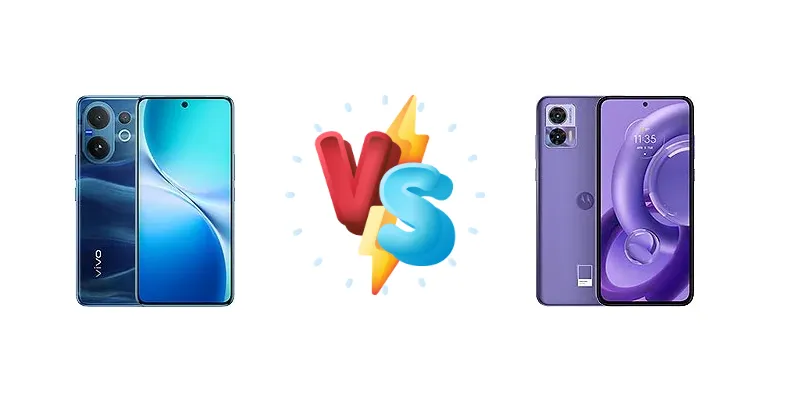
|
🏆 Quick Verdict
For users prioritizing raw performance and incredibly fast charging, the vivo V60 is the clear winner. Its Snapdragon 7 Gen 4 chipset and 90W charging significantly outperform the Motorola Edge 30 Neo. However, the Edge 30 Neo’s wireless charging and potentially more streamlined software experience make it a viable alternative for those with different priorities.
| PHONES | ||
|---|---|---|
| Phone Names | vivo V60 | Motorola Edge 30 Neo |
| Network | ||
|---|---|---|
| 2G bands | GSM 850 / 900 / 1800 / 1900 | GSM 850 / 900 / 1800 / 1900 |
| 3G bands | HSDPA 800 / 850 / 900 / 1700(AWS) / 1900 / 2100 | HSDPA 850 / 900 / 1700(AWS) / 1900 / 2100 |
| 4G bands | 1, 2, 3, 4, 5, 7, 8, 12, 17, 18, 19, 20, 26, 28, 38, 39, 40, 41, 42, 66 - International | 1, 2, 3, 4, 5, 7, 8, 12, 17, 20, 25, 26, 28, 32, 38, 40, 41, 42, 43 |
| 5G bands | 1, 3, 5, 7, 8, 20, 26, 28, 38, 40, 41, 66, 77, 78 SA/NSA - International | 1, 3, 5, 7, 8, 20, 28, 38, 40, 41, 66, 78 SA/NSA |
| Speed | HSPA, LTE, 5G | HSPA, LTE, 5G |
| Technology | GSM / HSPA / LTE / 5G | GSM / HSPA / LTE / 5G |
| Launch | ||
|---|---|---|
| Announced | 2025, August 12 | 2022, September 08 |
| Status | Available. Released 2025, August 19 | Available. Released 2022, October 07 |
| Body | ||
|---|---|---|
| Build | Glass front, plastic frame, plastic back or glass back | Glass front, plastic frame, plastic back |
| Dimensions | 163.5 x 77 x 7.5 mm or 7.8 mm | 152.9 x 71.2 x 7.8 mm (6.02 x 2.80 x 0.31 in) |
| SIM | Nano-SIM + Nano-SIM | · Nano-SIM· Nano-SIM + Nano-SIM |
| Weight | 192 g or 201 g (6.77 oz) | 155 g (5.47 oz) |
| - | Splash and dust resistant | |
| Display | ||
|---|---|---|
| Protection | Schott Xensation Core | - |
| Resolution | 1080 x 2392 pixels (~388 ppi density) | 1080 x 2400 pixels, 20:9 ratio (~419 ppi density) |
| Size | 6.77 inches, 110.9 cm2 (~88.1% screen-to-body ratio) | 6.28 inches, 95.2 cm2 (~87.5% screen-to-body ratio) |
| Type | AMOLED, 1B colors, HDR10+, 120Hz, 1500 nits (HBM), 5000 nits (peak) | P-OLED, 120Hz |
| Platform | ||
|---|---|---|
| CPU | Octa-core (1x2.8 GHz Cortex-720 & 4x2.4 GHz Cortex-720 & 3x1.8 GHz Cortex-520) | Octa-core (2x2.2 GHz Kryo 660 Gold & 6x1.7 GHz Kryo 660 Silver) |
| Chipset | Qualcomm SM7750-AB Snapdragon 7 Gen 4 (4 nm) | Qualcomm SM6375 Snapdragon 695 5G (6 nm) |
| GPU | Adreno 722 | Adreno 619 |
| OS | Android 15, up to 4 major Android upgrades, Funtouch 15 | Android 12, planned upgrade to Android 15 |
| Memory | ||
|---|---|---|
| Card slot | No | No |
| Internal | 128GB 8GB RAM, 256GB 8GB RAM, 256GB 12GB RAM, 512GB 12GB RAM, 512GB 16GB RAM | 128GB 6GB RAM, 128GB 8GB RAM, 256GB 8GB RAM |
| Main Camera | ||
|---|---|---|
| Dual | - | 64 MP, f/1.8, (wide), 1/1.97", 0.7µm, PDAF, OIS 13 MP, f/2.2, 120˚ (ultrawide), 1/3.0", 1.12µm, AF |
| Features | Zeiss optics, Ring-LED flash, panorama, HDR | Dual-LED flash, HDR, panorama |
| Triple | 50 MP, f/1.9, 23mm (wide), 1/1.56", 1.0µm, PDAF, OIS 50 MP, f/2.7, 73mm (periscope telephoto), 1/1.95", 0.8µm, PDAF, OIS, 3x optical zoom 8 MP, f/2.0, 15mm, 120˚ (ultrawide) | - |
| Video | 4K@30fps, 1080p@30/60fps, gyro-EIS, OIS | 1080p@30/60/120fps |
| Selfie camera | ||
|---|---|---|
| Features | Zeiss optics, HDR | HDR |
| Single | 50 MP, f/2.2, 21mm (wide), 1/2.76", 0.64µm, AF | 32 MP, f/2.4, (wide), 1/3.0", 0.7µm |
| Video | 4K@30fps, 1080p@30/60fps | 1080p@30fps |
| Sound | ||
|---|---|---|
| 3.5mm jack | - | No |
| 35mm jack | No | No |
| Loudspeaker | Yes, with stereo speakers | Yes, with stereo speakers |
| Comms | ||
|---|---|---|
| Bluetooth | 5.4, A2DP, LE | 5.1, A2DP, LE, aptX HD, aptX Adaptive |
| Infrared port | Yes | - |
| NFC | Yes | Yes |
| Positioning | GPS, GALILEO, GLONASS, QZSS, BDS, NavIC | GPS, GLONASS, GALILEO |
| Radio | No | No |
| USB | USB Type-C 2.0, OTG | USB Type-C 3.1, OTG |
| WLAN | Wi-Fi 802.11 a/b/g/n/ac/6, dual-band | Wi-Fi 802.11 a/b/g/n/ac, dual-band, Wi-Fi Direct |
| Features | ||
|---|---|---|
| Sensors | Fingerprint (under display, optical), accelerometer, gyro, compass | Fingerprint (under display, optical), accelerometer, proximity, compass |
| Battery | ||
|---|---|---|
| Charging | 90W wired, PD Reverse wired Bypass charging | 68W wired 5W wireless |
| Type | Si/C Li-Ion 6500 mAh | Li-Po 4020 mAh |
| Misc | ||
|---|---|---|
| Colors | Mist Grey, Moonlit Blue, Ocean Blue, Auspicious Gold, Berry Purple | Very Peri, Black Onyx, Ice Palace, Aqua Foam |
| Models | V2511 | XT2245-1 |
| Price | ₹ 36,999 | € 156.44 / $ 185.00 / £ 229.00 |
| SAR | 0.99 W/kg (head) 0.93 W/kg (body) | - |
| Tests | ||
|---|---|---|
| Battery life | - | Endurance rating 104h |
| Camera | - | Photo / Video |
| Display | - | Contrast ratio: Infinite (nominal) |
| Loudspeaker | - | -26.4 LUFS (Good) |
| Performance | - | AnTuTu: 380818 (v9) GeekBench: 1964 (v5.1) GFXBench: 16fps (ES 3.1 onscreen) |
vivo V60
- Significantly faster charging (90W)
- More powerful Snapdragon 7 Gen 4 chipset
- Higher display brightness for outdoor visibility
- Lacks wireless charging
- Software experience may be less refined than Motorola
Motorola Edge 30 Neo
- Wireless charging support
- Potentially cleaner software experience
- More compact form factor (likely, based on brand history)
- Slower charging speed (68W)
- Less powerful Snapdragon 695 chipset
- Lower display brightness
Display Comparison
The vivo V60’s display shines with a measured peak brightness of 1456 nits, significantly exceeding the Motorola Edge 30 Neo’s 1004 nits. This translates to superior visibility in direct sunlight. While both displays boast an 'infinite' contrast ratio (a common marketing term), the higher brightness of the V60 provides a more vibrant and engaging viewing experience. The lack of specified refresh rates for both devices leaves a gap in the comparison; however, the V60’s brightness advantage is a clear win for outdoor usability.
Camera Comparison
Both phones feature photo and video capabilities, but the provided data lacks specifics to draw definitive conclusions. Without sensor size, aperture, or image processing details, it’s difficult to assess camera quality. The absence of information regarding OIS (Optical Image Stabilization) is also a significant omission. We can assume, based on the market positioning, that both cameras will perform adequately in good lighting conditions, but the V60’s more powerful ISP (Image Signal Processor) within the Snapdragon 7 Gen 4 may offer an edge in low-light performance and video stabilization.
Performance
The performance gap between these two devices is substantial. The vivo V60 is powered by the Qualcomm SM7750-AB Snapdragon 7 Gen 4 (4nm), a modern chipset featuring an octa-core configuration with a high-clocked 2.8 GHz Cortex-720 prime core. In contrast, the Motorola Edge 30 Neo relies on the older Snapdragon 695 5G (6nm). The 4nm process node of the Snapdragon 7 Gen 4 offers superior power efficiency and thermal management, meaning the V60 is likely to sustain peak performance for longer periods. The V60’s CPU configuration, with its mix of Cortex-720 and Cortex-520 cores, also suggests a more balanced and powerful processing capability compared to the Edge 30 Neo’s Kryo 660 Gold and Silver cores.
Battery Life
The Motorola Edge 30 Neo has an endurance rating of 104 hours, but this is a broad metric. The vivo V60, in active use, achieves 15:52h, a more concrete measure. While the Edge 30 Neo offers 5W wireless charging, the V60’s 90W wired charging is a game-changer, allowing for incredibly fast top-ups. The V60 also supports bypass charging, which allows the phone to operate directly from the power adapter, reducing heat generation during extended gaming sessions. The Edge 30 Neo’s 68W wired charging is respectable, but it doesn’t match the V60’s speed.
Buying Guide
Buy the vivo V60 if you need a phone that can handle demanding tasks, benefits from extremely quick top-ups, and prioritizes processing power for gaming or multitasking. Buy the Motorola Edge 30 Neo if you prefer the convenience of wireless charging, value a potentially cleaner software experience, and are less concerned with achieving the absolute highest benchmark scores.