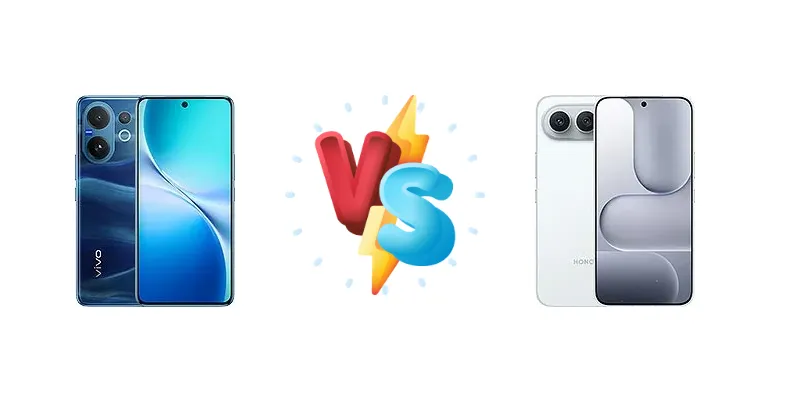
The vivo V60 and Honor 500 represent compelling options in the increasingly competitive mid-range smartphone market. While both leverage Qualcomm's Snapdragon platform, they target slightly different priorities. The V60 emphasizes extended battery life and rapid charging, while the Honor 500 prioritizes raw processing power with a more premium chipset. This comparison will dissect their key differences to determine which device best suits your needs.
🏆 Quick Verdict
For the average user prioritizing sustained performance and future-proofing, the Honor 500 emerges as the stronger choice. Its Snapdragon 8s Gen 4 chipset delivers a noticeable performance uplift. However, the vivo V60’s exceptional 15:52h battery life and 90W charging make it ideal for users who prioritize longevity and quick top-ups.
| Network |
|---|
| 2G bands | GSM 850 / 900 / 1800 / 1900 | GSM 850 / 900 / 1800 / 1900 |
| 3G bands | HSDPA 800 / 850 / 900 / 1700(AWS) / 1900 / 2100 | HSDPA 800 / 850 / 900 / 1700(AWS) / 1900 / 2100 |
| 4G bands | 1, 2, 3, 4, 5, 7, 8, 12, 17, 18, 19, 20, 26, 28, 38, 39, 40, 41, 42, 66 - International | LTE |
| 5G bands | 1, 3, 5, 7, 8, 20, 26, 28, 38, 40, 41, 66, 77, 78 SA/NSA - International | SA/NSA |
| Speed | HSPA, LTE, 5G | HSPA, LTE, 5G |
| Technology | GSM / HSPA / LTE / 5G | GSM / HSPA / LTE / 5G |
| Launch |
|---|
| Announced | 2025, August 12 | 2025, November 24 |
| Status | Available. Released 2025, August 19 | Available. Released 2025, November 27 |
| Body |
|---|
| Build | Glass front, plastic frame, plastic back or glass back | Glass front, aluminum frame |
| Dimensions | 163.5 x 77 x 7.5 mm or 7.8 mm | 155.8 x 74.2 x 7.8 mm (6.13 x 2.92 x 0.31 in) |
| SIM | Nano-SIM + Nano-SIM | Nano-SIM + Nano-SIM |
| Weight | 192 g or 201 g (6.77 oz) | 198 g (6.98 oz) |
| Display |
|---|
| Protection | Schott Xensation Core | Aluminosilicate glass |
| Resolution | 1080 x 2392 pixels (~388 ppi density) | 1264 x 2736 pixels, 19.5:9 ratio (~460 ppi density) |
| Size | 6.77 inches, 110.9 cm2 (~88.1% screen-to-body ratio) | 6.55 inches, 105.4 cm2 (~91.2% screen-to-body ratio) |
| Type | AMOLED, 1B colors, HDR10+, 120Hz, 1500 nits (HBM), 5000 nits (peak) | AMOLED, 1B colors, 120Hz, 3840Hz PWM, HDR Vivid, 6000 nits (peak) |
| Platform |
|---|
| CPU | Octa-core (1x2.8 GHz Cortex-720 & 4x2.4 GHz Cortex-720 & 3x1.8 GHz Cortex-520) | Octa-core (1x3.21 GHz Cortex-X4 & 3x3.0 GHz Cortex-A720 & 2x2.8 GHz Cortex-A720 & 2x2.0 GHz Cortex-A720) |
| Chipset | Qualcomm SM7750-AB Snapdragon 7 Gen 4 (4 nm) | Qualcomm SM8735 Snapdragon 8s Gen 4 (4 nm) |
| GPU | Adreno 722 | Adreno 825 |
| OS | Android 15, up to 4 major Android upgrades, Funtouch 15 | Android 16, MagicOS 10 |
| Memory |
|---|
| Card slot | No | No |
| Internal | 128GB 8GB RAM, 256GB 8GB RAM, 256GB 12GB RAM, 512GB 12GB RAM, 512GB 16GB RAM | 256GB 12GB RAM, 512GB 12GB RAM, 512GB 16GB RAM |
| Main Camera |
|---|
| Dual | - | 200 MP, f/1.9, (wide), 1/1.4", 0.56µm, PDAF, OIS
12 MP, f/2.2, 117˚ (ultrawide), AF |
| Features | Zeiss optics, Ring-LED flash, panorama, HDR | LED flash, HDR, panorama |
| Triple | 50 MP, f/1.9, 23mm (wide), 1/1.56", 1.0µm, PDAF, OIS
50 MP, f/2.7, 73mm (periscope telephoto), 1/1.95", 0.8µm, PDAF, OIS, 3x optical zoom
8 MP, f/2.0, 15mm, 120˚ (ultrawide) | - |
| Video | 4K@30fps, 1080p@30/60fps, gyro-EIS, OIS | 4K, 1080p, gyro-EIS, OIS |
| Selfie camera |
|---|
| Features | Zeiss optics, HDR | HDR |
| Single | 50 MP, f/2.2, 21mm (wide), 1/2.76", 0.64µm, AF | 50 MP, f/2.0, (wide) |
| Video | 4K@30fps, 1080p@30/60fps | 4K, 1080p, gyro-EIS |
| Sound |
|---|
| 35mm jack | No | No |
| Loudspeaker | Yes, with stereo speakers | Yes, with stereo speakers |
| Comms |
|---|
| Bluetooth | 5.4, A2DP, LE | 6.0, A2DP, LE, aptX HD, aptX Adaptive, aptX Lossless, LHDC 5, Auracast, ASHA |
| Infrared port | Yes | Yes |
| NFC | Yes | Yes |
| Positioning | GPS, GALILEO, GLONASS, QZSS, BDS, NavIC | GPS (L1+L5), GLONASS (L1), BDS (B1I+B1c+B2a+B2b), GALILEO (E1+E5a+E5b), QZSS (L1+L5), NavIC (L5) |
| Radio | No | No |
| USB | USB Type-C 2.0, OTG | USB Type-C 2.0, OTG |
| WLAN | Wi-Fi 802.11 a/b/g/n/ac/6, dual-band | Wi-Fi 802.11 a/b/g/n/ac/6/7, dual-band, Wi-Fi Direct |
| Features |
|---|
| Sensors | Fingerprint (under display, optical), accelerometer, gyro, compass | Fingerprint (under display, optical), accelerometer, gyro, proximity, compass (ultrasound) |
| Battery |
|---|
| Charging | 90W wired, PD
Reverse wired
Bypass charging | 80W wired
5W reverse wired |
| Type | Si/C Li-Ion 6500 mAh | Si/C Li-Ion 8000 mAh |
| Misc |
|---|
| Colors | Mist Grey, Moonlit Blue, Ocean Blue, Auspicious Gold, Berry Purple | Black, Silver, Blue, Pink |
| Models | V2511 | MEY-AN00 |
| Price | ₹ 36,999 | About 330 EUR |
| SAR | 0.99 W/kg (head) 0.93 W/kg (body) | - |
vivo V60
- Exceptional battery life (15:52h active use)
- Ultra-fast 90W wired charging with PD
- Bright 1456 nit display for outdoor visibility
- Less powerful chipset compared to the Honor 500
- Camera specifications are unknown, potentially lagging behind
Honor 500
- More powerful Snapdragon 8s Gen 4 chipset
- Superior CPU architecture for faster performance
- Likely better image processing capabilities
- Potentially shorter battery life due to more powerful chipset
- Slower 80W charging compared to the vivo V60
Display Comparison
The vivo V60 boasts a bright display, reaching a measured peak brightness of 1456 nits. While the Honor 500’s display specifications are not provided, it’s reasonable to expect a comparable brightness level given its positioning. The V60’s brightness is particularly beneficial for outdoor visibility. Without further details on the Honor 500’s panel technology (LTPO, refresh rate, color gamut), it’s difficult to assess its overall display quality beyond brightness. However, the V60’s high peak brightness gives it an immediate advantage for users who frequently consume content outdoors.
Camera Comparison
Unfortunately, detailed camera specifications are absent for both devices. However, given the market positioning, we can infer that the Honor 500 likely features a more sophisticated camera system. The Snapdragon 8s Gen 4’s ISP (Image Signal Processor) is more advanced, enabling better image processing and potentially superior low-light performance. Without knowing sensor sizes or lens apertures, it’s difficult to make a definitive judgment. The V60 likely focuses on a balanced camera experience, while the Honor 500 aims for higher image quality and more advanced features.
Performance
The core difference lies in the chipsets: the vivo V60 utilizes the Qualcomm SM7750-AB Snapdragon 7 Gen 4 (4nm), while the Honor 500 features the more powerful SM8735 Snapdragon 8s Gen 4 (4nm). The 8s Gen 4’s CPU configuration – a 1x3.21 GHz Cortex-X4 prime core alongside 3x3.0 GHz Cortex-A720, 2x2.8 GHz Cortex-A720, and 2x2.0 GHz Cortex-A720 – represents a significant architectural upgrade over the V60’s 1x2.8 GHz Cortex-720, 4x2.4 GHz Cortex-720, and 3x1.8 GHz Cortex-520. This translates to faster app loading times, smoother multitasking, and improved gaming performance on the Honor 500. Both chips are built on a 4nm process, ensuring good thermal efficiency, but the 8s Gen 4’s superior core design will likely result in better sustained performance under load.
Battery Life
The vivo V60 shines in battery endurance, achieving an impressive 15:52h of active use. While the Honor 500’s battery capacity is unknown, its more powerful chipset will likely consume more power. The V60’s 90W wired charging with PD and bypass charging is a significant advantage, allowing for incredibly fast top-ups. The Honor 500 offers 80W wired charging and 5W reverse wired charging, which is slower than the V60’s charging capabilities. The V60’s combination of long battery life and rapid charging makes it a compelling choice for users who prioritize these features.
Buying Guide
Buy the vivo V60 if you need all-day battery life and incredibly fast charging, even at the expense of peak performance. This phone is perfect for heavy social media users, commuters, and anyone who dislikes frequent charging. Buy the Honor 500 if you prefer a smoother experience with demanding apps and games, and value the extra processing headroom offered by the Snapdragon 8s Gen 4. This is the better choice for mobile gamers and power users.
Frequently Asked Questions
❓ Will the Snapdragon 8s Gen 4 in the Honor 500 get noticeably hotter during extended gaming sessions compared to the Snapdragon 7 Gen 4 in the vivo V60?
While both chipsets are built on a 4nm process, the Snapdragon 8s Gen 4’s higher performance ceiling will likely generate more heat under sustained load. However, Honor’s thermal management implementation will play a crucial role. Expect some throttling on the Honor 500 during prolonged gaming, but the performance gains should still be substantial.
❓ Does the vivo V60’s 90W charging significantly reduce battery lifespan over time?
Modern smartphones employ sophisticated charging algorithms to mitigate the impact of fast charging on battery health. While some degradation is inevitable over years of use, vivo’s 90W charging system with bypass charging should minimize long-term battery wear. The bypass charging feature allows the phone to be powered directly from the adapter, reducing heat buildup.
❓ Is the 5W reverse wired charging on the Honor 500 useful for charging accessories like earbuds?
The 5W reverse wired charging is primarily intended for emergency situations or charging small accessories like wireless earbuds or a smartwatch. It’s not a substitute for a dedicated charger and will be a very slow charging process for most devices.