
vivo V60 vs. Google Pixel 6a: A Deep Dive into Mid-Range Champions
| Phones Images | |||||
|---|---|---|---|---|---|
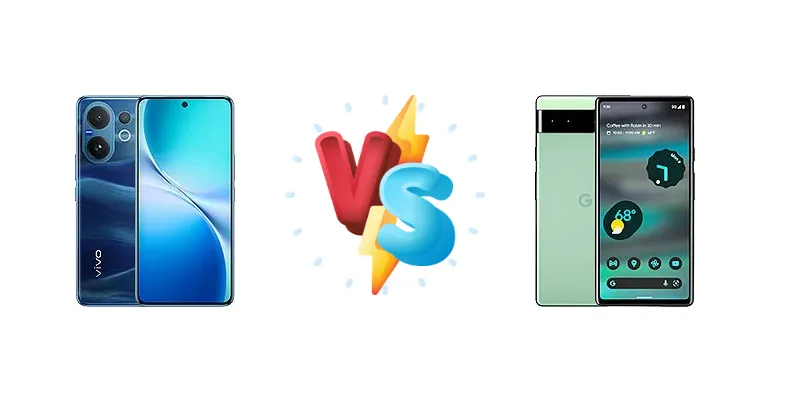
|
🏆 Quick Verdict
For users prioritizing blazing-fast charging and sustained performance, the vivo V60 is the clear winner. Its 90W charging and Snapdragon 7 Gen 4 chipset offer a significant advantage. However, the Pixel 6a remains a strong contender for those valuing Google’s software ecosystem and computational photography.
| PHONES | ||
|---|---|---|
| Phone Names | vivo V60 | Google Pixel 6a |
| Network | ||
|---|---|---|
| 2G bands | GSM 850 / 900 / 1800 / 1900 | GSM 850 / 900 / 1800 / 1900 |
| 3G bands | HSDPA 800 / 850 / 900 / 1700(AWS) / 1900 / 2100 | HSDPA 800 / 850 / 900 / 1700(AWS) / 1900 / 2100 |
| 4G bands | 1, 2, 3, 4, 5, 7, 8, 12, 17, 18, 19, 20, 26, 28, 38, 39, 40, 41, 42, 66 - International | 1, 2, 3, 4, 5, 7, 8, 12, 13, 14, 17, 18, 19, 20, 25, 26, 28, 29, 30, 38, 39, 40, 41, 42, 48, 66, 71 - GX7AS, GB62Z (USA/Canada) |
| 5G bands | 1, 3, 5, 7, 8, 20, 26, 28, 38, 40, 41, 66, 77, 78 SA/NSA - International | 1, 2, 3, 5, 7, 8, 12, 20, 25, 28, 30, 38, 40, 41, 48, 66, 71, 77, 78 SA/NSA/Sub6 - GX7AS (USA/Canada) |
| Speed | HSPA, LTE, 5G | HSPA, LTE, 5G |
| Technology | GSM / HSPA / LTE / 5G | GSM / HSPA / LTE / 5G |
| - | 1, 2, 3, 5, 7, 8, 12, 20, 25, 28, 30, 40, 48, 66, 71, 77, 78 SA/NSA/Sub6 - G1AZG (International) | |
| Launch | ||
|---|---|---|
| Announced | 2025, August 12 | 2022, May 11 |
| Status | Available. Released 2025, August 19 | Available. Released 2022, July 21 |
| Body | ||
|---|---|---|
| Build | Glass front, plastic frame, plastic back or glass back | Glass front (Gorilla Glass 3), aluminum frame, plastic back |
| Dimensions | 163.5 x 77 x 7.5 mm or 7.8 mm | 152.2 x 71.8 x 8.9 mm (5.99 x 2.83 x 0.35 in) |
| SIM | Nano-SIM + Nano-SIM | Nano-SIM + eSIM |
| Weight | 192 g or 201 g (6.77 oz) | 178 g (6.28 oz) |
| - | IP67 dust/water resistant (up to 1m for 30 min) | |
| Display | ||
|---|---|---|
| Protection | Schott Xensation Core | Corning Gorilla Glass 3 |
| Resolution | 1080 x 2392 pixels (~388 ppi density) | 1080 x 2400 pixels, 20:9 ratio (~429 ppi density) |
| Size | 6.77 inches, 110.9 cm2 (~88.1% screen-to-body ratio) | 6.1 inches, 90.7 cm2 (~83.0% screen-to-body ratio) |
| Type | AMOLED, 1B colors, HDR10+, 120Hz, 1500 nits (HBM), 5000 nits (peak) | OLED, HDR |
| - | Always-on display | |
| Platform | ||
|---|---|---|
| CPU | Octa-core (1x2.8 GHz Cortex-720 & 4x2.4 GHz Cortex-720 & 3x1.8 GHz Cortex-520) | Octa-core (2x2.80 GHz Cortex-X1 & 2x2.25 GHz Cortex-A76 & 4x1.80 GHz Cortex-A55) |
| Chipset | Qualcomm SM7750-AB Snapdragon 7 Gen 4 (4 nm) | Google Tensor (5 nm) |
| GPU | Adreno 722 | Mali-G78 MP20 |
| OS | Android 15, up to 4 major Android upgrades, Funtouch 15 | Android 12, upgradable to Android 15, up to 5 major Android upgrades |
| Memory | ||
|---|---|---|
| Card slot | No | No |
| Internal | 128GB 8GB RAM, 256GB 8GB RAM, 256GB 12GB RAM, 512GB 12GB RAM, 512GB 16GB RAM | 128GB 6GB RAM |
| - | UFS 3.1 | |
| Main Camera | ||
|---|---|---|
| Dual | - | 12.2 MP, f/1.7, 27mm, (wide), 1/2.55", 1.4µm, dual pixel PDAF, OIS 12 MP, f/2.2, 17mm, 114˚ (ultrawide), 1.25µm |
| Features | Zeiss optics, Ring-LED flash, panorama, HDR | Dual-LED flash, Pixel Shift, Auto-HDR, panorama |
| Single | - | 8 MP, f/2.0, 24mm (wide), 1.12µm |
| Triple | 50 MP, f/1.9, 23mm (wide), 1/1.56", 1.0µm, PDAF, OIS 50 MP, f/2.7, 73mm (periscope telephoto), 1/1.95", 0.8µm, PDAF, OIS, 3x optical zoom 8 MP, f/2.0, 15mm, 120˚ (ultrawide) | - |
| Video | 4K@30fps, 1080p@30/60fps, gyro-EIS, OIS | 4K@30/60fps, 1080p@30/60/120/240fps; gyro-EIS, OIS |
| Selfie camera | ||
|---|---|---|
| Features | Zeiss optics, HDR | HDR, panorama |
| Single | 50 MP, f/2.2, 21mm (wide), 1/2.76", 0.64µm, AF | 8 MP, f/2.0, 24mm (wide), 1.12µm |
| Video | 4K@30fps, 1080p@30/60fps | 1080p@30fps |
| Sound | ||
|---|---|---|
| 3.5mm jack | - | No |
| 35mm jack | No | No |
| Loudspeaker | Yes, with stereo speakers | Yes, with stereo speakers |
| Comms | ||
|---|---|---|
| Bluetooth | 5.4, A2DP, LE | 5.2, A2DP, LE |
| Infrared port | Yes | - |
| NFC | Yes | Yes |
| Positioning | GPS, GALILEO, GLONASS, QZSS, BDS, NavIC | GPS, GLONASS, GALILEO, QZSS |
| Radio | No | No |
| USB | USB Type-C 2.0, OTG | USB Type-C 3.1 |
| WLAN | Wi-Fi 802.11 a/b/g/n/ac/6, dual-band | Wi-Fi 802.11 a/b/g/n/ac/6e, dual-band, Wi-Fi Direct |
| Features | ||
|---|---|---|
| Sensors | Fingerprint (under display, optical), accelerometer, gyro, compass | Fingerprint (under display, optical), accelerometer, gyro, proximity, compass, barometer |
| Battery | ||
|---|---|---|
| Charging | 90W wired, PD Reverse wired Bypass charging | 18W wired, PD3.0 |
| Type | Si/C Li-Ion 6500 mAh | Li-Po 4410 mAh |
| Misc | ||
|---|---|---|
| Colors | Mist Grey, Moonlit Blue, Ocean Blue, Auspicious Gold, Berry Purple | Chalk, Charcoal, Sage |
| Models | V2511 | GX7AS, GB62Z, G1AZG, GB17L |
| Price | ₹ 36,999 | $ 138.99 / C$ 228.74 / ₹ 23,999 |
| SAR | 0.99 W/kg (head) 0.93 W/kg (body) | - |
| Tests | ||
|---|---|---|
| Battery life | - | Endurance rating 94h |
| Display | - | Contrast ratio: Infinite (nominal) |
vivo V60
- Incredibly fast 90W charging
- Powerful Snapdragon 7 Gen 4 chipset
- Brighter display for outdoor use
- Camera performance is unknown without further specs
- Software support may be shorter than Pixel
Google Pixel 6a
- Excellent camera image processing
- Clean Android experience with guaranteed updates
- Strong AI and machine learning capabilities
- Slow 18W charging
- Less powerful chipset for demanding tasks
Display Comparison
The vivo V60 boasts a significantly brighter display, reaching a measured 1456 nits, compared to the Pixel 6a’s 876 nits. This translates to superior visibility in direct sunlight. While the Pixel 6a claims an 'infinite' contrast ratio, this is typical of OLED panels and doesn't necessarily indicate a superior viewing experience. The V60’s higher brightness is a tangible benefit for outdoor users. We lack data on panel technology (LTPO, PWM) for the V60, but the Pixel 6a’s OLED panel delivers excellent color accuracy and deep blacks.
Camera Comparison
Both phones lack detailed camera specifications beyond the core chipset capabilities. The Pixel 6a is renowned for its computational photography prowess, leveraging the Tensor chip’s AI capabilities to produce stunning images, even in challenging conditions. Without knowing sensor sizes or lens apertures for the V60, it’s difficult to directly compare image quality. However, Google’s image processing algorithms are a significant advantage for the Pixel 6a, particularly in low-light scenarios. We can assume the V60 will rely more on hardware capabilities, while the Pixel 6a leans heavily on software optimization.
Performance
The chipset choice defines the performance profiles of these phones. The vivo V60’s Qualcomm Snapdragon 7 Gen 4 (4nm) utilizes a tri-cluster configuration – 1x2.8 GHz Cortex-720, 4x2.4 GHz Cortex-720, and 3x1.8 GHz Cortex-520 – aiming for efficiency and power. The Pixel 6a, however, employs Google’s Tensor chip (5nm), built on a different architectural philosophy prioritizing AI and machine learning tasks. The Tensor’s CPU configuration – 2x2.80 GHz Cortex-X1, 2x2.25 GHz Cortex-A76, and 4x1.80 GHz Cortex-A55 – suggests a focus on peak performance in specific workloads. While the Snapdragon 7 Gen 4 offers a more balanced approach, the Tensor excels in tasks like image processing and voice recognition. The 4nm process of the Snapdragon 7 Gen 4 should provide better thermal efficiency than the 5nm Tensor, potentially leading to less throttling during extended gaming sessions.
Battery Life
The Pixel 6a’s ‘Endurance rating’ of 94 hours is a useful metric, but doesn’t translate directly to real-world usage. The vivo V60, with an active use score of 15:52h, provides a more concrete measure. However, the V60’s standout feature is its 90W wired charging with PD support, including reverse wired charging and bypass charging. This allows for incredibly fast top-ups – significantly faster than the Pixel 6a’s 18W wired charging with PD3.0. While the Pixel 6a’s battery endurance is respectable, the V60’s charging speed is a game-changer for users who frequently need to recharge their devices.
Buying Guide
Buy the vivo V60 if you need a phone that charges incredibly quickly, handles demanding tasks with ease, and offers a brighter display for outdoor visibility. Buy the Google Pixel 6a if you prioritize a clean Android experience, exceptional camera image processing, and long-term software support, even if it means sacrificing charging speed and raw processing power.