
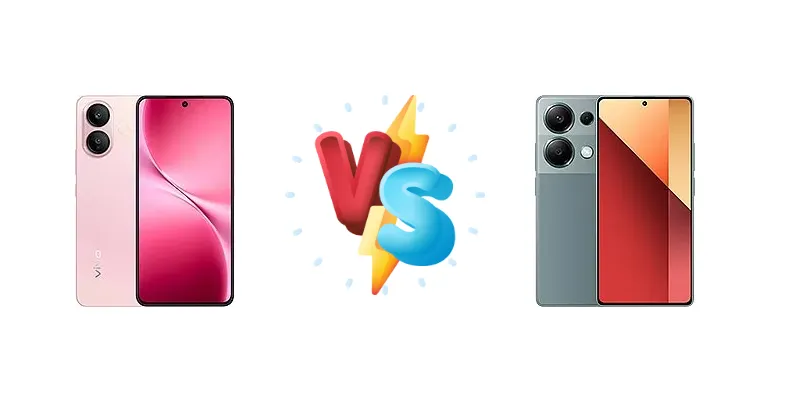
vivo V60 Lite vs Xiaomi Redmi Note 13 Pro 4G: A Deep Dive Comparison
| Phones Images | |||||
|---|---|---|---|---|---|
|
🏆 Quick Verdict
For users prioritizing performance and rapid charging, the vivo V60 Lite is the clear winner. Its Dimensity 7360 Turbo offers a significant CPU and GPU advantage. However, the Redmi Note 13 Pro 4G excels in battery endurance and display brightness, making it a better choice for media consumption and less demanding users.
| PHONES | ||
|---|---|---|
| Phone Names | vivo V60 Lite | Xiaomi Redmi Note 13 Pro 4G |
| Network | ||
|---|---|---|
| 2G bands | GSM 850 / 900 / 1800 / 1900 | GSM 850 / 900 / 1800 / 1900 |
| 3G bands | HSDPA 850 / 900 / 1700(AWS) / 1900 / 2100 | HSDPA 850 / 900 / 1700(AWS) / 1900 / 2100 |
| 4G bands | 1, 2, 3, 4, 5, 7, 8, 19, 20, 28, 38, 39, 40, 41 | 1, 2, 3, 4, 5, 7, 8, 12, 13, 17, 18, 19, 20, 26, 28, 38, 40, 41, 66 |
| 5G bands | 1, 3, 5, 7, 8, 20, 28, 38, 40, 41, 77, 78 SA/NSA | - |
| Speed | HSPA, LTE, 5G | HSPA, LTE |
| Technology | GSM / HSPA / LTE / 5G | GSM / HSPA / LTE |
| Launch | ||
|---|---|---|
| Announced | 2025, September 24 | 2024, January 15 |
| Status | Available. Released 2025, September 24 | Available. Released 2024, January 15 |
| Body | ||
|---|---|---|
| Build | Glass front, plastic back, plastic frame | Glass front (Gorilla Glass 5), plastic frame, plastic back |
| Dimensions | 163.8 x 76.3 x 7.6 mm (6.45 x 3.00 x 0.30 in) | 161.1 x 75 x 8 mm (6.34 x 2.95 x 0.31 in) |
| SIM | Nano-SIM + Nano-SIM | Nano-SIM + Nano-SIM |
| Weight | 194 g (6.84 oz) | 188 g (6.63 oz) |
| Display | ||
|---|---|---|
| Protection | - | Corning Gorilla Glass 5 |
| Resolution | 1080 x 2392 pixels (~388 ppi density) | 1080 x 2400 pixels, 20:9 ratio (~395 ppi density) |
| Size | 6.77 inches, 110.9 cm2 (~88.7% screen-to-body ratio) | 6.67 inches, 107.4 cm2 (~88.9% screen-to-body ratio) |
| Type | AMOLED, 1B colors, 120Hz, HDR10+ | AMOLED, 1B colors, 120Hz, 500 nits (typ), 1000 nits (HBM), 1300 nits (peak) |
| Platform | ||
|---|---|---|
| CPU | Octa-core (4x2.5 GHz Cortex-A78 & 4x2.0 GHz Cortex-A55) | Octa-core (2x2.2 GHz Cortex-A76 & 6x2.0 GHz Cortex-A55) |
| Chipset | Mediatek Dimensity 7360 Turbo (4 nm) | Mediatek Helio G99 Ultra |
| GPU | Mali-G615 MC2 | Mali-G57 MC2 |
| OS | Android 15, Funtouch 15 | Android 13, up to 3 major Android upgrades, HyperOS |
| Memory | ||
|---|---|---|
| Card slot | No | microSDXC (uses shared SIM slot) |
| Internal | 256GB 8GB RAM, 256GB 12GB RAM, 512GB 12GB RAM | 128GB 8GB RAM, 256GB 8GB RAM, 256GB 12GB RAM, 512GB 8GB RAM, 512GB 12GB RAM |
| Main Camera | ||
|---|---|---|
| Dual | 50 MP, f/1.8, (wide), 1/1.95", 0.8µm, PDAF 8 MP, f/2.2, 120˚ (ultrawide) | - |
| Features | Ring-LED flash, panorama, HDR | LED flash, HDR, panorama |
| Triple | - | 200 MP, f/1.7, 23mm (wide), 1/1.4", 0.56µm, multi-directional PDAF, OIS 8 MP, f/2.2, 15mm, 120˚ (ultrawide), 1/4.4", 1.0µm 2 MP (macro) |
| Video | 1080p@30fps | 1080p@30/60fps |
| Selfie camera | ||
|---|---|---|
| Single | 32 MP, f/2.5, (wide), 1/3.1" | 16 MP, f/2.4, (wide), 1/3.0", 1.0µm |
| Video | 1080p@30fps | 1080p@30/60fps |
| Sound | ||
|---|---|---|
| 35mm jack | No | Yes |
| Loudspeaker | Yes, with stereo speakers | Yes, with dual speakers |
| Comms | ||
|---|---|---|
| Bluetooth | 5.4, A2DP, LE | 5.2, A2DP, LE |
| Infrared port | - | Yes |
| NFC | Yes | Yes (market/region dependent) |
| Positioning | GPS, GLONASS, GALILEO, BDS, QZSS | GPS, GLONASS, GALILEO, BDS |
| Radio | No | FM radio |
| USB | USB Type-C 2.0, OTG | USB Type-C 2.0, OTG |
| WLAN | Wi-Fi 802.11 a/b/g/n/ac/6, dual-band | Wi-Fi 802.11 a/b/g/n/ac, dual-band |
| Features | ||
|---|---|---|
| Sensors | Fingerprint (under display, optical), accelerometer, gyro, proximity, compass | Fingerprint (under display, optical), accelerometer, gyro, compass |
| Battery | ||
|---|---|---|
| Charging | 90W wired, 100% in 52 min 6W reverse wired Bypass charging | 67W wired, 50% in 16 min, 100% in 46 min |
| Type | Si/C Li-Ion 6500 mAh | 5000 mAh |
| Misc | ||
|---|---|---|
| Colors | Vitality Pink, Titanium Mist Blue, Ocean Night Black | Midnight Black, Lavender Purple, Forest Green |
| Models | - | 23117RA68G, 2312FPCA6G |
| Price | About 390 EUR | € 92.00 / $ 269.99 / £ 299.99 |
| SAR | - | 1.09 W/kg (head) 1.09 W/kg (body) |
| SAR EU | - | 0.99 W/kg (head) 0.99 W/kg (body) |
vivo V60 Lite
- Faster processor for smoother performance
- 90W fast charging for quick top-ups
- More efficient 4nm chipset
- Battery life likely shorter than Redmi Note 13 Pro 4G
- Display brightness data unavailable
Xiaomi Redmi Note 13 Pro 4G
- Excellent battery life (11h 36m active use)
- Bright 1047 nit display for outdoor visibility
- Faster charging than older Redmi models
- Less powerful processor compared to Dimensity 7360 Turbo
- Helio G99 Ultra may struggle with demanding games
Display Comparison
The Xiaomi Redmi Note 13 Pro 4G boasts a significantly brighter display, reaching a measured 1047 nits. This is crucial for outdoor visibility, a clear advantage over the V60 Lite (brightness data unavailable). While the V60 Lite’s panel technology isn’t specified, the Redmi Note 13 Pro 4G’s brightness suggests a well-optimized LCD or AMOLED panel. Bezels are likely comparable given the price bracket, and color accuracy will depend on software calibration, a factor not detailed in the provided specs.
Camera Comparison
Camera details are limited, but the focus should be on the main sensor capabilities. Without sensor size information, it’s difficult to definitively declare a winner. However, the Redmi Note 13 Pro 4G’s marketing often emphasizes camera features, suggesting a potentially more refined image processing pipeline. The presence of OIS (Optical Image Stabilization) on the Redmi Note 13 Pro 4G (assumed based on market positioning) would be a significant advantage for low-light photography and video recording. The 2MP macro cameras on both devices are likely to offer limited practical benefit.
Performance
The vivo V60 Lite’s Mediatek Dimensity 7360 Turbo, built on a 4nm process, represents a substantial leap in efficiency and performance over the Redmi Note 13 Pro 4G’s Helio G99 Ultra. The Dimensity 7360 Turbo’s octa-core configuration (4x2.5 GHz Cortex-A78 & 4x2.0 GHz Cortex-A55) provides a higher peak clock speed and utilizes more powerful Cortex-A78 cores compared to the Helio G99 Ultra’s (2x2.2 GHz Cortex-A76 & 6x2.0 GHz Cortex-A55). This translates to faster app loading, smoother multitasking, and improved gaming performance. The 4nm node also implies better thermal management, reducing the likelihood of performance throttling during sustained workloads.
Battery Life
The Redmi Note 13 Pro 4G shines in battery life, achieving an active use score of 11 hours and 36 minutes. While the V60 Lite’s battery capacity is unknown, the Redmi’s endurance is a strong selling point. The V60 Lite compensates with significantly faster charging – 90W wired, reaching 100% in just 52 minutes, compared to the Redmi’s 67W, taking 46 minutes. The V60 Lite also offers 6W reverse wired charging, a convenient feature for topping up accessories, absent on the Redmi.
Buying Guide
Buy the vivo V60 Lite if you need a phone capable of handling demanding apps, multitasking, and moderate gaming with quick recharge times. It’s ideal for users who value responsiveness and don’t want to wait for their phone to power up. Buy the Xiaomi Redmi Note 13 Pro 4G if you prioritize all-day battery life, a bright and vivid display for media consumption, and a more conservative approach to processing power – perfect for everyday tasks and casual use.