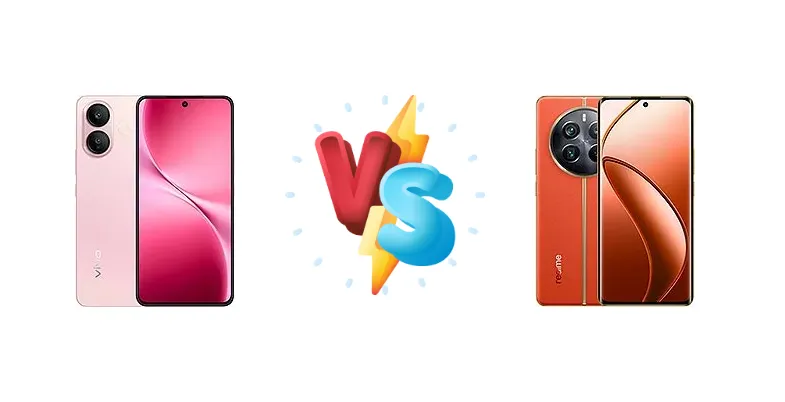
The mid-range smartphone market is fiercely competitive, and the vivo V60 Lite and Realme 12 Pro+ represent compelling options for users seeking premium features without the flagship price tag. This comparison dissects their core specifications, focusing on performance, battery life, and charging capabilities to determine which device offers the most well-rounded experience.
🏆 Quick Verdict
For users prioritizing raw processing power and responsiveness, the vivo V60 Lite, with its Dimensity 7360 Turbo, takes a slight edge. However, the Realme 12 Pro+ counters with significantly longer battery life and a brighter display, making it the better choice for media consumption and all-day use.
| Network |
|---|
| 2G bands | GSM 850 / 900 / 1800 / 1900 | GSM 850 / 900 / 1800 / 1900 |
| 3G bands | HSDPA 850 / 900 / 1700(AWS) / 1900 / 2100 | HSDPA 850 / 900 / 2100 |
| 4G bands | 1, 2, 3, 4, 5, 7, 8, 19, 20, 28, 38, 39, 40, 41 | 1, 3, 5, 8, 28, 40, 41 |
| 5G bands | 1, 3, 5, 7, 8, 20, 28, 38, 40, 41, 77, 78 SA/NSA | 1, 3, 5, 8, 28, 40, 41, 77, 78 SA/NSA |
| Speed | HSPA, LTE, 5G | HSPA, LTE, 5G |
| Technology | GSM / HSPA / LTE / 5G | GSM / HSPA / LTE / 5G |
| Launch |
|---|
| Announced | 2025, September 24 | 2024, January 29 |
| Status | Available. Released 2025, September 24 | Available. Released 2024, January 29 |
| Body |
|---|
| Build | Glass front, plastic back, plastic frame | - |
| Dimensions | 163.8 x 76.3 x 7.6 mm (6.45 x 3.00 x 0.30 in) | 161.5 x 74 x 8.8 mm (6.36 x 2.91 x 0.35 in) |
| SIM | Nano-SIM + Nano-SIM | Nano-SIM + Nano-SIM |
| Weight | 194 g (6.84 oz) | 196 g (6.91 oz) |
| Display |
|---|
| Resolution | 1080 x 2392 pixels (~388 ppi density) | 1080 x 2412 pixels, 20:9 ratio (~394 ppi density) |
| Size | 6.77 inches, 110.9 cm2 (~88.7% screen-to-body ratio) | 6.7 inches, 108.0 cm2 (~90.4% screen-to-body ratio) |
| Type | AMOLED, 1B colors, 120Hz, HDR10+ | AMOLED, 1B colors, 120Hz, 800 nits (HBM), 950 nits (peak) |
| Platform |
|---|
| CPU | Octa-core (4x2.5 GHz Cortex-A78 & 4x2.0 GHz Cortex-A55) | Octa-core (4x2.40 GHz Cortex-A78 & 4x1.95 GHz Cortex-A55) |
| Chipset | Mediatek Dimensity 7360 Turbo (4 nm) | Qualcomm SM7435-AB Snapdragon 7s Gen 2 (4 nm) |
| GPU | Mali-G615 MC2 | Adreno 710 |
| OS | Android 15, Funtouch 15 | Android 14, Realme UI 5.0 |
| Memory |
|---|
| Card slot | No | No |
| Internal | 256GB 8GB RAM, 256GB 12GB RAM, 512GB 12GB RAM | 128GB 8GB RAM, 256GB 8GB RAM, 256GB 12GB RAM, 512GB 12GB RAM |
| Main Camera |
|---|
| Dual | 50 MP, f/1.8, (wide), 1/1.95", 0.8µm, PDAF
8 MP, f/2.2, 120˚ (ultrawide) | - |
| Features | Ring-LED flash, panorama, HDR | LED flash, HDR, panorama |
| Triple | - | 50 MP, f/1.8, 24mm (wide), 1/1.56", 1.0µm, multi-directional PDAF, OIS
64 MP, f/2.8, 71mm, (periscope telephoto), 1/2.0", 0.7µm, PDAF, OIS, 3x optical zoom
8 MP, f/2.2, 16mm, 112˚ (ultrawide), 1/4.0", 1.12µm |
| Video | 1080p@30fps | 4K@30fps, 1080p@30/60/120fps, gyro-EIS |
| Selfie camera |
|---|
| Single | 32 MP, f/2.5, (wide), 1/3.1" | 32 MP, f/2.4, 22mm (wide) |
| Video | 1080p@30fps | 1080p@30fps |
| Sound |
|---|
| 35mm jack | No | No |
| Loudspeaker | Yes, with stereo speakers | Yes, with stereo speakers |
| Comms |
|---|
| Bluetooth | 5.4, A2DP, LE | 5.2, A2DP, LE |
| NFC | Yes | Yes (market/region dependent) |
| Positioning | GPS, GLONASS, GALILEO, BDS, QZSS | GPS, GLONASS, GALILEO, BDS, QZSS |
| Radio | No | No |
| USB | USB Type-C 2.0, OTG | USB Type-C 2.0 |
| WLAN | Wi-Fi 802.11 a/b/g/n/ac/6, dual-band | Wi-Fi 802.11 a/b/g/n/ac/6, dual-band |
| Features |
|---|
| Sensors | Fingerprint (under display, optical), accelerometer, gyro, proximity, compass | Fingerprint (under display, optical), accelerometer, gyro, proximity, compass |
| Battery |
|---|
| Charging | 90W wired, 100% in 52 min
6W reverse wired
Bypass charging | 67W wired, 50% in 19 min |
| Type | Si/C Li-Ion 6500 mAh | 5000 mAh |
| Misc |
|---|
| Colors | Vitality Pink, Titanium Mist Blue, Ocean Night Black | Submarine Blue, Navigator Beige, Explorer Red |
| Models | - | RMX3840, RMX3841 |
| Price | About 390 EUR | $ 465.00 / £ 299.00 / € 344.26 / ₹ 28,400 |
vivo V60 Lite
- Faster 90W charging for quicker top-ups.
- Potentially higher CPU performance due to the Dimensity 7360 Turbo's clock speed.
- 6W reverse wired charging for accessories.
- Battery life is likely shorter than the Realme 12 Pro+.
- Display brightness is likely lower than the Realme 12 Pro+.
Realme 12 Pro+
- Exceptional battery life with 13:24h of active use.
- Brighter display (802 nits) for better outdoor visibility.
- Potentially superior camera system based on Realme's branding.
- Slower 67W charging compared to the vivo V60 Lite.
- Slightly lower CPU clock speed.
Display Comparison
The Realme 12 Pro+ boasts a notably brighter display, reaching 802 nits measured, which translates to superior visibility under direct sunlight. While the vivo V60 Lite’s display specifications are not provided, the Realme’s brightness advantage is significant. Both devices utilize 4nm chipsets, suggesting similar power efficiency for display operation, but the Realme’s higher peak brightness is a clear win for outdoor users. We expect both to be FHD+ panels, typical for this price bracket, but the Realme’s brightness is the key differentiator.
Camera Comparison
Unfortunately, detailed camera specifications are absent for both devices. However, given Realme’s recent focus on camera technology, particularly with the 'Pro+' branding, we can anticipate a more sophisticated camera system on the 12 Pro+. The absence of sensor size or aperture information makes a direct comparison difficult, but Realme’s marketing often emphasizes high-resolution sensors and advanced image processing. The vivo V60 Lite likely offers a competent camera experience, but the Realme 12 Pro+ is positioned to deliver more versatile and higher-quality images.
Performance
Both the vivo V60 Lite and Realme 12 Pro+ employ 4nm chipsets, indicating a focus on efficiency. However, the vivo utilizes the Mediatek Dimensity 7360 Turbo, featuring a slightly higher peak CPU clock speed (2.5 GHz vs 2.40 GHz on the Snapdragon 7s Gen 2). While both CPUs share the same core configuration (4x Cortex-A78 & 4x Cortex-A55), the Dimensity’s higher clock speed *should* translate to a marginal performance advantage in CPU-bound tasks. The Snapdragon 7s Gen 2, however, often demonstrates strong GPU performance, potentially offering a better gaming experience depending on optimization. The vivo’s chipset is newer, potentially benefiting from architectural improvements.
Battery Life
The Realme 12 Pro+ shines in battery endurance, achieving an active use score of 13:24h. While the vivo V60 Lite’s battery capacity is unknown, the Realme’s impressive runtime is a significant advantage. The vivo attempts to compensate with 90W wired charging, promising a full charge in 52 minutes, while the Realme 12 Pro+ manages 50% charge in 19 minutes with its 67W charging. The vivo’s faster charging is appealing, but the Realme’s longer battery life reduces the frequency of needing to charge, making it more convenient for many users. The vivo also offers 6W reverse wired charging, a feature absent on the Realme.
Buying Guide
Buy the vivo V60 Lite if you need a phone that excels in demanding tasks like gaming and multitasking, and appreciate the speed of 90W charging. Buy the Realme 12 Pro+ if you prioritize extended battery life, a brighter screen for outdoor visibility, and a more balanced overall experience, even if it means slightly slower charging.
Frequently Asked Questions
❓ Does the Dimensity 7360 Turbo in the vivo V60 Lite get noticeably hotter than the Snapdragon 7s Gen 2 during extended gaming sessions?
While both chipsets are built on a 4nm process, the Dimensity 7360 Turbo's slightly higher clock speed *could* lead to more heat generation under sustained load. However, thermal management depends heavily on the phone's cooling system, which isn't specified. Real-world testing would be needed to determine if throttling is a significant issue on the vivo V60 Lite.
❓ How does the 67W charging on the Realme 12 Pro+ compare to the 90W charging on the vivo V60 Lite in terms of real-world usability?
Although the vivo V60 Lite boasts 90W charging, the Realme 12 Pro+'s 67W is still quite fast, reaching 50% in 19 minutes. The difference in full charge time (52 minutes vs. an estimated time based on 67W) may not be substantial enough to be a deciding factor for most users, especially considering the Realme's significantly longer battery life reduces the need for frequent top-ups.
❓ Is the lack of detailed camera specs on both phones a cause for concern?
It is somewhat concerning, as camera performance is a key purchasing factor. However, Realme has been consistently improving its camera technology, particularly in the 'Pro+' series. We anticipate the Realme 12 Pro+ to offer a more versatile and feature-rich camera experience than the vivo V60 Lite, based on brand trends.