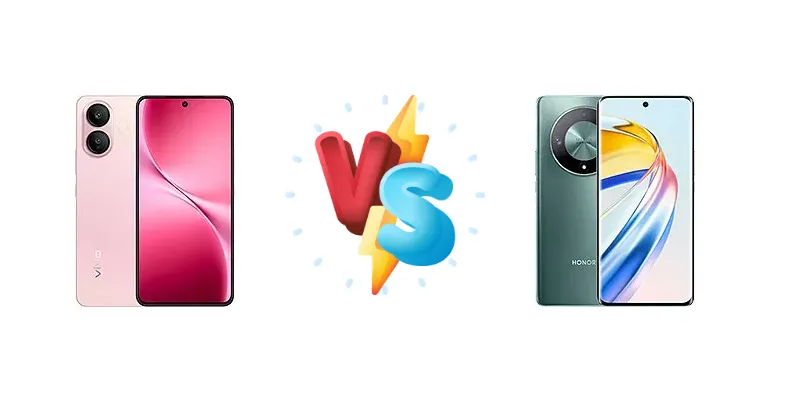
The mid-range smartphone market is fiercely competitive, and the vivo V60 Lite and Honor X9b represent compelling options for budget-conscious buyers. The V60 Lite prioritizes charging speed and raw CPU performance with the Dimensity 7360 Turbo, while the X9b aims for a balanced experience with the Snapdragon 6 Gen 1. This comparison dissects their key differences to help you choose the right phone for your needs.
🏆 Quick Verdict
For users prioritizing fast charging and demanding applications, the vivo V60 Lite is the clear winner. Its 90W charging and slightly more powerful CPU offer a tangible advantage. However, the Honor X9b provides a solid, efficient experience for everyday tasks and offers a more balanced approach.
| Network |
|---|
| 2G bands | GSM 850 / 900 / 1800 / 1900 | GSM 850 / 900 / 1800 / 1900 |
| 3G bands | HSDPA 850 / 900 / 1700(AWS) / 1900 / 2100 | HSDPA 850 / 900 / 1900 / 2100 |
| 4G bands | 1, 2, 3, 4, 5, 7, 8, 19, 20, 28, 38, 39, 40, 41 | 1, 2, 3, 4, 5, 7, 8, 20, 28, 32, 38, 40, 41 |
| 5G bands | 1, 3, 5, 7, 8, 20, 28, 38, 40, 41, 77, 78 SA/NSA | 1, 3, 7, 8, 20, 28, 38, 40, 41, 77, 78 SA/NSA |
| Speed | HSPA, LTE, 5G | HSPA, LTE, 5G |
| Technology | GSM / HSPA / LTE / 5G | GSM / HSPA / LTE / 5G |
| Launch |
|---|
| Announced | 2025, September 24 | 2023, October 18 |
| Status | Available. Released 2025, September 24 | Available. Released 2023, October |
| Body |
|---|
| Build | Glass front, plastic back, plastic frame | - |
| Dimensions | 163.8 x 76.3 x 7.6 mm (6.45 x 3.00 x 0.30 in) | 163.6 x 75.5 x 8 mm (6.44 x 2.97 x 0.31 in) |
| SIM | Nano-SIM + Nano-SIM | Nano-SIM + Nano-SIM |
| Weight | 194 g (6.84 oz) | 185 g (6.53 oz) |
| Display |
|---|
| Resolution | 1080 x 2392 pixels (~388 ppi density) | 1220 x 2652 pixels, 19.5:9 ratio (~431 ppi density) |
| Size | 6.77 inches, 110.9 cm2 (~88.7% screen-to-body ratio) | 6.78 inches, 112.6 cm2 (~91.2% screen-to-body ratio) |
| Type | AMOLED, 1B colors, 120Hz, HDR10+ | AMOLED, 1B colors, 120Hz, 1200 nits (peak) |
| Platform |
|---|
| CPU | Octa-core (4x2.5 GHz Cortex-A78 & 4x2.0 GHz Cortex-A55) | Octa-core (4x2.2 GHz Cortex-A78 & 4x1.8 GHz Cortex-A55) |
| Chipset | Mediatek Dimensity 7360 Turbo (4 nm) | Qualcomm SM6450 Snapdragon 6 Gen 1 (4 nm) |
| GPU | Mali-G615 MC2 | Adreno 710 |
| OS | Android 15, Funtouch 15 | Android 13, Magic OS 7.2 |
| Memory |
|---|
| Card slot | No | No |
| Internal | 256GB 8GB RAM, 256GB 12GB RAM, 512GB 12GB RAM | 256GB 8GB RAM, 256GB 12GB RAM, 512GB 8GB RAM, 512GB 12GB RAM |
| Main Camera |
|---|
| Dual | 50 MP, f/1.8, (wide), 1/1.95", 0.8µm, PDAF
8 MP, f/2.2, 120˚ (ultrawide) | - |
| Features | Ring-LED flash, panorama, HDR | LED flash, panorama, HDR |
| Triple | - | 108 MP, f/1.8, (wide), 1/1.67", PDAF
5 MP, f/2.2, (ultrawide)
2 MP (macro) |
| Video | 1080p@30fps | 4K@30fps, 1080p@30fps |
| Selfie camera |
|---|
| Single | 32 MP, f/2.5, (wide), 1/3.1" | 16 MP, f/2.5, (wide) |
| Video | 1080p@30fps | 1080p@30fps |
| Sound |
|---|
| 35mm jack | No | No |
| Loudspeaker | Yes, with stereo speakers | Yes |
| Comms |
|---|
| Bluetooth | 5.4, A2DP, LE | 5.1, A2DP, LE |
| Infrared port | - | Yes |
| NFC | Yes | Yes (market/region dependent) |
| Positioning | GPS, GLONASS, GALILEO, BDS, QZSS | GPS, GLONASS, GALILEO, BDS |
| Radio | No | No |
| USB | USB Type-C 2.0, OTG | USB Type-C 2.0, OTG |
| WLAN | Wi-Fi 802.11 a/b/g/n/ac/6, dual-band | Wi-Fi 802.11 a/b/g/n/ac, dual-band, Wi-Fi Direct |
| Features |
|---|
| Sensors | Fingerprint (under display, optical), accelerometer, gyro, proximity, compass | Fingerprint (under display, optical), accelerometer, gyro, proximity, compass |
| Battery |
|---|
| Charging | 90W wired, 100% in 52 min
6W reverse wired
Bypass charging | 35W wired
Reverse wired |
| Type | Si/C Li-Ion 6500 mAh | Li-Po 5800 mAh |
| Misc |
|---|
| Colors | Vitality Pink, Titanium Mist Blue, Ocean Night Black | Sunrise Orange, Midnight Black, Emerald Green |
| Models | - | ALI-NX1 |
| Price | About 390 EUR | About 970 EUR |
vivo V60 Lite
- Significantly faster 90W charging
- More powerful CPU for demanding tasks
- Reverse wired charging capability
- Potential for more thermal throttling under sustained load
- Image processing may be overly saturated for some users
Honor X9b
- Efficient Snapdragon 6 Gen 1 chipset
- Potentially better sustained performance
- Balanced overall experience
- Slower 35W charging
- Less powerful CPU for intensive applications
Display Comparison
Neither device's display specifications are provided, so a direct comparison is limited. However, given the price bracket, we can expect both to utilize AMOLED panels. The Honor X9b, based on brand positioning, may lean towards a slightly more color-accurate display tuned for media consumption. The V60 Lite, historically, focuses on vibrant colors. The absence of refresh rate or resolution data makes a definitive statement impossible, but both will likely target a 1080p+ resolution.
Camera Comparison
Without detailed camera specifications, a precise comparison is challenging. However, the chipset differences suggest the V60 Lite may have a slight edge in image processing speed due to the Dimensity 7360 Turbo’s more powerful ISP. Both phones likely feature a primary camera as their main selling point, and the image processing style will likely differ – vivo typically favors vibrant, saturated colors, while Honor aims for more natural tones. The absence of sensor size data prevents a definitive judgment on low-light performance.
Performance
The vivo V60 Lite’s Mediatek Dimensity 7360 Turbo (4nm) and the Honor X9b’s Qualcomm Snapdragon 6 Gen 1 (4nm) are both built on efficient 4nm processes, but differ in CPU architecture. The V60 Lite features four Cortex-A78 cores clocked at 2.5 GHz, while the X9b has Cortex-A78 cores clocked at 2.2 GHz. This suggests the V60 Lite will exhibit stronger peak performance in CPU-intensive tasks. However, the Snapdragon 6 Gen 1 often demonstrates superior sustained performance due to Qualcomm’s thermal management expertise. The V60 Lite’s higher clock speeds will benefit users engaged in tasks like video editing or running complex simulations, while the X9b will likely provide a smoother, more consistent experience during prolonged gaming sessions.
Battery Life
The charging capabilities are a significant differentiator. The vivo V60 Lite’s 90W wired charging can replenish the battery to 100% in just 52 minutes, a substantial advantage over the Honor X9b’s 35W charging. While battery capacity isn’t specified, the faster charging of the V60 Lite mitigates the impact of a potentially smaller battery. The V60 Lite also offers 6W reverse wired charging, a feature absent in the X9b, allowing it to top up accessories like earbuds. The Snapdragon 6 Gen 1’s efficiency may result in slightly better battery life during moderate usage, but the V60 Lite’s rapid charging will minimize downtime.
Buying Guide
Buy the vivo V60 Lite if you frequently find yourself needing to top up your battery quickly, or if you run demanding apps like video editors or graphically intensive games. Its 90W charging and Cortex-A78 cores will be beneficial. Buy the Honor X9b if you value a consistently smooth experience for everyday tasks, prioritize power efficiency, and prefer a more understated design. It’s a strong all-rounder for the average smartphone user.
Frequently Asked Questions
❓ Will the Dimensity 7360 Turbo in the vivo V60 Lite overheat during prolonged gaming sessions?
While the Dimensity 7360 Turbo is a capable chip, its higher clock speeds could lead to thermal throttling during extended gaming. However, the 4nm process helps mitigate this, and vivo’s software optimizations will play a crucial role in managing heat. The Honor X9b’s Snapdragon 6 Gen 1 is generally more efficient and may offer more consistent performance over longer periods.
❓ Is the 35W charging on the Honor X9b slow compared to the vivo V60 Lite’s 90W charging?
Yes, 35W charging is considerably slower than 90W. The vivo V60 Lite can fully charge in approximately 52 minutes, while the Honor X9b will take significantly longer. This difference is most noticeable for users who frequently need to quickly top up their battery.
❓ Does the Snapdragon 6 Gen 1 in the Honor X9b support advanced gaming features like frame interpolation?
The Snapdragon 6 Gen 1 supports Qualcomm’s Snapdragon Elite Gaming features, which can include frame interpolation and other optimizations. However, the extent to which these features are implemented depends on the game and the phone’s software. It's unlikely to match the performance of flagship Snapdragon chips, but it offers a noticeable improvement over older mid-range processors.