
vivo V60 Lite vs. Google Pixel 7a: Which Mid-Range Champion Reigns Supreme?
| Phones Images | |||||
|---|---|---|---|---|---|
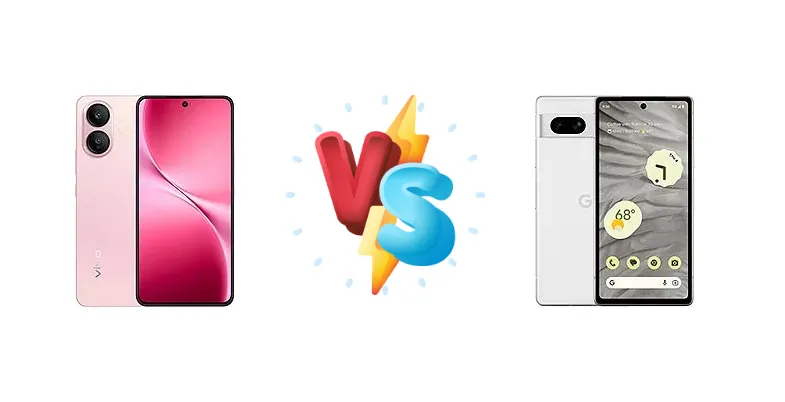
|
🏆 Quick Verdict
For the average user prioritizing camera quality and software experience, the Google Pixel 7a is the superior choice. Its Tensor G2 chip, coupled with Google’s image processing, delivers consistently excellent photos and videos. However, users who prioritize blazing-fast charging and a more powerful CPU for demanding tasks will find the vivo V60 Lite a more appealing option.
| PHONES | ||
|---|---|---|
| Phone Names | vivo V60 Lite | Google Pixel 7a |
| Network | ||
|---|---|---|
| 2G bands | GSM 850 / 900 / 1800 / 1900 | GSM 850 / 900 / 1800 / 1900 |
| 3G bands | HSDPA 850 / 900 / 1700(AWS) / 1900 / 2100 | HSDPA 800 / 850 / 900 / 1700(AWS) / 1900 / 2100 |
| 4G bands | 1, 2, 3, 4, 5, 7, 8, 19, 20, 28, 38, 39, 40, 41 | 1, 2, 3, 4, 5, 7, 8, 12, 13, 14, 17, 20, 25, 26, 28, 29, 30, 38, 40, 41, 48, 66, 71 - GWKK3, G0DZQ |
| 5G bands | 1, 3, 5, 7, 8, 20, 28, 38, 40, 41, 77, 78 SA/NSA | 1, 2, 3, 5, 7, 8, 12, 14, 20, 25, 28, 30, 38, 41, 48, 66, 71, 77, 78 SA/NSA/Sub6 - GWKK3 |
| Speed | HSPA, LTE, 5G | HSPA, LTE, 5G |
| Technology | GSM / HSPA / LTE / 5G | GSM / HSPA / LTE / 5G |
| - | 1, 2, 3, 5, 7, 8, 12, 20, 25, 28, 38, 40, 41, 66, 75, 76, 77, 78, 79 SA/NSA/Sub6 - GHL1X, G82U8 | |
| Launch | ||
|---|---|---|
| Announced | 2025, September 24 | 2023, May 10 |
| Status | Available. Released 2025, September 24 | Available. Released 2023, May 10 |
| Body | ||
|---|---|---|
| Build | Glass front, plastic back, plastic frame | Glass front (Gorilla Glass 3), aluminum frame, plastic back |
| Dimensions | 163.8 x 76.3 x 7.6 mm (6.45 x 3.00 x 0.30 in) | 152 x 72.9 x 9 mm (5.98 x 2.87 x 0.35 in) |
| SIM | Nano-SIM + Nano-SIM | Nano-SIM + eSIM |
| Weight | 194 g (6.84 oz) | 193.5 g (6.84 oz) |
| - | IP67 dust/water resistant (up to 1m for 30 min) | |
| Display | ||
|---|---|---|
| Protection | - | Corning Gorilla Glass 3 |
| Resolution | 1080 x 2392 pixels (~388 ppi density) | 1080 x 2400 pixels, 20:9 ratio (~429 ppi density) |
| Size | 6.77 inches, 110.9 cm2 (~88.7% screen-to-body ratio) | 6.1 inches, 90.7 cm2 (~81.8% screen-to-body ratio) |
| Type | AMOLED, 1B colors, 120Hz, HDR10+ | OLED, HDR, 90Hz |
| - | Always-on display | |
| Platform | ||
|---|---|---|
| CPU | Octa-core (4x2.5 GHz Cortex-A78 & 4x2.0 GHz Cortex-A55) | Octa-core (2x2.85 GHz Cortex-X1 & 2x2.35 GHz Cortex-A78 & 4x1.80 GHz Cortex-A55) |
| Chipset | Mediatek Dimensity 7360 Turbo (4 nm) | Google Tensor G2 (5 nm) |
| GPU | Mali-G615 MC2 | Mali-G710 MP7 |
| OS | Android 15, Funtouch 15 | Android 13, upgradable to Android 15, up to 5 major Android upgrades |
| Memory | ||
|---|---|---|
| Card slot | No | No |
| Internal | 256GB 8GB RAM, 256GB 12GB RAM, 512GB 12GB RAM | 128GB 8GB RAM |
| - | UFS 3.1 | |
| Main Camera | ||
|---|---|---|
| Dual | 50 MP, f/1.8, (wide), 1/1.95", 0.8µm, PDAF 8 MP, f/2.2, 120˚ (ultrawide) | 64 MP, f/1.9, 26mm (wide), 1/1.73", 0.8µm, dual pixel PDAF, OIS 13 MP, f/2.2, 120˚ (ultrawide), 1.12µm |
| Features | Ring-LED flash, panorama, HDR | Dual-LED flash, Pixel Shift, Auto-HDR, panorama |
| Video | 1080p@30fps | 4K@30/60fps, 1080p@30/60/120/240fps, OIS |
| Selfie camera | ||
|---|---|---|
| Features | - | HDR, panorama |
| Single | 32 MP, f/2.5, (wide), 1/3.1" | 13 MP, f/2.2, 20mm (ultrawide), 1.12µm |
| Video | 1080p@30fps | 4K@30fps, 1080p@30fps |
| Sound | ||
|---|---|---|
| 3.5mm jack | - | No |
| 35mm jack | No | No |
| Loudspeaker | Yes, with stereo speakers | Yes, with stereo speakers |
| Comms | ||
|---|---|---|
| Bluetooth | 5.4, A2DP, LE | 5.3, A2DP, LE |
| NFC | Yes | Yes |
| Positioning | GPS, GLONASS, GALILEO, BDS, QZSS | GPS, GLONASS, GALILEO, BDS, QZSS, NavIC |
| Radio | No | No |
| USB | USB Type-C 2.0, OTG | USB Type-C 3.2 |
| WLAN | Wi-Fi 802.11 a/b/g/n/ac/6, dual-band | Wi-Fi 802.11 a/b/g/n/ac/6e, tri-band |
| Features | ||
|---|---|---|
| Sensors | Fingerprint (under display, optical), accelerometer, gyro, proximity, compass | Fingerprint (under display, optical), accelerometer, gyro, proximity, compass, barometer |
| Battery | ||
|---|---|---|
| Charging | 90W wired, 100% in 52 min 6W reverse wired Bypass charging | 18W wired, PD3.0 7.5W wireless |
| Type | Si/C Li-Ion 6500 mAh | Li-Po 4385 mAh |
| Misc | ||
|---|---|---|
| Colors | Vitality Pink, Titanium Mist Blue, Ocean Night Black | Charcoal, Snow, Sea, Coral |
| Models | - | GWKK3, GHL1X, G0DZQ, G82U8 |
| Price | About 390 EUR | € 179.90 / $ 150.00 / £ 170.00 / ₹ 25,980 |
vivo V60 Lite
- Blazing-fast 90W charging
- Powerful Dimensity 7360 Turbo CPU
- Reverse wired charging capability
- Camera performance likely lags behind Pixel 7a
- Software updates may be less frequent
Google Pixel 7a
- Exceptional camera quality and image processing
- Clean and consistently updated Android experience
- Optimized performance through Tensor G2 and AI
- Slow 18W charging
- Less raw CPU power compared to V60 Lite
Display Comparison
The Pixel 7a boasts a measured peak brightness of 1070 nits, providing excellent visibility in direct sunlight. While the V60 Lite’s display specifications are not provided, it’s likely to be lower, potentially impacting outdoor usability. Both phones likely utilize OLED panels, but the Pixel 7a’s higher brightness and Google’s color calibration offer a more vibrant and accurate viewing experience. The absence of LTPO technology on either device suggests standard 60Hz or 90Hz refresh rates, impacting smoothness compared to flagship displays.
Camera Comparison
The Pixel 7a’s camera system is its standout feature. While specific sensor details are missing for the V60 Lite, the Pixel 7a leverages Google’s computational photography prowess, delivering exceptional image quality in various lighting conditions. The Tensor G2 chip’s image signal processor (ISP) excels at noise reduction, dynamic range optimization, and detail preservation. The Pixel 7a’s video capabilities are also superior, benefiting from advanced stabilization and processing. The V60 Lite will likely rely more on hardware specifications, but without knowing the sensor size or aperture, it’s difficult to assess its true potential against Google’s software-driven approach.
Performance
The core difference lies in the chipsets. The vivo V60 Lite’s Mediatek Dimensity 7360 Turbo (4nm) features a Cortex-A78 based octa-core CPU clocked up to 2.5 GHz, focusing on raw processing power. Conversely, the Google Pixel 7a’s Tensor G2 (5nm) employs a more complex CPU configuration with Cortex-X1 cores reaching 2.85 GHz, prioritizing AI and machine learning tasks. The 5nm process of the Tensor G2 generally offers better power efficiency than the 4nm Dimensity 7360 Turbo, potentially leading to longer sustained performance under load. While the V60 Lite may win in benchmark scores, the Tensor G2’s optimized software integration and AI capabilities provide a smoother, more responsive user experience in everyday tasks.
Battery Life
The Pixel 7a has an endurance rating of 76 hours, indicating solid battery life. However, its 18W wired charging is significantly slower than the V60 Lite’s 90W charging, which can reach 100% in just 52 minutes. The V60 Lite also offers 6W reverse wired charging, a feature absent on the Pixel 7a. While the Pixel 7a’s battery endurance suggests efficient power management, the V60 Lite’s charging speed is a major convenience factor, especially for users who frequently need to top up their battery quickly.
Buying Guide
Buy the vivo V60 Lite if you need exceptionally fast charging – its 90W capability is a game-changer – and prioritize raw CPU performance for gaming or multitasking. Buy the Google Pixel 7a if you prefer a best-in-class camera experience, a clean and consistently updated Android experience, and a phone that excels at computational photography, even if it means sacrificing charging speed.