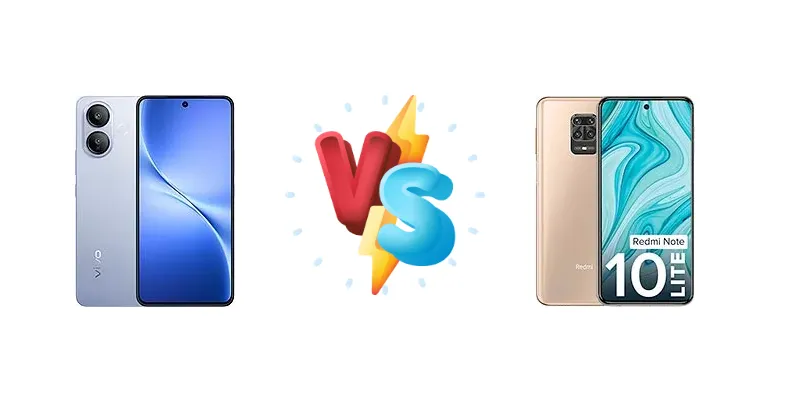
The vivo V60 Lite 4G and Xiaomi Redmi Note 10 Lite represent compelling options in the crowded budget smartphone space. While both aim to deliver a solid experience without breaking the bank, they take different approaches. The V60 Lite prioritizes charging speed and a newer chipset, while the Redmi Note 10 Lite leverages a slightly older, but still capable, processor and a more established brand presence. This comparison dissects their key differences to help you choose the right device.
🏆 Quick Verdict
For the average user prioritizing fast charging and potentially longer software support, the vivo V60 Lite 4G emerges as the winner. Its 90W charging significantly outperforms the Redmi Note 10 Lite’s 18W, and the Snapdragon 685, built on a more efficient 6nm process, offers a good balance of performance and battery life.
| Network |
|---|
| 2G bands | GSM 850 / 900 / 1800 / 1900 | GSM 850 / 900 / 1800 / 1900 |
| 3G bands | HSDPA 850 / 900 / 2100 | HSDPA 850 / 900 / 1700(AWS) / 1900 / 2100 |
| 4G bands | 1, 3, 5, 7, 8, 20, 28, 38, 40, 41 | 1, 2, 3, 4, 5, 7, 8, 20, 28, 38, 40, 41 |
| Speed | HSPA, LTE | HSPA, LTE |
| Technology | GSM / HSPA / LTE | GSM / HSPA / LTE |
| Launch |
|---|
| Announced | 2025, September 25 | 2021, October 01 |
| Status | Available. Released 2025, October 08 | Available. Released 2021, October 02 |
| Body |
|---|
| Build | Glass front, plastic back, plastic frame | Glass front (Gorilla Glass 5), glass back (Gorilla Glass 5), plastic frame |
| Dimensions | 163.8 x 76.3 x 7.6 mm (6.45 x 3.00 x 0.30 in) | 165.8 x 76.7 x 8.8 mm (6.53 x 3.02 x 0.35 in) |
| SIM | Nano-SIM + Nano-SIM | Nano-SIM + Nano-SIM |
| Weight | 194 g (6.84 oz) | 209 g (7.37 oz) |
| | - | Water-repellent coating |
| Display |
|---|
| Protection | - | Corning Gorilla Glass 5 |
| Resolution | 1080 x 2392 pixels (~388 ppi density) | 1080 x 2400 pixels, 20:9 ratio (~395 ppi density) |
| Size | 6.77 inches, 110.9 cm2 (~88.7% screen-to-body ratio) | 6.67 inches, 107.4 cm2 (~84.5% screen-to-body ratio) |
| Type | AMOLED, 1B colors, 120Hz | IPS LCD |
| Platform |
|---|
| CPU | Octa-core (4x2.8 GHz Cortex-A73 & 4x1.9 GHz Cortex-A53) | Octa-core (2x2.3 GHz Kryo 465 Gold & 6x1.8 GHz Kryo 465 Silver) |
| Chipset | Qualcomm SM6225 Snapdragon 685 (6 nm) | Qualcomm SM7125 Snapdragon 720G (8 nm) |
| GPU | Adreno 610 | Adreno 618 |
| OS | Android 15, Funtouch 15 | Android 10, MIUI 11 |
| Memory |
|---|
| Card slot | No | microSDXC (dedicated slot) |
| Internal | 128GB 8GB RAM, 256GB 8GB RAM | 64GB 4GB RAM, 64GB 6GB RAM, 128GB 4GB RAM, 128GB 6GB RAM |
| Main Camera |
|---|
| Dual | 50 MP, f/1.8, (wide), 1/1.95", 0.8µm, PDAF
8 MP, f/2.2, 120˚ (ultrawide) | - |
| Features | Ring-LED flash, panorama, HDR | LED flash, HDR, panorama |
| Quad | - | 48 MP, f/1.9, 26mm (wide), 0.8µm, PDAF
8 MP, f/2.2, 119˚ (ultrawide), 1/4.0", 1.12µm
5 MP (macro), AF
Auxiliary lens |
| Single | - | 16 MP, f/2.5, (wide), 1/3.06", 1.0µm |
| Video | 1080p@30fps | 4K@30fps, 1080p@30/60/120fps, 720p@960fps, gyro-EIS |
| Selfie camera |
|---|
| Features | - | HDR, panorama |
| Single | 32 MP, f/2.5, (wide), 1/3.1" | 16 MP, f/2.5, (wide), 1/3.06", 1.0µm |
| Video | 1080p@30fps | 1080p@30fps |
| Sound |
|---|
| 3.5mm jack | - | Yes |
| 35mm jack | No | Yes |
| Loudspeaker | Yes, with stereo speakers | Yes |
| Comms |
|---|
| Bluetooth | 5.0, A2DP, LE | 5.0, A2DP, LE |
| Infrared port | - | Yes |
| NFC | Yes (market/region dependent) | Yes |
| Positioning | GPS, GLONASS, GALILEO, BDS, QZSS | GPS, GLONASS, GALILEO, BDS, NavIC |
| Radio | No | FM radio, recording |
| USB | USB Type-C 2.0, OTG | USB Type-C 2.0 |
| WLAN | Wi-Fi 802.11 a/b/g/n/ac, dual-band | Wi-Fi 802.11 a/b/g/n/ac, dual-band, Wi-Fi Direct |
| Features |
|---|
| Sensors | Fingerprint (under display, optical), accelerometer, gyro, proximity, compass | Fingerprint (side-mounted), accelerometer, gyro, proximity, compass |
| Battery |
|---|
| Charging | 90W wired, 100% in 55 min
6W reverse wired
Bypass charging | 18W wired |
| Type | Si/C Li-Ion 6500 mAh | Li-Po 5020 mAh |
| Misc |
|---|
| Colors | Black, Blue | Aurora Blue, Glacier White, Interstellar Black, Champagne Gold |
| Models | V2530 | M2002F4LG |
| Price | About 450 EUR | About 200 EUR |
| SAR | - | 1.17 W/kg (head) 0.86 W/kg (body) |
| SAR EU | - | 1.01 W/kg (head) 1.39 W/kg (body) |
vivo V60 Lite 4G
- Ultra-fast 90W charging
- More efficient Snapdragon 685 (6nm)
- Potential for longer software support due to newer chipset
- Brand recognition may be lower than Xiaomi
- Camera performance details unknown
Xiaomi Redmi Note 10 Lite
- Established brand with a large user base
- Mature MIUI software ecosystem
- Potentially better image processing
- Slow 18W charging
- Older Snapdragon 720G (8nm) less power efficient
- May receive fewer software updates
Display Comparison
Neither device boasts a particularly standout display. Given the context data focuses on processing power, we can infer both likely utilize standard LCD panels common in this price bracket. The absence of specifications like refresh rate or resolution suggests neither prioritizes display quality. Bezels are likely comparable, typical of budget devices. Color accuracy will likely be adequate but not exceptional, leaning towards warmer tones as is common with both brands.
Camera Comparison
Without detailed camera specs, a direct comparison is difficult. However, both phones likely feature a primary camera sensor around the 48MP-50MP range, typical for this segment. The Redmi Note 10 Lite may have a slight edge in image processing due to Xiaomi’s more mature camera software algorithms. The inclusion of a 2MP macro camera on both devices is largely a marketing tactic, offering limited practical benefit due to the low resolution and lack of optical image stabilization (OIS). The aperture size of the main lens will be a key differentiator, but without that data, it's impossible to determine which phone captures more light.
Performance
The core difference lies in the chipsets. The vivo V60 Lite 4G’s Snapdragon 685 (6nm) and the Redmi Note 10 Lite’s Snapdragon 720G (8nm) represent different design philosophies. While the 720G has a higher clock speed on its prime cores (2.3 GHz vs 2.8 GHz on the V60 Lite), the 6nm process of the 685 offers superior power efficiency. This translates to potentially better sustained performance and less thermal throttling during extended gaming sessions. The 720G’s Kryo 465 Gold cores are architecturally older than the Cortex-A73 cores in the 685, meaning the 685 benefits from architectural improvements despite the clock speed difference. Users engaging in demanding tasks like video editing or prolonged gaming will likely see a more consistent experience on the V60 Lite.
Battery Life
The battery capacity is not specified for either device, but both likely fall in the 5000mAh range, standard for this class. However, the charging capabilities are drastically different. The vivo V60 Lite 4G’s 90W charging is a game-changer, promising a full charge in approximately 55 minutes. The Redmi Note 10 Lite’s 18W charging is comparatively slow, requiring significantly longer to reach 100%. The V60 Lite also offers 6W reverse wired charging, a useful feature for topping up accessories. This charging speed difference is the most significant advantage of the V60 Lite, catering to users who prioritize convenience and minimal downtime.
Buying Guide
Buy the vivo V60 Lite 4G if you need incredibly fast charging, frequently top up your phone throughout the day, or value a more modern chipset architecture for potential future software updates. Buy the Xiaomi Redmi Note 10 Lite if you prefer a brand with a larger user base and established software ecosystem, and are less concerned with having the absolute fastest charging speeds or the latest processor generation.
Frequently Asked Questions
❓ Does the Snapdragon 685 in the vivo V60 Lite 4G struggle with graphically intensive games like PUBG or Call of Duty?
While not a flagship chipset, the Snapdragon 685 is capable of running PUBG and Call of Duty at medium settings. The 6nm process and improved thermal management should prevent significant throttling, allowing for reasonably sustained gameplay. However, users seeking the highest frame rates and graphics settings may need to compromise.
❓ Is the 18W charging on the Redmi Note 10 Lite slow enough to be a major inconvenience?
Yes, 18W charging is noticeably slower than the 90W charging on the vivo V60 Lite 4G. Expect a full charge to take well over two hours, which can be frustrating for users accustomed to faster charging speeds. This is the biggest drawback of the Redmi Note 10 Lite.
❓ How does the software experience differ between vivo's Funtouch OS and Xiaomi's MIUI?
MIUI is known for its extensive customization options and feature set, but can also be perceived as bloated with pre-installed apps. Funtouch OS is generally cleaner and more streamlined, but may lack some of the advanced features found in MIUI. Preference is subjective, but MIUI has a larger user base and more readily available support resources.