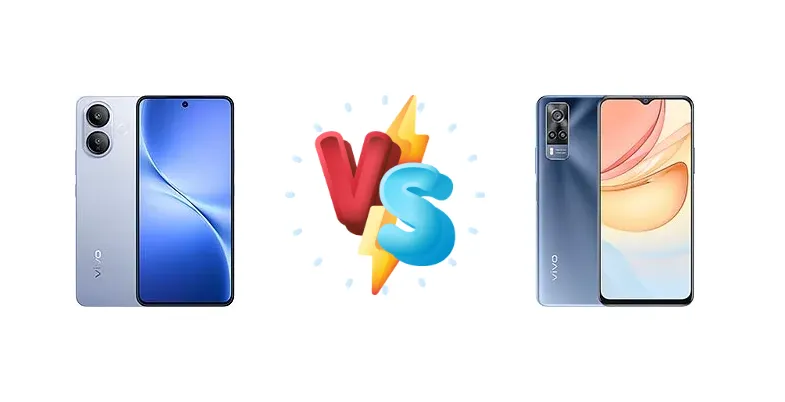
The vivo V60 Lite 4G and Y53s 4G represent vivo’s commitment to the affordable smartphone market. While both aim to deliver a solid experience without breaking the bank, they take distinctly different approaches under the hood. The V60 Lite prioritizes efficiency with a newer Snapdragon chipset and blazing-fast charging, while the Y53s relies on a MediaTek Helio G80, a proven performer in its class. This comparison will dissect the key differences to help you determine which device best suits your needs.
🏆 Quick Verdict
For the average user prioritizing long-term performance and faster charging, the vivo V60 Lite 4G emerges as the stronger contender. Its Snapdragon 685, built on a 6nm process, offers superior efficiency and sustained performance compared to the Y53s’ 12nm Helio G80. The 90W charging is a game-changer in this price bracket, significantly reducing downtime.
| Network |
|---|
| 2G bands | GSM 850 / 900 / 1800 / 1900 | GSM 850 / 900 / 1800 / 1900 |
| 3G bands | HSDPA 850 / 900 / 2100 | HSDPA 850 / 900 / 1700(AWS) / 2100 |
| 4G bands | 1, 3, 5, 7, 8, 20, 28, 38, 40, 41 | 1, 3, 5, 7, 8, 20, 38, 40, 41 |
| Speed | HSPA, LTE | HSPA, LTE |
| Technology | GSM / HSPA / LTE | GSM / HSPA / LTE |
| Launch |
|---|
| Announced | 2025, September 25 | 2021, July 09 |
| Status | Available. Released 2025, October 08 | Available. Released 2021, July 09 |
| Body |
|---|
| Build | Glass front, plastic back, plastic frame | Glass front, plastic frame, plastic back |
| Dimensions | 163.8 x 76.3 x 7.6 mm (6.45 x 3.00 x 0.30 in) | 164 x 75.5 x 8.4 mm (6.46 x 2.97 x 0.33 in) |
| SIM | Nano-SIM + Nano-SIM | Nano-SIM + Nano-SIM |
| Weight | 194 g (6.84 oz) | 190 g (6.70 oz) |
| Display |
|---|
| Resolution | 1080 x 2392 pixels (~388 ppi density) | 1080 x 2408 pixels, 20:9 ratio (~401 ppi density) |
| Size | 6.77 inches, 110.9 cm2 (~88.7% screen-to-body ratio) | 6.58 inches, 104.3 cm2 (~84.2% screen-to-body ratio) |
| Type | AMOLED, 1B colors, 120Hz | IPS LCD |
| Platform |
|---|
| CPU | Octa-core (4x2.8 GHz Cortex-A73 & 4x1.9 GHz Cortex-A53) | Octa-core (2x2.0 GHz Cortex-A75 & 6x1.8 GHz Cortex-A55) |
| Chipset | Qualcomm SM6225 Snapdragon 685 (6 nm) | Mediatek MT6769V/CU Helio G80 (12 nm) |
| GPU | Adreno 610 | Mali-G52 MC2 |
| OS | Android 15, Funtouch 15 | Android 11, Funtouch 11.1 |
| Memory |
|---|
| Card slot | No | microSDXC (dedicated slot) |
| Internal | 128GB 8GB RAM, 256GB 8GB RAM | 128GB 6GB RAM, 128GB 8GB RAM |
| Main Camera |
|---|
| Dual | 50 MP, f/1.8, (wide), 1/1.95", 0.8µm, PDAF
8 MP, f/2.2, 120˚ (ultrawide) | - |
| Features | Ring-LED flash, panorama, HDR | LED flash, HDR, panorama |
| Single | - | 16 MP, f/2.0, (wide) |
| Triple | - | 64 MP, f/1.8, 26mm (wide), 1/1.97", 0.7µm, PDAF
2 MP (macro)
Auxiliary lens |
| Video | 1080p@30fps | 1080p@30fps, gyro-EIS |
| Selfie camera |
|---|
| Single | 32 MP, f/2.5, (wide), 1/3.1" | 16 MP, f/2.0, (wide) |
| Video | 1080p@30fps | 1080p@30fps |
| Sound |
|---|
| 3.5mm jack | - | Yes |
| 35mm jack | No | Yes |
| Loudspeaker | Yes, with stereo speakers | Yes |
| Comms |
|---|
| Bluetooth | 5.0, A2DP, LE | 5.1, A2DP, LE |
| NFC | Yes (market/region dependent) | No |
| Positioning | GPS, GLONASS, GALILEO, BDS, QZSS | GPS |
| Radio | No | Unspecified |
| USB | USB Type-C 2.0, OTG | USB Type-C 2.0, OTG |
| WLAN | Wi-Fi 802.11 a/b/g/n/ac, dual-band | Wi-Fi 802.11 a/b/g/n/ac, dual-band, Wi-Fi Direct |
| Features |
|---|
| Sensors | Fingerprint (under display, optical), accelerometer, gyro, proximity, compass | Fingerprint (side-mounted), accelerometer, gyro, proximity, compass |
| Battery |
|---|
| Charging | 90W wired, 100% in 55 min
6W reverse wired
Bypass charging | 33W wired |
| Type | Si/C Li-Ion 6500 mAh | 5000 mAh |
| Misc |
|---|
| Colors | Black, Blue | Blue Purple, Black Green |
| Models | V2530 | - |
| Price | About 450 EUR | About 260 EUR |
vivo V60 Lite 4G
- Significantly faster 90W charging
- More efficient Snapdragon 685 chipset
- Reverse wired charging capability
- Potentially higher price point
- Display specifications unknown
vivo Y53s 4G
- Potentially lower price
- Proven Helio G80 performance
- Familiar MediaTek platform
- Slower 33W charging
- Less efficient 12nm Helio G80
Display Comparison
Neither device’s display specifications are provided, so a direct comparison is limited. However, given the market positioning, both likely feature LCD panels. The Y53s, being an older model, may have slightly larger bezels. Color accuracy will likely be similar, tuned for vibrant visuals typical of vivo phones. Without knowing the refresh rates or peak brightness, it’s difficult to declare a clear winner; however, newer models often benefit from display improvements.
Camera Comparison
Without detailed camera specifications, a comprehensive comparison is challenging. Both phones likely feature a multi-camera setup, but the quality will depend heavily on sensor size and image processing. It’s reasonable to assume the V60 Lite, being a newer model, may benefit from improved software algorithms. The presence of a 2MP macro camera on either device is unlikely to significantly impact image quality; these are often included for marketing purposes rather than practical benefit. Focusing on the main sensor’s megapixel count and aperture would be more informative.
Performance
The core difference lies in the chipsets. The vivo V60 Lite’s Qualcomm Snapdragon 685 (6nm) boasts a more efficient architecture than the Y53s’ MediaTek Helio G80 (12nm). The Snapdragon 685’s CPU configuration – 4x2.8 GHz Cortex-A73 & 4x1.9 GHz Cortex-A53 – provides a performance edge over the Helio G80’s 2x2.0 GHz Cortex-A75 & 6x1.8 GHz Cortex-A55. The 6nm process translates to lower heat generation and improved sustained performance, crucial for gaming and multitasking. While the Helio G80 is capable, the Snapdragon 685 offers a more future-proof experience.
Battery Life
The vivo V60 Lite 4G’s 90W wired charging is a standout feature, capable of charging the device to 100% in just 55 minutes. This is a significant advantage over the Y53s’ 33W charging. While battery capacity isn’t specified for either device, the Snapdragon 685’s superior efficiency means the V60 Lite will likely deliver comparable or better battery life despite potentially having a smaller battery. The V60 Lite also includes 6W reverse wired charging, a feature absent on the Y53s, allowing it to top up other devices.
Buying Guide
Buy the vivo V60 Lite 4G if you need a phone that can handle daily tasks smoothly, offers exceptionally fast charging, and benefits from a more modern, power-efficient chipset. Buy the vivo Y53s 4G if you prefer a slightly more established platform and are less concerned with the absolute fastest charging speeds or peak performance, potentially finding it at a lower price point.
Frequently Asked Questions
❓ Will the Snapdragon 685 in the V60 Lite handle demanding games like PUBG Mobile smoothly?
The Snapdragon 685 is capable of running PUBG Mobile, but expect to play at medium settings for a consistently smooth experience. The 6nm process helps mitigate thermal throttling, allowing for sustained performance during gaming sessions. However, it won't match the performance of higher-end chipsets.
❓ How much faster is the 90W charging on the V60 Lite compared to the 33W charging on the Y53s in real-world use?
The 90W charging on the V60 Lite can take a phone from 0% to 100% in approximately 55 minutes, while the Y53s’ 33W charging will likely take over 1.5 to 2 hours. This means you can get a significant charge in a much shorter time with the V60 Lite, ideal for users who are always on the go.
❓ Does the Helio G80 in the Y53s get noticeably hot during extended gaming sessions?
The Helio G80, being built on a 12nm process, is more prone to heat generation than the Snapdragon 685. Extended gaming sessions may result in noticeable warming, and potentially some performance throttling to manage temperatures. It's not a dealbreaker, but something to be aware of.