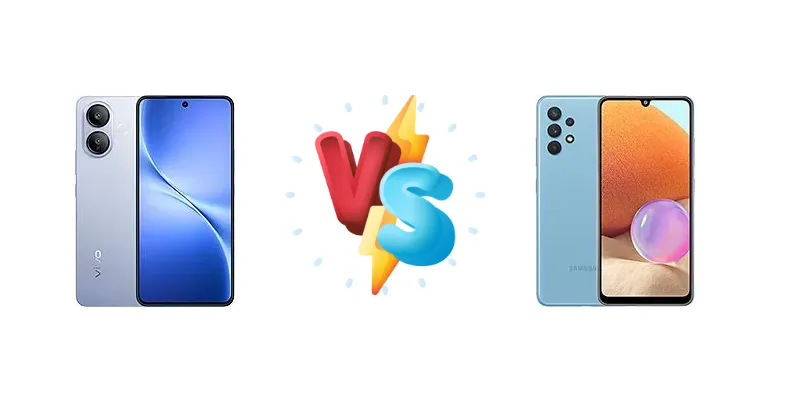
The budget smartphone market is fiercely competitive, and the vivo V60 Lite 4G and Samsung Galaxy A32 represent compelling options for users seeking value. While both aim for affordability, they take distinctly different approaches: the V60 Lite prioritizes processing power and rapid charging, while the A32 leans towards a brighter display and established brand recognition. This comparison dissects their key specifications to determine which device best suits your needs.
🏆 Quick Verdict
For the average user prioritizing responsiveness and quick top-ups, the vivo V60 Lite 4G emerges as the winner. Its Snapdragon 685 chipset, built on a more efficient 6nm process, offers a noticeable performance advantage over the Galaxy A32’s Helio G80. The 90W charging is a game-changer in this price bracket, significantly reducing downtime.
| Network |
|---|
| 2G bands | GSM 850 / 900 / 1800 / 1900 | GSM 850 / 900 / 1800 / 1900 |
| 3G bands | HSDPA 850 / 900 / 2100 | HSDPA 850 / 900 / 1900 / 2100 |
| 4G bands | 1, 3, 5, 7, 8, 20, 28, 38, 40, 41 | 1, 2, 3, 5, 7, 8, 20, 28, 38, 40, 41 |
| Speed | HSPA, LTE | HSPA, LTE |
| Technology | GSM / HSPA / LTE | GSM / HSPA / LTE |
| Launch |
|---|
| Announced | 2025, September 25 | 2021, February 25 |
| Status | Available. Released 2025, October 08 | Available. Released 2021, February 25 |
| Body |
|---|
| Build | Glass front, plastic back, plastic frame | Glass front (Gorilla Glass 5), plastic frame, plastic back |
| Dimensions | 163.8 x 76.3 x 7.6 mm (6.45 x 3.00 x 0.30 in) | 158.9 x 73.6 x 8.4 mm (6.26 x 2.90 x 0.33 in) |
| SIM | Nano-SIM + Nano-SIM | · Nano-SIM· Nano-SIM + Nano-SIM |
| Weight | 194 g (6.84 oz) | 184 g (6.49 oz) |
| Display |
|---|
| Protection | - | Corning Gorilla Glass 5 |
| Resolution | 1080 x 2392 pixels (~388 ppi density) | 1080 x 2400 pixels, 20:9 ratio (~411 ppi density) |
| Size | 6.77 inches, 110.9 cm2 (~88.7% screen-to-body ratio) | 6.4 inches, 98.9 cm2 (~84.6% screen-to-body ratio) |
| Type | AMOLED, 1B colors, 120Hz | Super AMOLED, 90Hz, 800 nits (HBM) |
| Platform |
|---|
| CPU | Octa-core (4x2.8 GHz Cortex-A73 & 4x1.9 GHz Cortex-A53) | Octa-core (2x2.0 GHz Cortex-A75 & 6x1.8 GHz Cortex-A55) |
| Chipset | Qualcomm SM6225 Snapdragon 685 (6 nm) | Mediatek MT6769V/CU Helio G80 (12 nm) |
| GPU | Adreno 610 | Mali-G52 MC2 |
| OS | Android 15, Funtouch 15 | Android 11, upgradable to Android 13, One UI 5 |
| Memory |
|---|
| Card slot | No | microSDXC (dedicated slot) |
| Internal | 128GB 8GB RAM, 256GB 8GB RAM | 64GB 4GB RAM, 64GB 6GB RAM, 128GB 4GB RAM, 128GB 6GB RAM, 128GB 8GB RAM |
| Main Camera |
|---|
| Dual | 50 MP, f/1.8, (wide), 1/1.95", 0.8µm, PDAF
8 MP, f/2.2, 120˚ (ultrawide) | - |
| Features | Ring-LED flash, panorama, HDR | LED flash, panorama, HDR |
| Quad | - | 64 MP, f/1.8, 26mm (wide), PDAF
8 MP, f/2.2, 123˚, (ultrawide), 1/4.0", 1.12µm
5 MP (macro)
Auxiliary lens |
| Single | - | 20 MP, f/2.2, (wide) |
| Video | 1080p@30fps | 1080p@30fps |
| Selfie camera |
|---|
| Single | 32 MP, f/2.5, (wide), 1/3.1" | 20 MP, f/2.2, (wide) |
| Video | 1080p@30fps | 1080p@30fps |
| Sound |
|---|
| 3.5mm jack | - | Yes |
| 35mm jack | No | Yes |
| Loudspeaker | Yes, with stereo speakers | Yes |
| Comms |
|---|
| Bluetooth | 5.0, A2DP, LE | 5.0, A2DP, LE |
| NFC | Yes (market/region dependent) | Yes (market/region dependent) |
| Positioning | GPS, GLONASS, GALILEO, BDS, QZSS | GPS, GLONASS, BDS, GALILEO |
| Radio | No | FM radio, RDS, recording |
| USB | USB Type-C 2.0, OTG | USB Type-C 2.0, OTG |
| WLAN | Wi-Fi 802.11 a/b/g/n/ac, dual-band | Wi-Fi 802.11 a/b/g/n/ac, dual-band, Wi-Fi Direct |
| Features |
|---|
| Sensors | Fingerprint (under display, optical), accelerometer, gyro, proximity, compass | Fingerprint (under display, optical), accelerometer, gyro, compass |
| | - | Virtual proximity sensing |
| Battery |
|---|
| Charging | 90W wired, 100% in 55 min
6W reverse wired
Bypass charging | 15W wired |
| Type | Si/C Li-Ion 6500 mAh | Li-Ion 5000 mAh |
| Misc |
|---|
| Colors | Black, Blue | Awesome Black, Awesome White, Awesome Blue, Awesome Violet |
| Models | V2530 | SM-A325F, SM-A325F/DS, SM-A325M, SM-A325N |
| Price | About 450 EUR | € 124.99 / £ 89.38 |
| SAR EU | - | 0.45 W/kg (head) 1.30 W/kg (body) |
| Tests |
|---|
| Battery life | - |
Endurance rating 119h
|
| Camera | - |
Photo / Video |
| Display | - |
Contrast ratio: Infinite (nominal) |
| Loudspeaker | - |
-30.3 LUFS (Below average)
|
| Performance | - |
AnTuTu: 286666 (v8)
GeekBench: 1277 (v5.1)
GFXBench: 8.1fps (ES 3.1 onscreen) |
vivo V60 Lite 4G
- Significantly faster 90W charging
- More efficient Snapdragon 685 chipset
- Potentially better thermal management
- Bypass charging for reduced battery wear
- Display specifications currently unknown
- Brand recognition less established than Samsung
Samsung Galaxy A32
- Brighter display for outdoor visibility (814 nits)
- Established Samsung brand and ecosystem
- Solid battery endurance (119h)
- Wide availability
- Slower 15W charging
- Less powerful and efficient Helio G80 chipset
- Potential for thermal throttling under load
- 2MP macro camera offers limited utility
Display Comparison
The Samsung Galaxy A32 boasts a measured peak brightness of 814 nits, a significant advantage for outdoor use compared to the likely lower (unspecified) peak brightness of the vivo V60 Lite 4G. While the A32’s contrast ratio is listed as ‘Infinite (nominal)’ – a marketing term – the lack of specifics suggests it’s a standard LCD panel. The V60 Lite’s display specifications are currently unavailable, making a direct comparison difficult, but given its price point, it likely utilizes a similar LCD technology. The A32’s brightness is a clear win for users who frequently use their phones in direct sunlight.
Camera Comparison
Both devices offer photo and video capabilities, but detailed camera specifications are limited. Without information on sensor sizes, apertures, or image processing algorithms, a definitive comparison is challenging. However, the prevalence of larger sensors in newer devices suggests the V60 Lite, being a more recent release, may benefit from improved low-light performance. The A32’s camera system is likely tuned for Samsung’s signature vibrant color profile, while the V60 Lite’s image processing remains unknown. The inclusion of a 2MP macro camera on the A32 is unlikely to provide significant value, given the limitations of such sensors.
Performance
The vivo V60 Lite 4G’s Qualcomm Snapdragon 685, fabricated on a 6nm process, represents a substantial architectural leap over the Samsung Galaxy A32’s 12nm Mediatek Helio G80. The 6nm node inherently offers better power efficiency and thermal characteristics, translating to less throttling during sustained workloads. While both CPUs utilize an octa-core configuration, the Snapdragon 685’s Cortex-A73 cores clocked at 2.8 GHz provide a performance edge over the A32’s 2.0 GHz Cortex-A75 cores. This difference will be most noticeable in demanding applications and gaming. The V60 Lite is the clear winner for users prioritizing performance.
Battery Life
The Samsung Galaxy A32 has an endurance rating of 119 hours, indicating solid battery life. However, the vivo V60 Lite 4G’s 90W wired charging capability dramatically alters the battery equation. While the A32 is limited to 15W charging, the V60 Lite can reach 100% charge in just 55 minutes. This rapid charging mitigates any potential disadvantage from a potentially smaller battery capacity (unspecified for the V60 Lite). The V60 Lite’s bypass charging feature further enhances convenience by allowing the phone to function directly from the power adapter, reducing battery wear during extended use.
Buying Guide
Buy the vivo V60 Lite 4G if you need a phone that feels snappy for everyday tasks, handles moderate gaming without significant lag, and can be fully charged in under an hour. Buy the Samsung Galaxy A32 if you prioritize a brighter display for outdoor visibility, value the Samsung brand ecosystem, and prefer a phone with a proven endurance rating, even if it means slower charging and less processing power.
Frequently Asked Questions
❓ Does the Mediatek Helio G80 in the Samsung Galaxy A32 experience significant thermal throttling during prolonged gaming sessions?
The Helio G80, built on a 12nm process, is known to exhibit thermal throttling under sustained load. While it can handle casual gaming, demanding titles may experience frame rate drops and reduced performance after extended play. The Snapdragon 685 in the V60 Lite, with its 6nm process, is better equipped to manage heat and maintain consistent performance.
❓ How does the 90W charging on the vivo V60 Lite 4G compare to the 15W charging on the Samsung Galaxy A32 in real-world usage?
The difference is substantial. The V60 Lite can go from 0% to 100% in approximately 55 minutes, while the A32 will take over two hours. This means you can quickly top up the V60 Lite during short breaks, whereas the A32 requires a much longer charging period. This is a major convenience factor for users who are frequently on the go.
❓ Is the lack of detailed display specifications for the vivo V60 Lite 4G a major concern?
It's a valid concern. While we can assume it's an LCD panel, the absence of information regarding peak brightness and color accuracy makes it difficult to assess its quality. However, given the V60 Lite's focus on performance and charging speed, display quality may not have been a primary design consideration.