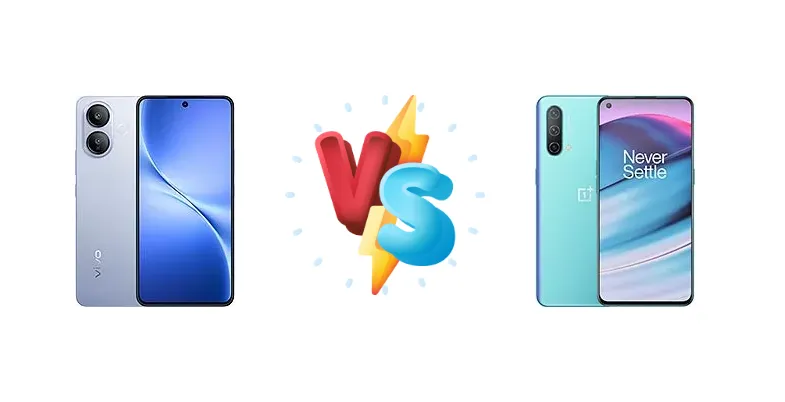
The vivo V60 Lite 4G and OnePlus Nord CE 5G represent compelling options in the increasingly competitive mid-range smartphone market. While both aim to deliver a balanced experience, they diverge significantly in their approach to performance and charging speed. This comparison dissects their key specifications to determine which device best suits your priorities.
🏆 Quick Verdict
For users prioritizing rapid charging and a more modern CPU architecture, the vivo V60 Lite 4G emerges as the winner. Its 90W charging significantly reduces downtime, and the Snapdragon 685, while not a performance leader, offers a newer fabrication process. However, the OnePlus Nord CE 5G remains a strong contender for those valuing 5G connectivity and a slightly brighter display.
| Network |
|---|
| 2G bands | GSM 850 / 900 / 1800 / 1900 | GSM 850 / 900 / 1800 / 1900 |
| 3G bands | HSDPA 850 / 900 / 2100 | HSDPA 800 / 850 / 900 / 1700(AWS) / 1900 / 2100 |
| 4G bands | 1, 3, 5, 7, 8, 20, 28, 38, 40, 41 | 1, 2, 3, 4, 5, 7, 8, 12, 17, 18, 19, 20, 26, 28, 39, 40, 41, 66 - Europe |
| 5G bands | - | 1, 3, 5, 7, 8, 20, 28, 38, 40, 41, 77, 78 SA/NSA - Europe |
| Speed | HSPA, LTE | HSPA 42.2/5.76 Mbps, LTE Cat18 1200/150 Mbps, 5G |
| Technology | GSM / HSPA / LTE | GSM / HSPA / LTE / 5G |
| | - | 78 SA/NSA - India |
| Launch |
|---|
| Announced | 2025, September 25 | 2021, June 10 |
| Status | Available. Released 2025, October 08 | Available. Released 2021, June 11 |
| Body |
|---|
| Build | Glass front, plastic back, plastic frame | Glass front, plastic frame, plastic back |
| Dimensions | 163.8 x 76.3 x 7.6 mm (6.45 x 3.00 x 0.30 in) | 159.2 x 73.5 x 7.9 mm (6.27 x 2.89 x 0.31 in) |
| SIM | Nano-SIM + Nano-SIM | Nano-SIM + Nano-SIM |
| Weight | 194 g (6.84 oz) | 170 g (6.00 oz) |
| Display |
|---|
| Resolution | 1080 x 2392 pixels (~388 ppi density) | 1080 x 2400 pixels, 20:9 ratio (~410 ppi density) |
| Size | 6.77 inches, 110.9 cm2 (~88.7% screen-to-body ratio) | 6.43 inches, 99.3 cm2 (~84.9% screen-to-body ratio) |
| Type | AMOLED, 1B colors, 120Hz | Fluid AMOLED, 90Hz |
| Platform |
|---|
| CPU | Octa-core (4x2.8 GHz Cortex-A73 & 4x1.9 GHz Cortex-A53) | Octa-core (2x2.2 GHz Kryo 570 & 6x1.8 GHz Kryo 570) |
| Chipset | Qualcomm SM6225 Snapdragon 685 (6 nm) | Qualcomm SM7225 Snapdragon 750G 5G (8 nm) |
| GPU | Adreno 610 | Adreno 619 |
| OS | Android 15, Funtouch 15 | Android 11, upgradable to Android 13, OxygenOS 13 |
| Memory |
|---|
| Card slot | No | No |
| Internal | 128GB 8GB RAM, 256GB 8GB RAM | 128GB 6GB RAM, 128GB 8GB RAM, 256GB 12GB RAM |
| | - | UFS 2.1 |
| Main Camera |
|---|
| Dual | 50 MP, f/1.8, (wide), 1/1.95", 0.8µm, PDAF
8 MP, f/2.2, 120˚ (ultrawide) | - |
| Features | Ring-LED flash, panorama, HDR | LED flash, HDR, panorama |
| Single | - | 16 MP, f/2.5, (wide), 1/3.0", 1.0µm |
| Triple | - | 64 MP, f/1.8, 26mm (wide), 0.7µm, PDAF
8 MP, f/2.3, 119˚ (ultrawide)
Auxiliary lens |
| Video | 1080p@30fps | 4K@30fps, 1080p@30/60/120fps, gyro-EIS |
| Selfie camera |
|---|
| Features | - | HDR |
| Single | 32 MP, f/2.5, (wide), 1/3.1" | 16 MP, f/2.5, (wide), 1/3.0", 1.0µm |
| Video | 1080p@30fps | 1080p@30/60fps |
| Sound |
|---|
| 3.5mm jack | - | Yes |
| 35mm jack | No | Yes |
| Loudspeaker | Yes, with stereo speakers | Yes |
| Comms |
|---|
| Bluetooth | 5.0, A2DP, LE | 5.1, A2DP, LE, aptX HD |
| NFC | Yes (market/region dependent) | Yes |
| Positioning | GPS, GLONASS, GALILEO, BDS, QZSS | GPS, GLONASS, GALILEO, BDS, NavIC |
| Radio | No | No |
| USB | USB Type-C 2.0, OTG | USB Type-C 2.0, OTG |
| WLAN | Wi-Fi 802.11 a/b/g/n/ac, dual-band | Wi-Fi 802.11 a/b/g/n/ac, dual-band, Wi-Fi Direct |
| Features |
|---|
| Sensors | Fingerprint (under display, optical), accelerometer, gyro, proximity, compass | Fingerprint (under display, optical), accelerometer, gyro, proximity, compass |
| Battery |
|---|
| Charging | 90W wired, 100% in 55 min
6W reverse wired
Bypass charging | 30W wired, 70% in 30 min |
| Type | Si/C Li-Ion 6500 mAh | Li-Po 4500 mAh |
| Misc |
|---|
| Colors | Black, Blue | Blue Void, Charkoal Ink, Silver Ray |
| Models | V2530 | EB2101, EB2103 |
| Price | About 450 EUR | About 250 EUR |
| Tests |
|---|
| Battery life | - |
Endurance rating 117h
|
| Camera | - |
Photo / Video |
| Display | - |
Contrast ratio: Infinite (nominal) |
| Loudspeaker | - |
-29.9 LUFS (Average)
|
| Performance | - |
AnTuTu: 318672 (v8) | 391770 (v9)
GeekBench: 1812 (v5.1)
GFXBench: 17fps (ES 3.1 onscreen) |
vivo V60 Lite 4G
- Ultra-fast 90W charging for minimal downtime
- More modern CPU architecture with Cortex-A73 cores
- 6W reverse wired charging for accessory top-ups
- Lacks 5G connectivity
- Display brightness is unconfirmed and potentially lower than the Nord CE 5G
OnePlus Nord CE 5G
- Integrated 5G modem for future network compatibility
- Higher peak display brightness (607 nits) for outdoor visibility
- Potentially better thermal management due to 8nm process
- Significantly slower 30W charging
- Older CPU architecture compared to the Snapdragon 685
Display Comparison
The OnePlus Nord CE 5G boasts a measured peak brightness of 607 nits, offering superior visibility in direct sunlight compared to the unmeasured brightness of the vivo V60 Lite 4G. While both displays feature an 'infinite' contrast ratio (typical for OLED/AMOLED panels), the Nord CE 5G’s higher brightness is a tangible advantage for outdoor use. Details regarding the panel technology (e.g., LTPO) and color accuracy are absent for both devices, making a definitive judgment on display quality beyond brightness difficult.
Camera Comparison
Both phones offer photo and video capabilities, but detailed camera specifications are limited. Without sensor size information or aperture details, a direct comparison is challenging. The absence of specifics suggests neither phone is positioned as a camera-centric device. The prevalence of 2MP macro lenses on both devices suggests these are largely marketing features with limited practical utility. Image processing styles will likely differentiate the two, but without sample images, this remains speculative.
Performance
The core difference lies in the chipsets: the vivo V60 Lite 4G utilizes the Qualcomm Snapdragon 685 (6nm), while the OnePlus Nord CE 5G features the Snapdragon 750G (8nm). The 8nm process of the 750G *should* offer better thermal efficiency, but the 685’s newer Cortex-A73 cores clocked at 2.8 GHz provide a potential performance edge in single-core tasks. The 750G’s Kryo 570 cores (2x2.2 GHz & 6x1.8 GHz) are designed for sustained performance, but the 685’s architecture is more modern. The lack of RAM specifications for the V60 Lite hinders a complete performance assessment, but the 750G’s integrated 5G modem is a clear advantage for future network compatibility.
Battery Life
Both devices achieve an endurance rating of 117 hours, indicating similar overall battery life despite differing charging capabilities. However, the charging experience is drastically different. The vivo V60 Lite 4G’s 90W wired charging promises a full charge in just 55 minutes, a significant advantage over the OnePlus Nord CE 5G’s 30W charging, which reaches 70% in 30 minutes. The V60 Lite also includes 6W reverse wired charging, a feature absent on the Nord CE 5G, allowing it to top up accessories.
Buying Guide
Buy the vivo V60 Lite 4G if you need blazing-fast charging and a phone that spends less time tethered to a wall. This is ideal for users who are constantly on the move and demand minimal interruption. Buy the OnePlus Nord CE 5G if you prioritize 5G connectivity for future-proofing and prefer a display with a higher peak brightness for outdoor visibility, even if it means slower charging speeds.
Frequently Asked Questions
❓ Does the Snapdragon 685 in the vivo V60 Lite 4G struggle with demanding games like PUBG or Genshin Impact?
While the Snapdragon 685 isn't a flagship chipset, its Cortex-A73 cores and 6nm fabrication process should allow for playable performance in PUBG at medium settings. Genshin Impact may require lower settings and frame rate targets. The lack of detailed thermal management information makes predicting sustained performance challenging, but the 6nm process should help mitigate throttling.
❓ Is the 70% charge in 30 minutes with the OnePlus Nord CE 5G's 30W charging sufficient for most users?
For many users, reaching 70% charge in 30 minutes is adequate for a full day of moderate use. However, users who heavily utilize their phones for gaming, video streaming, or other demanding tasks may find the slower charging speed limiting. The vivo V60 Lite 4G’s 90W charging offers a significantly faster top-up.
❓ How does the lack of 5G on the vivo V60 Lite 4G impact its long-term usability?
The absence of 5G on the vivo V60 Lite 4G means you won't benefit from faster data speeds on 5G networks. However, 4G LTE remains widely available and sufficient for most tasks. The impact on long-term usability depends on the rollout of 5G in your region and your data usage habits. If 5G coverage is limited or you primarily use Wi-Fi, the lack of 5G is less of a concern.