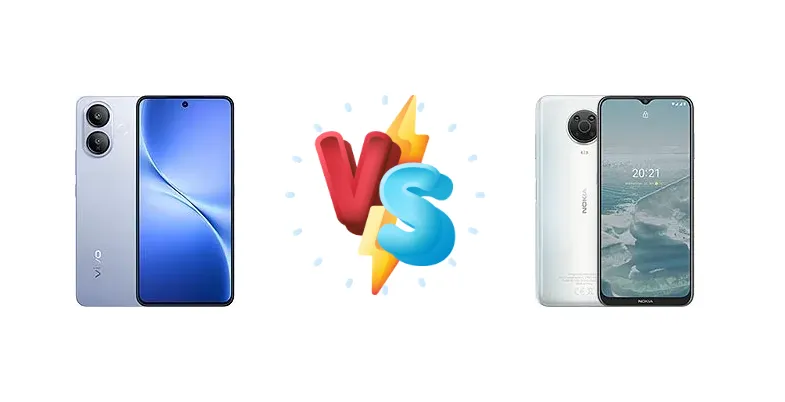
The sub-$200 smartphone market is fiercely competitive. The vivo V60 Lite 4G and Nokia G20 both aim to deliver essential smartphone functionality at an accessible price, but they take drastically different approaches to achieving this. The V60 Lite prioritizes processing power with a modern Snapdragon chipset, while the G20 focuses on a larger display and a more conservative, efficiency-focused processor. This comparison dissects these choices to determine which phone best suits your needs.
🏆 Quick Verdict
For the average user prioritizing responsiveness and future-proofing, the vivo V60 Lite 4G is the clear winner. Its Snapdragon 685 chipset offers significantly better performance than the Nokia G20’s Helio G35, and the 90W fast charging is a game-changer. While the G20 offers a larger display, the performance gap is too substantial to ignore.
| Network |
|---|
| 2G bands | GSM 850 / 900 / 1800 / 1900 | GSM 850 / 900 / 1800 / 1900 |
| 3G bands | HSDPA 850 / 900 / 2100 | HSDPA 850 / 900 / 1900 / 2100 - International |
| 4G bands | 1, 3, 5, 7, 8, 20, 28, 38, 40, 41 | 1, 3, 5, 7, 8, 20, 28, 38, 40, 41 - International |
| Speed | HSPA, LTE | HSPA 42.2/5.76 Mbps, LTE Cat4 150/50 Mbps |
| Technology | GSM / HSPA / LTE | GSM / HSPA / LTE |
| | - | 1, 2, 3, 4, 5, 7, 8, 12, 17, 28, 66 - LATAM |
| Launch |
|---|
| Announced | 2025, September 25 | 2021, April 08 |
| Status | Available. Released 2025, October 08 | Available. Released 2021, May 17 |
| Body |
|---|
| Build | Glass front, plastic back, plastic frame | - |
| Dimensions | 163.8 x 76.3 x 7.6 mm (6.45 x 3.00 x 0.30 in) | 164.9 x 76 x 9.2 mm (6.49 x 2.99 x 0.36 in) |
| SIM | Nano-SIM + Nano-SIM | · Nano-SIM· Nano-SIM + Nano-SIM |
| Weight | 194 g (6.84 oz) | 197 g (6.95 oz) |
| | - | Splash protection |
| Display |
|---|
| Resolution | 1080 x 2392 pixels (~388 ppi density) | 720 x 1600 pixels, 20:9 ratio (~269 ppi density) |
| Size | 6.77 inches, 110.9 cm2 (~88.7% screen-to-body ratio) | 6.52 inches, 102.6 cm2 (~81.9% screen-to-body ratio) |
| Type | AMOLED, 1B colors, 120Hz | IPS LCD |
| Platform |
|---|
| CPU | Octa-core (4x2.8 GHz Cortex-A73 & 4x1.9 GHz Cortex-A53) | Octa-core (4x2.3 GHz Cortex-A53 & 4x1.8 GHz Cortex-A53) |
| Chipset | Qualcomm SM6225 Snapdragon 685 (6 nm) | Mediatek MT6765G Helio G35 (12 nm) |
| GPU | Adreno 610 | PowerVR GE8320 |
| OS | Android 15, Funtouch 15 | Android 11, upgradable to Android 13 |
| Memory |
|---|
| Card slot | No | microSDXC (dedicated slot) |
| Internal | 128GB 8GB RAM, 256GB 8GB RAM | 64GB 4GB RAM, 128GB 4GB RAM |
| Main Camera |
|---|
| Dual | 50 MP, f/1.8, (wide), 1/1.95", 0.8µm, PDAF
8 MP, f/2.2, 120˚ (ultrawide) | - |
| Features | Ring-LED flash, panorama, HDR | LED flash, HDR, panorama |
| Quad | - | 48 MP, f/1.8, (wide), PDAF
5 MP, (ultrawide)
2 MP (macro)
Auxiliary lens |
| Single | - | 8 MP, (wide) |
| Video | 1080p@30fps | 1080p@30fps |
| Selfie camera |
|---|
| Single | 32 MP, f/2.5, (wide), 1/3.1" | 8 MP, (wide) |
| Video | 1080p@30fps | 1080p@30fps |
| Sound |
|---|
| 3.5mm jack | - | Yes |
| 35mm jack | No | Yes |
| Loudspeaker | Yes, with stereo speakers | Yes |
| Comms |
|---|
| Bluetooth | 5.0, A2DP, LE | 5.0, A2DP, LE |
| NFC | Yes (market/region dependent) | Yes (market/region dependent) |
| Positioning | GPS, GLONASS, GALILEO, BDS, QZSS | GPS, GLONASS, BDS |
| Radio | No | FM radio |
| USB | USB Type-C 2.0, OTG | USB Type-C 2.0, OTG |
| WLAN | Wi-Fi 802.11 a/b/g/n/ac, dual-band | Wi-Fi 802.11 b/g/n |
| Features |
|---|
| Sensors | Fingerprint (under display, optical), accelerometer, gyro, proximity, compass | Fingerprint (side-mounted), accelerometer, gyro, proximity |
| Battery |
|---|
| Charging | 90W wired, 100% in 55 min
6W reverse wired
Bypass charging | 10W wired |
| Type | Si/C Li-Ion 6500 mAh | Li-Po 5050 mAh |
| Misc |
|---|
| Colors | Black, Blue | Glacier, Night |
| Models | V2530 | TA-1336, TA-1343, TA-1347, TA-1372, TA-1365 |
| Price | About 450 EUR | About 90 EUR |
| SAR | - | 1.01 W/kg (head) 1.02 W/kg (body) |
| SAR EU | - | 0.49 W/kg (head) 1.13 W/kg (body) |
vivo V60 Lite 4G
- Significantly faster Snapdragon 685 processor
- Ultra-fast 90W charging (0-100% in 55 minutes)
- More efficient 6nm chipset for better battery life under load
- Battery capacity unspecified, potentially smaller than Nokia G20
- Camera specifications not fully detailed
Nokia G20
- Large 5000mAh battery for potentially longer standby time
- Larger 6.5-inch display
- More affordable price point (likely)
- Slow 10W charging
- Underpowered MediaTek Helio G35 processor
- 12nm process node leads to lower efficiency and potential throttling
Display Comparison
While both phones feature displays suitable for everyday tasks, the Nokia G20 boasts a larger 6.5-inch panel compared to the vivo V60 Lite 4G’s size (unspecified, but likely around 6.5-6.6 inches based on market positioning). However, display quality extends beyond size. The V60 Lite, being a newer device, likely benefits from improved color accuracy and brightness. The Nokia G20’s panel, while large, is likely to be less vibrant and may struggle in direct sunlight. Neither manufacturer specifies refresh rates, suggesting both operate at the standard 60Hz.
Camera Comparison
Both phones likely feature multi-camera setups, but the specifics beyond the main sensor are less critical. The V60 Lite 4G’s camera specifications are not provided, but given its positioning, it likely features a more capable primary sensor than the Nokia G20. The G20’s camera details are also limited, and the inclusion of 2MP macro and depth sensors adds little practical value. Image processing algorithms will also play a role, and Qualcomm’s ISP (Image Signal Processor) within the Snapdragon 685 is generally more advanced than MediaTek’s equivalent in the Helio G35, resulting in better dynamic range and noise reduction.
Performance
The core difference lies in the chipsets. The vivo V60 Lite 4G’s Qualcomm Snapdragon 685 (6nm) is a substantial upgrade over the Nokia G20’s MediaTek Helio G35 (12nm). The 6nm process node of the Snapdragon 685 translates to significantly improved power efficiency and thermal performance, meaning less throttling during sustained tasks. The Snapdragon 685’s CPU configuration – Octa-core (4x2.8 GHz Cortex-A73 & 4x1.9 GHz Cortex-A53) – is also more powerful than the G20’s Octa-core (4x2.3 GHz Cortex-A53 & 4x1.8 GHz Cortex-A53). The Cortex-A73 cores in the V60 Lite provide a noticeable performance boost in CPU-intensive applications. The G35, while adequate for basic tasks, will struggle with demanding games or heavy multitasking.
Battery Life
The Nokia G20 features a large 5000mAh battery, aiming for extended battery life. However, the vivo V60 Lite 4G compensates for a potentially smaller battery (specifications unavailable) with its incredibly fast 90W wired charging. This allows for a full charge in just 55 minutes, a massive advantage over the G20’s slow 10W charging. The Snapdragon 685’s superior power efficiency also contributes to better real-world battery performance, potentially offsetting any capacity difference. The V60 Lite also offers 6W reverse wired charging, a feature absent on the G20.
Buying Guide
Buy the vivo V60 Lite 4G if you need a phone that can handle multitasking, moderate gaming, and benefit from significantly faster charging speeds. This is the phone for users who want a smooth experience and don't want to wait hours for a full charge. Buy the Nokia G20 if you prioritize a larger screen for media consumption and prefer a simpler, more basic smartphone experience, and are willing to trade performance for potentially longer battery life in light usage scenarios.
Frequently Asked Questions
❓ Will the Nokia G20 struggle with popular social media apps like TikTok and Instagram?
The MediaTek Helio G35 in the Nokia G20 is a basic processor. While it can run these apps, you may experience noticeable lag and slowdowns, especially when multitasking or using the apps for extended periods. The vivo V60 Lite 4G’s Snapdragon 685 will provide a much smoother and more responsive experience.
❓ How much faster is the 90W charging on the vivo V60 Lite 4G compared to the Nokia G20’s 10W charging in real-world use?
The difference is dramatic. The vivo V60 Lite 4G can go from 0% to 100% in approximately 55 minutes. The Nokia G20, with its 10W charging, will take several hours – likely over 3-4 hours – to achieve a full charge. This means you can quickly top up the V60 Lite during short breaks, while the G20 requires overnight charging.
❓ Is the Nokia G20 a good choice for mobile gaming?
The Nokia G20 is not well-suited for mobile gaming. The Helio G35 processor lacks the graphical power to run demanding games smoothly, even at lower settings. You’ll likely experience significant frame rate drops and lag. The vivo V60 Lite 4G, while not a gaming powerhouse, will offer a considerably better gaming experience.