
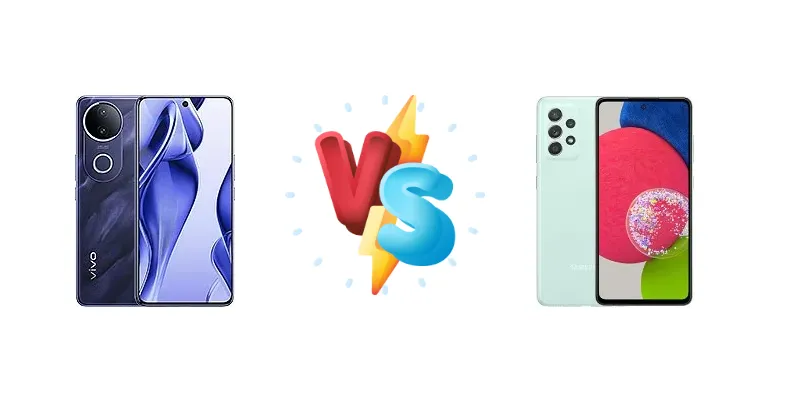
vivo V50e vs. Samsung Galaxy A52s 5G: A Detailed Comparison
| Phones Images | |||||
|---|---|---|---|---|---|
|
🏆 Quick Verdict
For the average user prioritizing rapid charging and potentially better long-term performance, the vivo V50e is the stronger choice. Its 90W charging significantly outperforms the A52s 5G’s 25W, and the Dimensity 7300 offers a newer architecture. However, the A52s 5G remains a very capable device, particularly for those valuing proven battery life and a mature software experience.
| PHONES | ||
|---|---|---|
| Phone Names | vivo V50e | Samsung Galaxy A52s 5G |
| Network | ||
|---|---|---|
| 2G bands | GSM 850 / 900 / 1800 / 1900 | GSM 850 / 900 / 1800 / 1900 |
| 3G bands | HSDPA 850 / 900 / 1900 / 2100 | HSDPA 850 / 900 / 1700(AWS) / 1900 / 2100 |
| 4G bands | 1, 3, 5, 8, 18, 19, 26, 28, 38, 40, 41, 42 | 1, 2, 3, 4, 5, 7, 8, 12, 17, 20, 26, 28, 32, 38, 40, 41, 66 |
| 5G bands | 1, 3, 5, 8, 26, 28, 40, 77, 78 SA/NSA | 1, 3, 5, 7, 8, 20, 28, 38, 40, 41, 66, 78 SA/NSA/Sub6 |
| Speed | HSPA, LTE, 5G | HSPA 42.2/5.76 Mbps, LTE Cat18 1200/150 Mbps, 5G |
| Technology | GSM / HSPA / LTE / 5G | GSM / HSPA / LTE / 5G |
| Launch | ||
|---|---|---|
| Announced | 2025, April 10 | 2021, August 17 |
| Status | Available. Released 2025, April 17 | Available. Released 2021, September 01 |
| Body | ||
|---|---|---|
| Build | Glass front, plastic back | Glass front (Gorilla Glass 5), plastic back |
| Dimensions | 163.3 x 76.7 x 7.4 mm or 7.6 mm | 159.9 x 75.1 x 8.4 mm (6.30 x 2.96 x 0.33 in) |
| SIM | Nano-SIM + Nano-SIM | · Nano-SIM· Nano-SIM + Nano-SIM |
| Weight | 186 g (6.56 oz) | 189 g (6.67 oz) |
| - | IP67 dust/water resistant (up to 1m for 30 min) | |
| Display | ||
|---|---|---|
| Protection | Diamond Shield Glass | Corning Gorilla Glass 5 |
| Resolution | 1080 x 2392 pixels (~388 ppi density) | 1080 x 2400 pixels, 20:9 ratio (~405 ppi density) |
| Size | 6.77 inches, 110.9 cm2 (~88.5% screen-to-body ratio) | 6.5 inches, 102.0 cm2 (~84.9% screen-to-body ratio) |
| Type | AMOLED, 1B colors, 120Hz, HDR10+, 1800 nits (peak) | Super AMOLED, 120Hz, 800 nits (HBM) |
| Platform | ||
|---|---|---|
| CPU | Octa-core (4x2.5 GHz Cortex-A78 & 4x2.0 GHz Cortex-A55) | Octa-core (1x2.4 GHz Cortex-A78 & 3x2.2 GHz Cortex-A78 & 4x1.9 GHz Cortex-A55) |
| Chipset | Mediatek Dimensity 7300 (4 nm) | Qualcomm SM7325 Snapdragon 778G 5G (6 nm) |
| GPU | Mali-G615 MC2 | Adreno 642L |
| OS | Android 15, Funtouch 15 | Android 11, upgradable to Android 14, One UI 6 |
| Memory | ||
|---|---|---|
| Card slot | No | microSDXC (uses shared SIM slot) |
| Internal | 128GB 8GB RAM, 256GB 8GB RAM | 128GB 4GB RAM, 128GB 6GB RAM, 128GB 8GB RAM, 256GB 6GB RAM, 256GB 8GB RAM |
| Main Camera | ||
|---|---|---|
| Dual | 50 MP, f/1.8, (wide), 1/1.95", 0.8µm, PDAF, OIS 8 MP, f/2.2, 116˚ (ultrawide) | - |
| Features | Ring-LED flash, panorama, HDR | LED flash, panorama, HDR |
| Quad | - | 64 MP, f/1.8, 26mm (wide), 1/1.7", 0.8µm, PDAF, OIS 12 MP, f/2.2, 123˚ (ultrawide), 1.12µm 5 MP (macro) Auxiliary lens |
| Single | - | 32 MP, f/2.2, 26mm (wide), 1/2.8", 0.8µm |
| Video | 4K, 1080p, HDR, gyro-EIS, OIS | 4K@30fps, 1080p@30/60fps; gyro-EIS |
| Selfie camera | ||
|---|---|---|
| Features | - | HDR |
| Single | 50 MP, f/2.0, 22mm (wide), 1/2.76", 0.64µm, AF | 32 MP, f/2.2, 26mm (wide), 1/2.8", 0.8µm |
| Video | 4K, 1080p | 4K@30fps, 1080p@30/60fps |
| Sound | ||
|---|---|---|
| 3.5mm jack | - | Yes |
| 35mm jack | No | Yes |
| Loudspeaker | Yes, with stereo speakers | Yes, with stereo speakers |
| Comms | ||
|---|---|---|
| Bluetooth | Yes | 5.0, A2DP, LE |
| NFC | No | Yes (market/region dependent) |
| Positioning | GPS, GALILEO, GLONASS, BDS, QZSS | GPS, GLONASS, GALILEO, BDS, QZSS |
| Radio | No | No |
| USB | USB Type-C 2.0, OTG | USB Type-C 2.0, OTG |
| WLAN | Yes | Wi-Fi 802.11 a/b/g/n/ac/6, dual-band, Wi-Fi Direct |
| Features | ||
|---|---|---|
| Sensors | Fingerprint (under display, optical), accelerometer, gyro, proximity, compass | Fingerprint (under display, optical), accelerometer, gyro, compass |
| - | Virtual Proximity Sensing | |
| Battery | ||
|---|---|---|
| Charging | 90W wired Reverse wired | 25W wired |
| Type | Li-Ion 5600 mAh | Li-Ion 4500 mAh |
| Misc | ||
|---|---|---|
| Colors | Sapphire Blue, Pearl White | Awesome Black, Awesome White, Awesome Purple, Awesome Mint |
| Models | V2428 | SM-A528B, SM-A528B/DS, SM-A528N |
| Price | € 249.70 / ₹ 24,999 | £ 112.98 / € 249.47 |
| SAR | 0.99 W/kg (head) 0.87 W/kg (body) | 0.72 W/kg (head) |
| SAR EU | - | 0.88 W/kg (head) 0.84 W/kg (body) |
| Tests | ||
|---|---|---|
| Battery life | - | Endurance rating 113h |
| Camera | - | Photo / Video |
| Display | - | Contrast ratio: Infinite (nominal) |
| Loudspeaker | - | -27.5 LUFS (Good) |
| Performance | - | AnTuTu: 429675 (v8), 506432(v9) GeekBench: 11060 (v4.4), 2801 (v5.1) GFXBench: 28fps (ES 3.1 onscreen) |
vivo V50e
- Blazing-fast 90W charging
- Newer Mediatek Dimensity 7300 chipset
- Potentially better power efficiency with 4nm process
- Battery capacity not specified
- Camera performance unproven
Samsung Galaxy A52s 5G
- Proven 113-hour battery endurance
- Reliable Snapdragon 778G 5G chipset
- Well-regarded display with 800 nits brightness
- Slower 25W charging
- Older chipset architecture
Display Comparison
The Samsung Galaxy A52s 5G boasts a measured peak brightness of 800 nits, ensuring good visibility outdoors. While the vivo V50e’s display specifications are not provided, it’s reasonable to expect a similar brightness level given its market positioning. Both displays feature an 'Infinite' (Samsung) contrast ratio, typical for AMOLED panels. The A52s 5G’s display technology is well-regarded, but without specifics on the V50e’s panel type (LTPO, refresh rate), it’s difficult to definitively declare a winner. The A52s 5G’s established performance in real-world viewing conditions gives it a slight edge.
Camera Comparison
Both devices offer photo and video capabilities, but detailed camera specifications are limited. Without sensor size information or aperture details, a direct comparison is challenging. The A52s 5G’s camera system has a strong reputation for producing balanced and accurate images. The V50e’s camera performance will depend heavily on its image processing algorithms and sensor quality, which are currently unknown. It’s crucial to avoid focusing on the often-underperforming 2MP macro lenses found on both devices; the primary sensor and image processing are far more important.
Performance
The vivo V50e’s Mediatek Dimensity 7300 (4nm) and the Samsung Galaxy A52s 5G’s Qualcomm Snapdragon 778G 5G (6nm) represent different approaches to mid-range performance. The Dimensity 7300’s 4nm process should offer improved power efficiency compared to the 6nm Snapdragon 778G, potentially leading to better sustained performance and reduced thermal throttling. The CPU configuration differs significantly: the V50e utilizes 4x2.5 GHz Cortex-A78 cores alongside 4x2.0 GHz Cortex-A55 cores, while the A52s 5G has 1x2.4 GHz Cortex-A78, 3x2.2 GHz Cortex-A78, and 4x1.9 GHz Cortex-A55 cores. The V50e’s newer architecture and potentially more efficient process give it a theoretical advantage in both single-core and multi-core tasks, especially in demanding applications. However, the A52s 5G’s Snapdragon 778G is a proven performer with excellent GPU capabilities.
Battery Life
The Samsung Galaxy A52s 5G has an endurance rating of 113 hours, indicating solid battery life. The vivo V50e’s battery capacity is not specified, but its 90W wired charging is a significant advantage. This allows for incredibly fast top-ups – potentially a full charge in under 40 minutes. While the A52s 5G’s 25W charging is adequate, it’s considerably slower. The V50e’s charging speed effectively mitigates any potential disadvantage from a smaller battery capacity, making it more convenient for users who frequently need to recharge.
Buying Guide
Buy the vivo V50e if you need incredibly fast charging, prioritize a newer processor for future-proofing, and frequently find yourself needing to top up your battery quickly. Buy the Samsung Galaxy A52s 5G if you prefer a phone with a well-established track record for battery endurance, a known and reliable chipset, and a potentially more refined software experience based on Samsung’s One UI.