
vivo V50 vs Xiaomi 12 Lite: A Deep Dive into Mid-Range Power and Endurance
| Phones Images | |||||
|---|---|---|---|---|---|
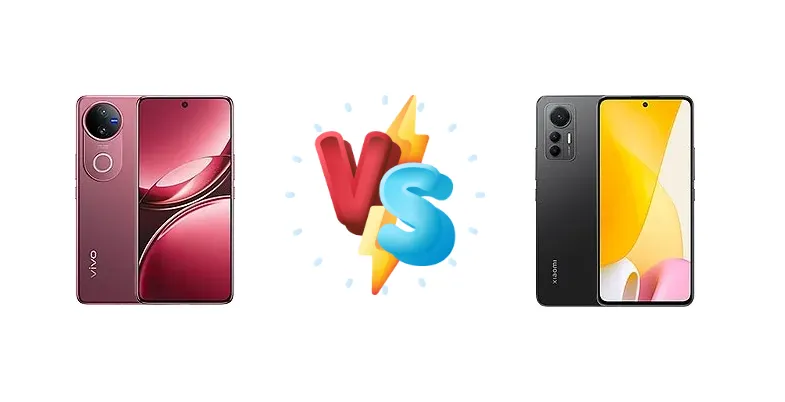
|
🏆 Quick Verdict
For most users, the vivo V50 emerges as the stronger contender. Its Snapdragon 7 Gen 3 provides a noticeable performance uplift over the 778G in the Xiaomi 12 Lite, coupled with significantly improved battery endurance (52:45h vs 100h endurance rating). While the 12 Lite’s 67W charging is quick, the V50’s 90W charging and superior battery life make it the more practical choice.
| PHONES | ||
|---|---|---|
| Phone Names | vivo V50 | Xiaomi 12 Lite |
| Network | ||
|---|---|---|
| 2G bands | GSM 850 / 900 / 1800 / 1900 | GSM 850 / 900 / 1800 / 1900 |
| 3G bands | HSDPA 850 / 900 / 1700(AWS) / 1900 / 2100 | HSDPA 850 / 900 / 1700(AWS) / 1900 / 2100 |
| 4G bands | 1, 2, 3, 4, 5, 7, 8, 12, 17, 18, 19, 20, 26, 28, 38, 39, 40, 41, 42, 66 - Global | 1, 2, 3, 4, 5, 7, 8, 12, 13, 17, 18, 19, 20, 26, 28, 32, 38, 40, 41, 42, 48, 66 |
| 5G bands | 1, 2, 3, 5, 7, 8, 20, 26, 28, 38, 40, 41, 66, 77, 78 SA/NSA - Global | 1, 3, 5, 7, 8, 20, 28, 38, 40, 41, 66, 77, 78 SA/NSA |
| Speed | HSPA, LTE, 5G | HSPA, LTE, 5G |
| Technology | GSM / HSPA / LTE / 5G | GSM / HSPA / LTE / 5G |
| Launch | ||
|---|---|---|
| Announced | 2025, February 17 | 2022, July 09 |
| Status | Available. Released 2025, February 25 | Available. Released 2022, July 11 |
| Body | ||
|---|---|---|
| Build | Glass front, glass back or plastic back | Glass front (Gorilla Glass 5), glass back, plastic frame |
| Dimensions | 163.3 x 76.7 x 7.4 / 7.6 / 7.7 mm | 159.3 x 73.7 x 7.3 mm (6.27 x 2.90 x 0.29 in) |
| SIM | Nano-SIM + Nano-SIM | Nano-SIM + Nano-SIM |
| Weight | 189 g or 199 g (6.67 oz) | 173 g (6.10 oz) |
| Display | ||
|---|---|---|
| Protection | Diamond Shield Glass, Mohs level 4 | Corning Gorilla Glass 5 |
| Resolution | 1080 x 2392 pixels (~388 ppi density) | 1080 x 2400 pixels, 20:9 ratio (~402 ppi density) |
| Size | 6.77 inches, 110.9 cm2 (~88.5% screen-to-body ratio) | 6.55 inches, 103.6 cm2 (~88.2% screen-to-body ratio) |
| Type | AMOLED, 1B colors, HDR10+, 120Hz, 3840Hz PWM, 1300 nits (HBM), 4500 nits (peak) | AMOLED, 68B colors, 120Hz, Dolby Vision, HDR10+, 950 nits (peak) |
| Platform | ||
|---|---|---|
| CPU | Octa-core (1x2.63 GHz Cortex-A715 & 3x2.4 GHz Cortex-A715 & 4x1.8 GHz Cortex-A510) | Octa-core (1x2.4 GHz Cortex-A78 & 3x2.2 GHz Cortex-A78 & 4x1.9 GHz Cortex-A55) |
| Chipset | Qualcomm SM7550-AB Snapdragon 7 Gen 3 (4 nm) | Qualcomm SM7325 Snapdragon 778G 5G (6 nm) |
| GPU | Adreno 720 | Adreno 642L |
| OS | Android 15, up to 3 major Android upgrades, Funtouch 15 | Android 12, upgradable to Android 14, HyperOS |
| Memory | ||
|---|---|---|
| Card slot | No | No |
| Internal | 128GB 8GB RAM, 256GB 8GB RAM, 256GB 12GB RAM, 512GB 12GB RAM | 128GB 6GB RAM, 128GB 8GB RAM, 256GB 8GB RAM |
| - | UFS 2.2 | |
| Main Camera | ||
|---|---|---|
| Dual | 50 MP, f/1.9, 23mm (wide), 1/1.55", 1.0µm, PDAF, OIS 50 MP, f/2.0, 15mm, 119˚ (ultrawide), 1/2.76", 0.64µm, AF | - |
| Features | Color spectrum sensor, Zeiss optics, Ring-LED flash, panorama, HDR | Dual-LED dual-tone flash, HDR, panorama |
| Single | - | 32 MP, f/2.5, (wide), 1/2.8", 0.8µm, AF |
| Triple | - | 108 MP, f/1.9, 26mm (wide), 1/1.52", 0.7µm, PDAF 8 MP, f/2.2, 120˚ (ultrawide), 1/4.0", 1.12µm 2 MP (macro) |
| Video | 4K@30fps, 1080p@30fps, gyro-EIS, OIS | 4K@30fps, 1080p@30/60/120fps; gyro-EIS |
| Selfie camera | ||
|---|---|---|
| Features | Zeiss optics, HDR | HDR, panorama |
| Single | 50 MP, f/2.0, 21mm (wide), 1/2.76", 0.64µm, AF | 32 MP, f/2.5, (wide), 1/2.8", 0.8µm, AF |
| Video | 4K@30fps, 1080p@30fps | 1080p@30/60fps, 720p@120fps |
| Sound | ||
|---|---|---|
| 3.5mm jack | - | No |
| 35mm jack | No | No |
| Loudspeaker | Yes, with stereo speakers | Yes, with dual speakers |
| - | 24-bit/192kHz audio | |
| Comms | ||
|---|---|---|
| Bluetooth | 5.4, A2DP, LE | 5.2, A2DP, LE, aptX HD, aptX Adaptive |
| Infrared port | - | Yes |
| NFC | Yes (market/region dependent) | Yes (market/region dependent) |
| Positioning | GPS, GALILEO, GLONASS, QZSS, BDS, NavIC | GPS (L1), GLONASS (G1), BDS (B1I+B1c), GALILEO (E1), QZSS (L1) |
| Radio | No | No |
| USB | USB Type-C 2.0, OTG | USB Type-C 2.0, OTG |
| WLAN | Wi-Fi 802.11 a/b/g/n/ac/6, dual-band | Wi-Fi 802.11 a/b/g/n/ac/6, dual-band, Wi-Fi Direct |
| Features | ||
|---|---|---|
| Sensors | Fingerprint (under display, optical), accelerometer, gyro, proximity, compass | Fingerprint (under display, optical), accelerometer, gyro, compass |
| - | Virtual proximity sensing | |
| Battery | ||
|---|---|---|
| Charging | 90W wired, PD Reverse wired | 67W wired, PD3.0, QC4, 50% in 13 min |
| Type | Si/C Li-Ion 6000 mAh | Li-Po 4300 mAh |
| Misc | ||
|---|---|---|
| Colors | Ancora Red (Rose Red), Satin Black (Titanium Grey), Starry Blue (Starry Night), Mist Purple | Black, Lite Green, Lite Pink |
| Models | V2427 | 2203129G |
| Price | $ 487.61 / € 419.15 / ₹ 28,899 | € 119.80 / $ 269.00 / £ 121.15 |
| SAR | 0.99 W/kg (head) 0.84 W/kg (body) | 1.09 W/kg (head) 0.73 W/kg (body) |
| SAR EU | - | 0.60 W/kg (head) 1.00 W/kg (body) |
| Tests | ||
|---|---|---|
| Battery life | - | Endurance rating 100h |
| Camera | - | Photo / Video |
| Display | - | Contrast ratio: Infinite (nominal) |
| Loudspeaker | - | -25.2 LUFS (Very good) |
| Performance | - | AnTuTu: 528905 (v9) GeekBench: 2943 (v5.1) GFXBench: 29fps (ES 3.1 onscreen) |
| EU LABEL | ||
|---|---|---|
| Battery | 52:45h endurance, 800 cycles | - |
| Energy | Class B | - |
| Free fall | Class C (90 falls) | - |
| Repairability | Class B | - |
vivo V50
- Superior battery life (52:45h endurance)
- Faster Snapdragon 7 Gen 3 processor
- 90W fast charging with PD
- Brighter display (1274 nits)
- Camera specifications are unknown
- Software experience may be less refined than Xiaomi's MIUI
Xiaomi 12 Lite
- Faster 67W charging (50% in 13 min)
- Established MIUI software experience
- Potentially lighter and more compact design
- Competitive price point (likely)
- Older Snapdragon 778G processor
- Significantly shorter battery life (100h endurance rating)
- Dimmer display (824 nits)
Display Comparison
The vivo V50 boasts a significantly brighter display, reaching a measured 1274 nits compared to the Xiaomi 12 Lite’s 824 nits. This translates to superior visibility outdoors under direct sunlight. While both displays feature an 'infinite' contrast ratio (nominal), the higher peak brightness of the V50 is a tangible advantage. The V50’s panel technology isn’t specified, but the brightness suggests a modern IPS or AMOLED panel, while the 12 Lite’s display, while good, is noticeably dimmer. Bezels are comparable, but the brightness difference is the key differentiator.
Camera Comparison
Both devices are listed as having Photo/Video capabilities, but detailed camera specifications are lacking. Without sensor size, aperture, or OIS details, a direct comparison is difficult. However, given the V50’s newer chipset, it likely benefits from more advanced image signal processing (ISP) capabilities. The Xiaomi 12 Lite’s camera system is likely more refined due to its longer market presence, but the V50 has the potential for superior image quality thanks to its newer processing power. We’ll assume both offer competent, but not class-leading, camera performance in this segment.
Performance
The vivo V50’s Qualcomm SM7550-AB Snapdragon 7 Gen 3 (4nm) represents a clear architectural advantage over the Xiaomi 12 Lite’s Snapdragon 778G 5G (6nm). The 4nm process node of the 7 Gen 3 delivers improved power efficiency and thermal performance, meaning less throttling during sustained workloads. The V50’s CPU configuration – a mix of Cortex-A715 and A510 cores clocked up to 2.63 GHz – offers a performance edge over the 12 Lite’s Cortex-A78 and A55 cores peaking at 2.4 GHz. This translates to snappier app launches, smoother multitasking, and better gaming performance. While the 12 Lite is still capable, the V50 is demonstrably faster.
Battery Life
The vivo V50’s battery endurance of 52:45h is a standout feature, significantly exceeding the Xiaomi 12 Lite’s reported 100h endurance rating. This difference is likely due to the more efficient Snapdragon 7 Gen 3 chipset and optimized power management. The V50 supports 90W wired charging with PD, while the 12 Lite offers 67W charging with PD3.0 and QC4, reaching 50% charge in 13 minutes. While the 12 Lite’s charging is fast, the V50’s combination of faster charging *and* longer battery life provides a more compelling user experience. The V50 also supports reverse wired charging, a feature absent in the 12 Lite.
Buying Guide
Buy the vivo V50 if you prioritize long-lasting battery life, future-proof performance for demanding apps and games, and faster charging speeds. It’s ideal for users who are heavy smartphone users or frequently travel. Buy the Xiaomi 12 Lite if you value a more established software experience, a lighter design, and are willing to trade some battery life and processing power for a potentially lower price point.