
vivo V50 vs. Samsung Galaxy A53 5G: A Deep Dive into Mid-Range Champions
| Phones Images | |||||
|---|---|---|---|---|---|
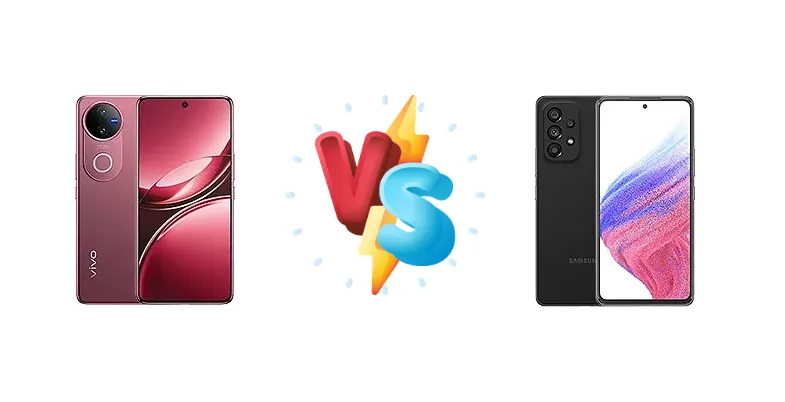
|
🏆 Quick Verdict
For most users, the vivo V50 emerges as the stronger contender. Its Snapdragon 7 Gen 3 chipset offers a noticeable performance uplift over the Exynos 1280, and the 90W charging is a game-changer. While the A53 5G has a longer history, the V50’s modern features and efficiency give it the edge.
| PHONES | ||
|---|---|---|
| Phone Names | vivo V50 | Samsung Galaxy A53 5G |
| Network | ||
|---|---|---|
| 2G bands | GSM 850 / 900 / 1800 / 1900 | GSM 850 / 900 / 1800 / 1900 |
| 3G bands | HSDPA 850 / 900 / 1700(AWS) / 1900 / 2100 | HSDPA 850 / 900 / 1700(AWS) / 1900 / 2100 |
| 4G bands | 1, 2, 3, 4, 5, 7, 8, 12, 17, 18, 19, 20, 26, 28, 38, 39, 40, 41, 42, 66 - Global | 1, 2, 3, 4, 5, 7, 12, 14, 20, 29, 30, 38, 39, 40, 41, 46, 48, 66 - SM-A536U |
| 5G bands | 1, 2, 3, 5, 7, 8, 20, 26, 28, 38, 40, 41, 66, 77, 78 SA/NSA - Global | 2, 5, 41, 66, 77, 78 SA/NSA/Sub6/mmWave - SM-A536U |
| Speed | HSPA, LTE, 5G | HSPA, LTE, 5G |
| Technology | GSM / HSPA / LTE / 5G | GSM / HSPA / LTE / 5G |
| - | 2, 5, 48, 66, 77, 78, 260, 261 SA/NSA/Sub6/mmWave - SM-A536V | |
| Launch | ||
|---|---|---|
| Announced | 2025, February 17 | 2022, March 17 |
| Status | Available. Released 2025, February 25 | Available. Released 2022, March 24 |
| Body | ||
|---|---|---|
| Build | Glass front, glass back or plastic back | Glass front (Gorilla Glass 5), plastic frame, plastic back |
| Dimensions | 163.3 x 76.7 x 7.4 / 7.6 / 7.7 mm | 159.6 x 74.8 x 8.1 mm (6.28 x 2.94 x 0.32 in) |
| SIM | Nano-SIM + Nano-SIM | · Nano-SIM· Nano-SIM + Nano-SIM |
| Weight | 189 g or 199 g (6.67 oz) | 189 g (6.67 oz) |
| - | IP67 dust/water resistant (up to 1m for 30 min) | |
| Display | ||
|---|---|---|
| Protection | Diamond Shield Glass, Mohs level 4 | Corning Gorilla Glass 5 |
| Resolution | 1080 x 2392 pixels (~388 ppi density) | 1080 x 2400 pixels, 20:9 ratio (~405 ppi density) |
| Size | 6.77 inches, 110.9 cm2 (~88.5% screen-to-body ratio) | 6.5 inches, 102.0 cm2 (~85.4% screen-to-body ratio) |
| Type | AMOLED, 1B colors, HDR10+, 120Hz, 3840Hz PWM, 1300 nits (HBM), 4500 nits (peak) | Super AMOLED, 120Hz, 800 nits (HBM) |
| Platform | ||
|---|---|---|
| CPU | Octa-core (1x2.63 GHz Cortex-A715 & 3x2.4 GHz Cortex-A715 & 4x1.8 GHz Cortex-A510) | Octa-core (2x2.4 GHz Cortex-A78 & 6x2.0 GHz Cortex-A55) |
| Chipset | Qualcomm SM7550-AB Snapdragon 7 Gen 3 (4 nm) | Exynos 1280 (5 nm) |
| GPU | Adreno 720 | Mali-G68 |
| OS | Android 15, up to 3 major Android upgrades, Funtouch 15 | Android 12, up to 4 major Android upgrades, One UI 8 |
| Memory | ||
|---|---|---|
| Card slot | No | microSDXC (uses shared SIM slot) |
| Internal | 128GB 8GB RAM, 256GB 8GB RAM, 256GB 12GB RAM, 512GB 12GB RAM | 128GB 4GB RAM, 128GB 6GB RAM, 128GB 8GB RAM, 256GB 6GB RAM, 256GB 8GB RAM |
| Main Camera | ||
|---|---|---|
| Dual | 50 MP, f/1.9, 23mm (wide), 1/1.55", 1.0µm, PDAF, OIS 50 MP, f/2.0, 15mm, 119˚ (ultrawide), 1/2.76", 0.64µm, AF | - |
| Features | Color spectrum sensor, Zeiss optics, Ring-LED flash, panorama, HDR | LED flash, panorama, HDR |
| Quad | - | 64 MP, f/1.8, 26mm (wide), 1/1.7X", 0.8µm, PDAF, OIS 12 MP, f/2.2, 123˚ (ultrawide), 1.12µm 5 MP (macro) Auxiliary lens |
| Single | - | 32 MP, f/2.2, 26mm (wide), 1/2.8", 0.8µm |
| Video | 4K@30fps, 1080p@30fps, gyro-EIS, OIS | 4K@30fps, 1080p@30/60fps; gyro-EIS |
| Selfie camera | ||
|---|---|---|
| Features | Zeiss optics, HDR | HDR |
| Single | 50 MP, f/2.0, 21mm (wide), 1/2.76", 0.64µm, AF | 32 MP, f/2.2, 26mm (wide), 1/2.8", 0.8µm |
| Video | 4K@30fps, 1080p@30fps | 4K@30fps, 1080p@30fps |
| Sound | ||
|---|---|---|
| 3.5mm jack | - | No |
| 35mm jack | No | No |
| Loudspeaker | Yes, with stereo speakers | Yes, with stereo speakers |
| Comms | ||
|---|---|---|
| Bluetooth | 5.4, A2DP, LE | 5.1, A2DP, LE |
| NFC | Yes (market/region dependent) | Yes (market/region dependent) |
| Positioning | GPS, GALILEO, GLONASS, QZSS, BDS, NavIC | GPS, GLONASS, GALILEO, BDS |
| Radio | No | No |
| USB | USB Type-C 2.0, OTG | USB Type-C 2.0, OTG |
| WLAN | Wi-Fi 802.11 a/b/g/n/ac/6, dual-band | Wi-Fi 802.11 a/b/g/n/ac, dual-band, Wi-Fi Direct |
| Features | ||
|---|---|---|
| Sensors | Fingerprint (under display, optical), accelerometer, gyro, proximity, compass | Fingerprint (under display, optical), accelerometer, gyro, compass, barometer (market/region dependent) |
| - | Virtual proximity sensing | |
| Battery | ||
|---|---|---|
| Charging | 90W wired, PD Reverse wired | 25W wired |
| Type | Si/C Li-Ion 6000 mAh | Li-Po 5000 mAh |
| Misc | ||
|---|---|---|
| Colors | Ancora Red (Rose Red), Satin Black (Titanium Grey), Starry Blue (Starry Night), Mist Purple | Black, White, Blue, Peach |
| Models | V2427 | SM-A536B, SM-A536B/DS, SM-A536U, SM-A536U1, SM-A5360, SM-A536E, SM-A536E/DS, SM-A536V, SM-A536W, SM-A536N, SM-S536DL |
| Price | $ 487.61 / € 419.15 / ₹ 28,899 | $ 151.42 / £ 185.00 / € 169.14 |
| SAR | 0.99 W/kg (head) 0.84 W/kg (body) | 0.75 W/kg (head) 1.58 W/kg (body) |
| SAR EU | - | 0.89 W/kg (head) 1.60 W/kg (body) |
| Tests | ||
|---|---|---|
| Battery life | - | Endurance rating 113h |
| Camera | - | Photo / Video |
| Display | - | Contrast ratio: Infinite (nominal) |
| Loudspeaker | - | -26.5 LUFS (Good) |
| Performance | - | AnTuTu: 329802 (v8), 379313 (v9) GeekBench: 1891 (v5.1) GFXBench: 19fps (ES 3.1 onscreen) |
| EU LABEL | ||
|---|---|---|
| Battery | 52:45h endurance, 800 cycles | - |
| Energy | Class B | - |
| Free fall | Class C (90 falls) | - |
| Repairability | Class B | - |
vivo V50
- Significantly faster 90W charging
- More powerful Snapdragon 7 Gen 3 chipset
- Higher display brightness for outdoor visibility
- Long-term software support is less certain than Samsung
- Camera details are limited in available data
Samsung Galaxy A53 5G
- Established brand reputation and software support
- Proven reliability and user base
- Potentially better color science in photos (based on brand history)
- Slower 25W charging
- Older and less efficient Exynos 1280 chipset
- Lower display brightness
Display Comparison
The vivo V50’s display significantly outshines the Galaxy A53 5G in peak brightness, reaching a measured 1274 nits compared to the A53’s 830 nits. This translates to superior visibility outdoors under direct sunlight. While Samsung boasts an 'Infinite' contrast ratio, this is a marketing term; both phones utilize OLED panels offering excellent contrast. The V50’s higher brightness is particularly beneficial for HDR content consumption, offering a more dynamic and vibrant viewing experience. We lack PWM frequency data for both, but the V50’s newer panel tech *may* offer improvements for flicker sensitivity.
Camera Comparison
Both devices feature capable camera systems, but detailed sensor information beyond 'Photo/Video' is missing for the A53. The A53’s camera is known for its color science, but the V50’s newer image signal processor (ISP) within the Snapdragon 7 Gen 3 likely offers improved noise reduction and dynamic range. Without specific sensor sizes or aperture details for the A53, it’s difficult to make a definitive judgment. The inclusion of a 2MP macro camera on the A53 is largely a marketing gimmick and offers limited practical benefit. The V50’s processing capabilities will likely provide a more versatile and consistently high-quality camera experience.
Performance
The Qualcomm Snapdragon 7 Gen 3 (4nm) in the vivo V50 represents a substantial architectural leap over the Samsung Exynos 1280 (5nm). The Snapdragon utilizes a tri-cluster configuration with Cortex-A715 cores, offering improved single-core and multi-core performance compared to the A53’s Cortex-A78 and A55 cores. The 4nm process node of the Snapdragon also contributes to better thermal efficiency, potentially reducing throttling during sustained workloads like gaming. While both phones likely feature similar RAM configurations, the Snapdragon’s more efficient architecture will result in a smoother, more responsive user experience.
Battery Life
The vivo V50’s 52:45h endurance rating, coupled with 800 charge cycles, is a significant improvement over the Galaxy A53 5G’s 113h endurance. The V50’s active use score of 15:20h further demonstrates its superior battery life. Crucially, the V50 supports 90W wired charging with Power Delivery (PD), allowing for a full charge in a fraction of the time compared to the A53’s 25W charging. This difference in charging speed is a major convenience factor, especially for users who frequently find themselves needing to top up their battery quickly. The V50 also offers reverse wired charging, a feature absent on the A53.
Buying Guide
Buy the vivo V50 if you prioritize performance for gaming and demanding apps, and value incredibly fast charging. You'll benefit from a more responsive experience and less downtime. Buy the Samsung Galaxy A53 5G if you prefer a phone with a well-established software ecosystem, a proven track record for reliability, and are less concerned with having the absolute latest chipset.