
Motorola Moto G200 5G vs vivo V50: A Detailed Comparison of Power and Efficiency
| Phones Images | |||||
|---|---|---|---|---|---|
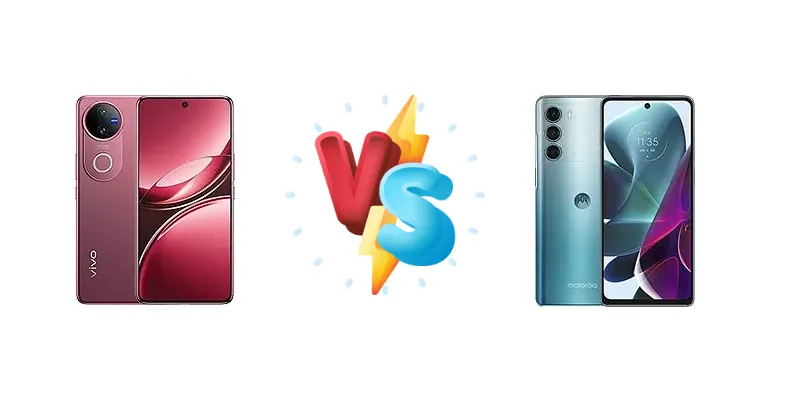
|
🏆 Quick Verdict
For the average user prioritizing long-term battery life and a brighter display, the vivo V50 is the better choice. Its Snapdragon 7 Gen 3 offers excellent performance with superior efficiency, and the 90W charging is a significant advantage. However, power users demanding maximum performance for demanding tasks will still find value in the Motorola Moto G200 5G.
| PHONES | ||
|---|---|---|
| Phone Names | vivo V50 | Motorola Moto G200 5G |
| Network | ||
|---|---|---|
| 2G bands | GSM 850 / 900 / 1800 / 1900 | GSM 850 / 900 / 1800 / 1900 |
| 3G bands | HSDPA 850 / 900 / 1700(AWS) / 1900 / 2100 | HSDPA 850 / 900 / 1700(AWS) / 1900 / 2100 |
| 4G bands | 1, 2, 3, 4, 5, 7, 8, 12, 17, 18, 19, 20, 26, 28, 38, 39, 40, 41, 42, 66 - Global | 1, 2, 3, 4, 5, 7, 8, 12, 13, 17, 18, 19, 20, 26, 28, 32, 38, 39, 40, 41, 42, 43, 66 |
| 5G bands | 1, 2, 3, 5, 7, 8, 20, 26, 28, 38, 40, 41, 66, 77, 78 SA/NSA - Global | 1, 3, 5, 7, 8, 20, 28, 38, 40, 41, 66, 77, 78 SA/NSA/Sub6 |
| Speed | HSPA, LTE, 5G | HSPA 42.2/5.76 Mbps, LTE Cat20 2000/150 Mbps, 5G |
| Technology | GSM / HSPA / LTE / 5G | GSM / HSPA / LTE / 5G |
| Launch | ||
|---|---|---|
| Announced | 2025, February 17 | 2021, November 18 |
| Status | Available. Released 2025, February 25 | Available. Released 2022, February 10 |
| Body | ||
|---|---|---|
| Build | Glass front, glass back or plastic back | Glass front, plastic frame, plastic back |
| Dimensions | 163.3 x 76.7 x 7.4 / 7.6 / 7.7 mm | 168.1 x 75.5 x 8.9 mm (6.62 x 2.97 x 0.35 in) |
| SIM | Nano-SIM + Nano-SIM | · Nano-SIM· Nano-SIM + Nano-SIM |
| Weight | 189 g or 199 g (6.67 oz) | 202 g (7.13 oz) |
| - | Water-repellent design | |
| Display | ||
|---|---|---|
| Protection | Diamond Shield Glass, Mohs level 4 | - |
| Resolution | 1080 x 2392 pixels (~388 ppi density) | 1080 x 2460 pixels (~395 ppi density) |
| Size | 6.77 inches, 110.9 cm2 (~88.5% screen-to-body ratio) | 6.8 inches, 109.8 cm2 (~86.5% screen-to-body ratio) |
| Type | AMOLED, 1B colors, HDR10+, 120Hz, 3840Hz PWM, 1300 nits (HBM), 4500 nits (peak) | LCD, 144Hz, HDR10 |
| Platform | ||
|---|---|---|
| CPU | Octa-core (1x2.63 GHz Cortex-A715 & 3x2.4 GHz Cortex-A715 & 4x1.8 GHz Cortex-A510) | Octa-core (1x2.99 GHz Cortex-X1 & 3x2.42 GHz Cortex-A78 & 4x1.80 GHz Cortex-A55) |
| Chipset | Qualcomm SM7550-AB Snapdragon 7 Gen 3 (4 nm) | Qualcomm SM8350 Snapdragon 888+ 5G (5 nm) |
| GPU | Adreno 720 | Adreno 660 |
| OS | Android 15, up to 3 major Android upgrades, Funtouch 15 | Android 11, upgradable to Android 12 |
| Memory | ||
|---|---|---|
| Card slot | No | No |
| Internal | 128GB 8GB RAM, 256GB 8GB RAM, 256GB 12GB RAM, 512GB 12GB RAM | 128GB 8GB RAM, 256GB 8GB RAM |
| - | UFS 3.1 | |
| Main Camera | ||
|---|---|---|
| Dual | 50 MP, f/1.9, 23mm (wide), 1/1.55", 1.0µm, PDAF, OIS 50 MP, f/2.0, 15mm, 119˚ (ultrawide), 1/2.76", 0.64µm, AF | - |
| Features | Color spectrum sensor, Zeiss optics, Ring-LED flash, panorama, HDR | Dual-LED dual-tone flash, HDR, panorama |
| Triple | - | 108 MP, f/1.9, (wide), 1/1.52", 0.7µm, PDAF 13 MP, f/2.2, 119˚ (ultrawide), 1.12µm, AF Auxiliary lens |
| Video | 4K@30fps, 1080p@30fps, gyro-EIS, OIS | 8K@24fps, 4K@30fps, 1080p@30/60/120/240fps, 1080p@960fps, gyro-EIS |
| Selfie camera | ||
|---|---|---|
| Features | Zeiss optics, HDR | - |
| Single | 50 MP, f/2.0, 21mm (wide), 1/2.76", 0.64µm, AF | 16 MP, f/2.2, (wide), 1.0µm |
| Video | 4K@30fps, 1080p@30fps | 1080p@30fps |
| Sound | ||
|---|---|---|
| 3.5mm jack | - | No |
| 35mm jack | No | No |
| Loudspeaker | Yes, with stereo speakers | Yes |
| Comms | ||
|---|---|---|
| Bluetooth | 5.4, A2DP, LE | 5.2, A2DP, LE, aptX HD, aptX Adaptive |
| NFC | Yes (market/region dependent) | Yes |
| Positioning | GPS, GALILEO, GLONASS, QZSS, BDS, NavIC | GPS, GLONASS, GALILEO |
| Radio | No | No |
| USB | USB Type-C 2.0, OTG | USB Type-C 3.1 |
| WLAN | Wi-Fi 802.11 a/b/g/n/ac/6, dual-band | Wi-Fi 802.11 a/b/g/n/ac/6e, dual-band, Wi-Fi Direct |
| Features | ||
|---|---|---|
| Sensors | Fingerprint (under display, optical), accelerometer, gyro, proximity, compass | Fingerprint (side-mounted), accelerometer, gyro, proximity, compass |
| - | Ready For support | |
| Battery | ||
|---|---|---|
| Charging | 90W wired, PD Reverse wired | 33W wired |
| Type | Si/C Li-Ion 6000 mAh | Li-Po 5000 mAh |
| Misc | ||
|---|---|---|
| Colors | Ancora Red (Rose Red), Satin Black (Titanium Grey), Starry Blue (Starry Night), Mist Purple | Stellar Blue, Glacier Green |
| Models | V2427 | - |
| Price | $ 487.61 / € 419.15 / ₹ 28,899 | About 290 EUR |
| SAR | 0.99 W/kg (head) 0.84 W/kg (body) | - |
| Tests | ||
|---|---|---|
| Battery life | - | Endurance rating 102h |
| Camera | - | Photo / Video |
| Display | - | Contrast ratio: 1633:1 (nominal) |
| Loudspeaker | - | -26.7 LUFS (Good) |
| Performance | - | AnTuTu: 682346 (v8), 811124 (v9) GeekBench: 3319 (v5.1) GFXBench: 60fps (ES 3.1 onscreen) |
| EU LABEL | ||
|---|---|---|
| Battery | 52:45h endurance, 800 cycles | - |
| Energy | Class B | - |
| Free fall | Class C (90 falls) | - |
| Repairability | Class B | - |
vivo V50
- Exceptional battery life (52:45h endurance)
- Ultra-fast 90W charging
- Significantly brighter display (1274 nits)
- Processor is less powerful than the G200's
- Display refresh rate is unknown
Motorola Moto G200 5G
- Powerful Snapdragon 888+ processor
- High contrast ratio (1633:1)
- 5G connectivity
- Significantly shorter battery life
- Slower 33W charging
- Dimmer display (558 nits)
Display Comparison
The vivo V50 boasts a significantly brighter display, reaching a measured 1274 nits, compared to the Motorola Moto G200 5G’s 558 nits. This translates to far superior visibility outdoors under direct sunlight. While the G200 has a 1633:1 contrast ratio, the V50’s higher brightness is more impactful for everyday use. The V50’s panel technology isn’t specified, but the G200’s nominal 1633:1 contrast suggests a standard IPS LCD, lacking the dynamic range of OLED panels often found in this price bracket. The lack of refresh rate information for the V50 is a notable omission, but the brightness difference is a clear win for the vivo device.
Camera Comparison
Both devices feature 'Photo / Video' capabilities, but detailed camera specifications are lacking for both. Without sensor size, aperture, or OIS information, a direct comparison is difficult. The G200’s age suggests it may lack some of the computational photography advancements found in newer devices like the V50. The presence of a 2MP macro camera on the G200 is likely a marketing feature with limited practical value. The V50’s camera performance will depend heavily on its image processing algorithms and sensor quality, which remain unknown without further data.
Performance
The Motorola Moto G200 5G’s Snapdragon 888+ (5nm) offers a theoretical performance advantage over the vivo V50’s Snapdragon 7 Gen 3 (4nm). The 888+ features a Cortex-X1 prime core clocked at 2.99 GHz, while the 7 Gen 3 utilizes Cortex-A715 cores peaking at 2.63 GHz. However, the 7 Gen 3’s newer 4nm process provides superior power efficiency. The G200’s older architecture is more prone to thermal throttling under sustained load, potentially negating its raw performance lead. The V50’s CPU configuration (1x2.63 GHz Cortex-A715 & 3x2.4 GHz Cortex-A715 & 4x1.8 GHz Cortex-A510) is well-balanced for everyday tasks and moderate gaming, while the G200’s (1x2.99 GHz Cortex-X1 & 3x2.42 GHz Cortex-A78 & 4x1.80 GHz Cortex-A55) is geared towards maximum throughput.
Battery Life
The vivo V50’s endurance rating of 52:45h is dramatically higher than the Motorola Moto G200 5G’s 102h. This discrepancy is likely due to the more efficient Snapdragon 7 Gen 3 and optimized software. The V50 also features 90W wired charging with PD and reverse wired charging, allowing for incredibly fast top-ups. The G200’s 33W charging is significantly slower. While the G200’s 102h endurance rating sounds impressive, it’s likely based on older testing methodologies and doesn’t reflect real-world active use. The V50’s 15:20h active use score provides a more realistic expectation of battery performance.
Buying Guide
Buy the vivo V50 if you need exceptional battery endurance (52:45h) and fast charging, coupled with a bright, easily viewable display. It’s ideal for daily use, media consumption, and users who value efficiency. Buy the Motorola Moto G200 5G if you prioritize raw processing power for gaming or demanding applications, and are willing to accept shorter battery life and slower charging in exchange for the Snapdragon 888+’s capabilities.