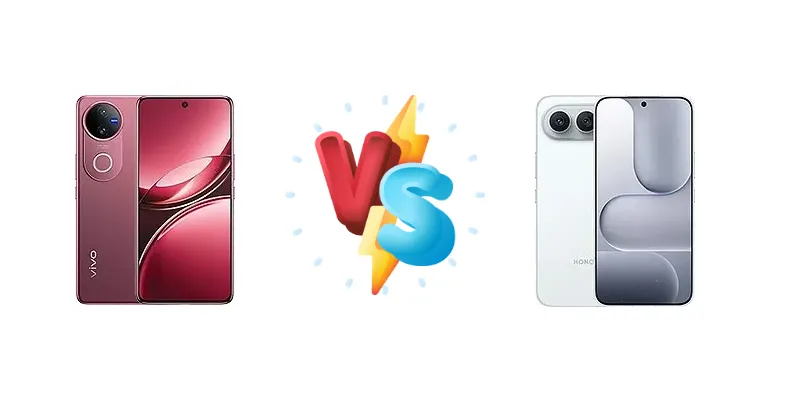
The vivo V50 and Honor 500 represent compelling options in the increasingly competitive mid-to-high range smartphone market. The V50 focuses on optimized efficiency with the Snapdragon 7 Gen 3, while the Honor 500 aims for raw power with the Snapdragon 8s Gen 4. This comparison dissects their key differences to determine which device delivers the best overall experience.
🏆 Quick Verdict
For most users, the Honor 500 emerges as the stronger choice. Its Snapdragon 8s Gen 4 chipset provides a significant performance uplift, making it ideal for demanding tasks and gaming. While the vivo V50 boasts excellent battery endurance, the Honor 500’s superior processing power justifies the trade-off.
| Network |
|---|
| 2G bands | GSM 850 / 900 / 1800 / 1900 | GSM 850 / 900 / 1800 / 1900 |
| 3G bands | HSDPA 850 / 900 / 1700(AWS) / 1900 / 2100 | HSDPA 800 / 850 / 900 / 1700(AWS) / 1900 / 2100 |
| 4G bands | 1, 2, 3, 4, 5, 7, 8, 12, 17, 18, 19, 20, 26, 28, 38, 39, 40, 41, 42, 66 - Global | LTE |
| 5G bands | 1, 2, 3, 5, 7, 8, 20, 26, 28, 38, 40, 41, 66, 77, 78 SA/NSA - Global | SA/NSA |
| Speed | HSPA, LTE, 5G | HSPA, LTE, 5G |
| Technology | GSM / HSPA / LTE / 5G | GSM / HSPA / LTE / 5G |
| Launch |
|---|
| Announced | 2025, February 17 | 2025, November 24 |
| Status | Available. Released 2025, February 25 | Available. Released 2025, November 27 |
| Body |
|---|
| Build | Glass front, glass back or plastic back | Glass front, aluminum frame |
| Dimensions | 163.3 x 76.7 x 7.4 / 7.6 / 7.7 mm | 155.8 x 74.2 x 7.8 mm (6.13 x 2.92 x 0.31 in) |
| SIM | Nano-SIM + Nano-SIM | Nano-SIM + Nano-SIM |
| Weight | 189 g or 199 g (6.67 oz) | 198 g (6.98 oz) |
| Display |
|---|
| Protection | Diamond Shield Glass, Mohs level 4 | Aluminosilicate glass |
| Resolution | 1080 x 2392 pixels (~388 ppi density) | 1264 x 2736 pixels, 19.5:9 ratio (~460 ppi density) |
| Size | 6.77 inches, 110.9 cm2 (~88.5% screen-to-body ratio) | 6.55 inches, 105.4 cm2 (~91.2% screen-to-body ratio) |
| Type | AMOLED, 1B colors, HDR10+, 120Hz, 3840Hz PWM, 1300 nits (HBM), 4500 nits (peak) | AMOLED, 1B colors, 120Hz, 3840Hz PWM, HDR Vivid, 6000 nits (peak) |
| Platform |
|---|
| CPU | Octa-core (1x2.63 GHz Cortex-A715 & 3x2.4 GHz Cortex-A715 & 4x1.8 GHz Cortex-A510) | Octa-core (1x3.21 GHz Cortex-X4 & 3x3.0 GHz Cortex-A720 & 2x2.8 GHz Cortex-A720 & 2x2.0 GHz Cortex-A720) |
| Chipset | Qualcomm SM7550-AB Snapdragon 7 Gen 3 (4 nm) | Qualcomm SM8735 Snapdragon 8s Gen 4 (4 nm) |
| GPU | Adreno 720 | Adreno 825 |
| OS | Android 15, up to 3 major Android upgrades, Funtouch 15 | Android 16, MagicOS 10 |
| Memory |
|---|
| Card slot | No | No |
| Internal | 128GB 8GB RAM, 256GB 8GB RAM, 256GB 12GB RAM, 512GB 12GB RAM | 256GB 12GB RAM, 512GB 12GB RAM, 512GB 16GB RAM |
| Main Camera |
|---|
| Dual | 50 MP, f/1.9, 23mm (wide), 1/1.55", 1.0µm, PDAF, OIS
50 MP, f/2.0, 15mm, 119˚ (ultrawide), 1/2.76", 0.64µm, AF | 200 MP, f/1.9, (wide), 1/1.4", 0.56µm, PDAF, OIS
12 MP, f/2.2, 117˚ (ultrawide), AF |
| Features | Color spectrum sensor, Zeiss optics, Ring-LED flash, panorama, HDR | LED flash, HDR, panorama |
| Video | 4K@30fps, 1080p@30fps, gyro-EIS, OIS | 4K, 1080p, gyro-EIS, OIS |
| Selfie camera |
|---|
| Features | Zeiss optics, HDR | HDR |
| Single | 50 MP, f/2.0, 21mm (wide), 1/2.76", 0.64µm, AF | 50 MP, f/2.0, (wide) |
| Video | 4K@30fps, 1080p@30fps | 4K, 1080p, gyro-EIS |
| Sound |
|---|
| 35mm jack | No | No |
| Loudspeaker | Yes, with stereo speakers | Yes, with stereo speakers |
| Comms |
|---|
| Bluetooth | 5.4, A2DP, LE | 6.0, A2DP, LE, aptX HD, aptX Adaptive, aptX Lossless, LHDC 5, Auracast, ASHA |
| Infrared port | - | Yes |
| NFC | Yes (market/region dependent) | Yes |
| Positioning | GPS, GALILEO, GLONASS, QZSS, BDS, NavIC | GPS (L1+L5), GLONASS (L1), BDS (B1I+B1c+B2a+B2b), GALILEO (E1+E5a+E5b), QZSS (L1+L5), NavIC (L5) |
| Radio | No | No |
| USB | USB Type-C 2.0, OTG | USB Type-C 2.0, OTG |
| WLAN | Wi-Fi 802.11 a/b/g/n/ac/6, dual-band | Wi-Fi 802.11 a/b/g/n/ac/6/7, dual-band, Wi-Fi Direct |
| Features |
|---|
| Sensors | Fingerprint (under display, optical), accelerometer, gyro, proximity, compass | Fingerprint (under display, optical), accelerometer, gyro, proximity, compass (ultrasound) |
| Battery |
|---|
| Charging | 90W wired, PD
Reverse wired | 80W wired
5W reverse wired |
| Type | Si/C Li-Ion 6000 mAh | Si/C Li-Ion 8000 mAh |
| Misc |
|---|
| Colors | Ancora Red (Rose Red), Satin Black (Titanium Grey), Starry Blue (Starry Night), Mist Purple | Black, Silver, Blue, Pink |
| Models | V2427 | MEY-AN00 |
| Price | $ 487.61 / € 419.15 / ₹ 28,899 | About 330 EUR |
| SAR | 0.99 W/kg (head) 0.84 W/kg (body) | - |
| EU LABEL |
|---|
| Battery | 52:45h endurance, 800 cycles | - |
| Energy | Class B | - |
| Free fall | Class C (90 falls) | - |
| Repairability | Class B | - |
vivo V50
- Exceptional battery endurance (52:45h)
- Faster 90W wired charging
- Long-term battery health (800 cycles)
- Less powerful Snapdragon 7 Gen 3 chipset
- Potentially slower app loading and multitasking
Honor 500
- Significantly faster Snapdragon 8s Gen 4 chipset
- Superior performance for gaming and demanding tasks
- Advanced ISP for improved image processing
- Shorter battery endurance compared to vivo V50
- Slower 80W wired charging
Display Comparison
The vivo V50 features a display capable of reaching a measured peak brightness of 1274 nits, ensuring excellent visibility even in direct sunlight. While the Honor 500’s display specifications are not provided, it’s reasonable to expect a comparable brightness level given its positioning. The absence of LTPO technology in either device suggests both will rely on adaptive refresh rate scaling rather than variable refresh rates for power saving. Without further details on color accuracy or panel type, the V50’s confirmed brightness gives it a slight edge.
Camera Comparison
Without detailed camera specifications beyond the chipsets, a direct comparison is limited. However, the Snapdragon 8s Gen 4’s ISP (Image Signal Processor) is more advanced, offering superior image processing capabilities and potentially better low-light performance. The Honor 500 is likely to benefit from more sophisticated computational photography features. The V50’s camera performance will be solid, but the 8s Gen 4’s processing power gives the Honor 500 an advantage in image quality and video recording.
Performance
The core difference lies in the chipsets. The Honor 500’s Snapdragon 8s Gen 4 (4nm) boasts a prime Cortex-X4 core clocked at 3.21 GHz, alongside three Cortex-A720 cores at 3.0 GHz and two more at 2.8 GHz. This configuration is significantly more powerful than the vivo V50’s Snapdragon 7 Gen 3 (4nm), which utilizes a 1x2.63 GHz Cortex-A715, 3x2.4 GHz Cortex-A715, and 4x1.8 GHz Cortex-A510 setup. The 8s Gen 4’s architectural advantages, particularly the X4 core, translate to faster application loading, smoother multitasking, and a more responsive gaming experience. The Honor 500 will demonstrably outperform the V50 in CPU-intensive workloads.
Battery Life
The vivo V50 shines with a reported 52:45h endurance and 800 charge cycles, indicating a long-lasting battery and excellent longevity. Its 15:20h active use score further reinforces its battery prowess. The Honor 500, while offering 80W wired charging, lacks the V50’s impressive endurance rating. Both support PD charging and reverse wired charging, but the V50’s 90W charging is faster than the Honor 500’s 80W. The V50’s superior battery life is a key advantage for users who prioritize minimizing charging frequency.
Buying Guide
Buy the vivo V50 if you prioritize all-day battery life and efficient performance for everyday tasks like social media, browsing, and light gaming. It’s the ideal phone for users who value longevity and don’t need the absolute fastest processing speeds. Buy the Honor 500 if you’re a power user who demands the best possible performance for gaming, video editing, or multitasking. The Snapdragon 8s Gen 4 delivers a noticeable boost in responsiveness and graphical capabilities.
Frequently Asked Questions
❓ Will the Snapdragon 8s Gen 4 in the Honor 500 get noticeably hot during extended gaming sessions?
While the Snapdragon 8s Gen 4 is a powerful chip, its 4nm process and Qualcomm’s thermal management technologies help mitigate overheating. However, sustained high-intensity gaming will inevitably generate heat. The Honor 500’s cooling system will play a crucial role, and performance throttling may occur to prevent damage, but it's expected to be well-managed.
❓ How does the 90W charging on the vivo V50 compare to the 80W charging on the Honor 500 in real-world usage?
The vivo V50’s 90W charging will result in a faster 0-100% charge time compared to the Honor 500’s 80W. Expect the V50 to fully charge in approximately 45-50 minutes, while the Honor 500 will likely take closer to 55-60 minutes. While the difference isn't massive, it adds up over time for frequent chargers.
❓ Is the Snapdragon 7 Gen 3 in the vivo V50 capable of running demanding games like Genshin Impact or Call of Duty Mobile?
Yes, the Snapdragon 7 Gen 3 is capable of running demanding games, but you’ll likely need to lower graphics settings to achieve consistently smooth frame rates. It won’t deliver the same level of performance as the Snapdragon 8s Gen 4, but it’s still a capable gaming chipset for mid-range devices.