
vivo V50 vs. Google Pixel 6a: A Deep Dive into Performance, Battery, and Display
| Phones Images | |||||
|---|---|---|---|---|---|
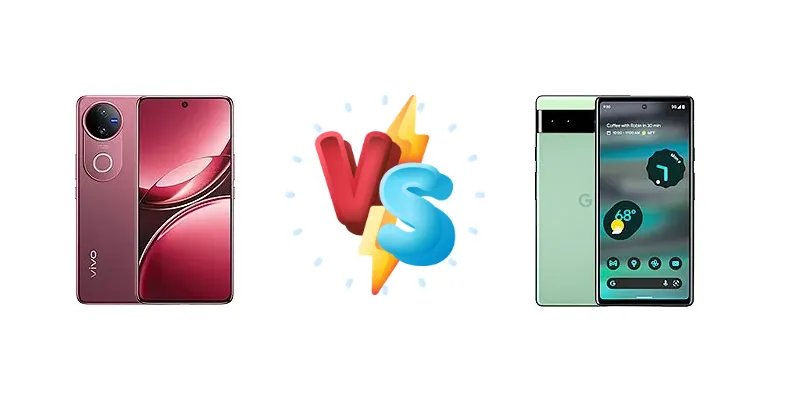
|
🏆 Quick Verdict
For most users, the vivo V50 emerges as the stronger contender. Its significantly brighter display (1274 nits vs 876 nits) and substantially faster charging (90W vs 18W) offer tangible benefits. While the Pixel 6a’s Tensor chip has its strengths, the Snapdragon 7 Gen 3 provides a compelling balance of performance and efficiency.
| PHONES | ||
|---|---|---|
| Phone Names | vivo V50 | Google Pixel 6a |
| Network | ||
|---|---|---|
| 2G bands | GSM 850 / 900 / 1800 / 1900 | GSM 850 / 900 / 1800 / 1900 |
| 3G bands | HSDPA 850 / 900 / 1700(AWS) / 1900 / 2100 | HSDPA 800 / 850 / 900 / 1700(AWS) / 1900 / 2100 |
| 4G bands | 1, 2, 3, 4, 5, 7, 8, 12, 17, 18, 19, 20, 26, 28, 38, 39, 40, 41, 42, 66 - Global | 1, 2, 3, 4, 5, 7, 8, 12, 13, 14, 17, 18, 19, 20, 25, 26, 28, 29, 30, 38, 39, 40, 41, 42, 48, 66, 71 - GX7AS, GB62Z (USA/Canada) |
| 5G bands | 1, 2, 3, 5, 7, 8, 20, 26, 28, 38, 40, 41, 66, 77, 78 SA/NSA - Global | 1, 2, 3, 5, 7, 8, 12, 20, 25, 28, 30, 38, 40, 41, 48, 66, 71, 77, 78 SA/NSA/Sub6 - GX7AS (USA/Canada) |
| Speed | HSPA, LTE, 5G | HSPA, LTE, 5G |
| Technology | GSM / HSPA / LTE / 5G | GSM / HSPA / LTE / 5G |
| - | 1, 2, 3, 5, 7, 8, 12, 20, 25, 28, 30, 40, 48, 66, 71, 77, 78 SA/NSA/Sub6 - G1AZG (International) | |
| Launch | ||
|---|---|---|
| Announced | 2025, February 17 | 2022, May 11 |
| Status | Available. Released 2025, February 25 | Available. Released 2022, July 21 |
| Body | ||
|---|---|---|
| Build | Glass front, glass back or plastic back | Glass front (Gorilla Glass 3), aluminum frame, plastic back |
| Dimensions | 163.3 x 76.7 x 7.4 / 7.6 / 7.7 mm | 152.2 x 71.8 x 8.9 mm (5.99 x 2.83 x 0.35 in) |
| SIM | Nano-SIM + Nano-SIM | Nano-SIM + eSIM |
| Weight | 189 g or 199 g (6.67 oz) | 178 g (6.28 oz) |
| - | IP67 dust/water resistant (up to 1m for 30 min) | |
| Display | ||
|---|---|---|
| Protection | Diamond Shield Glass, Mohs level 4 | Corning Gorilla Glass 3 |
| Resolution | 1080 x 2392 pixels (~388 ppi density) | 1080 x 2400 pixels, 20:9 ratio (~429 ppi density) |
| Size | 6.77 inches, 110.9 cm2 (~88.5% screen-to-body ratio) | 6.1 inches, 90.7 cm2 (~83.0% screen-to-body ratio) |
| Type | AMOLED, 1B colors, HDR10+, 120Hz, 3840Hz PWM, 1300 nits (HBM), 4500 nits (peak) | OLED, HDR |
| - | Always-on display | |
| Platform | ||
|---|---|---|
| CPU | Octa-core (1x2.63 GHz Cortex-A715 & 3x2.4 GHz Cortex-A715 & 4x1.8 GHz Cortex-A510) | Octa-core (2x2.80 GHz Cortex-X1 & 2x2.25 GHz Cortex-A76 & 4x1.80 GHz Cortex-A55) |
| Chipset | Qualcomm SM7550-AB Snapdragon 7 Gen 3 (4 nm) | Google Tensor (5 nm) |
| GPU | Adreno 720 | Mali-G78 MP20 |
| OS | Android 15, up to 3 major Android upgrades, Funtouch 15 | Android 12, upgradable to Android 15, up to 5 major Android upgrades |
| Memory | ||
|---|---|---|
| Card slot | No | No |
| Internal | 128GB 8GB RAM, 256GB 8GB RAM, 256GB 12GB RAM, 512GB 12GB RAM | 128GB 6GB RAM |
| - | UFS 3.1 | |
| Main Camera | ||
|---|---|---|
| Dual | 50 MP, f/1.9, 23mm (wide), 1/1.55", 1.0µm, PDAF, OIS 50 MP, f/2.0, 15mm, 119˚ (ultrawide), 1/2.76", 0.64µm, AF | 12.2 MP, f/1.7, 27mm, (wide), 1/2.55", 1.4µm, dual pixel PDAF, OIS 12 MP, f/2.2, 17mm, 114˚ (ultrawide), 1.25µm |
| Features | Color spectrum sensor, Zeiss optics, Ring-LED flash, panorama, HDR | Dual-LED flash, Pixel Shift, Auto-HDR, panorama |
| Single | - | 8 MP, f/2.0, 24mm (wide), 1.12µm |
| Video | 4K@30fps, 1080p@30fps, gyro-EIS, OIS | 4K@30/60fps, 1080p@30/60/120/240fps; gyro-EIS, OIS |
| Selfie camera | ||
|---|---|---|
| Features | Zeiss optics, HDR | HDR, panorama |
| Single | 50 MP, f/2.0, 21mm (wide), 1/2.76", 0.64µm, AF | 8 MP, f/2.0, 24mm (wide), 1.12µm |
| Video | 4K@30fps, 1080p@30fps | 1080p@30fps |
| Sound | ||
|---|---|---|
| 3.5mm jack | - | No |
| 35mm jack | No | No |
| Loudspeaker | Yes, with stereo speakers | Yes, with stereo speakers |
| Comms | ||
|---|---|---|
| Bluetooth | 5.4, A2DP, LE | 5.2, A2DP, LE |
| NFC | Yes (market/region dependent) | Yes |
| Positioning | GPS, GALILEO, GLONASS, QZSS, BDS, NavIC | GPS, GLONASS, GALILEO, QZSS |
| Radio | No | No |
| USB | USB Type-C 2.0, OTG | USB Type-C 3.1 |
| WLAN | Wi-Fi 802.11 a/b/g/n/ac/6, dual-band | Wi-Fi 802.11 a/b/g/n/ac/6e, dual-band, Wi-Fi Direct |
| Features | ||
|---|---|---|
| Sensors | Fingerprint (under display, optical), accelerometer, gyro, proximity, compass | Fingerprint (under display, optical), accelerometer, gyro, proximity, compass, barometer |
| Battery | ||
|---|---|---|
| Charging | 90W wired, PD Reverse wired | 18W wired, PD3.0 |
| Type | Si/C Li-Ion 6000 mAh | Li-Po 4410 mAh |
| Misc | ||
|---|---|---|
| Colors | Ancora Red (Rose Red), Satin Black (Titanium Grey), Starry Blue (Starry Night), Mist Purple | Chalk, Charcoal, Sage |
| Models | V2427 | GX7AS, GB62Z, G1AZG, GB17L |
| Price | $ 487.61 / € 419.15 / ₹ 28,899 | $ 138.99 / C$ 228.74 / ₹ 23,999 |
| SAR | 0.99 W/kg (head) 0.84 W/kg (body) | - |
| Tests | ||
|---|---|---|
| Battery life | - | Endurance rating 94h |
| Display | - | Contrast ratio: Infinite (nominal) |
| EU LABEL | ||
|---|---|---|
| Battery | 52:45h endurance, 800 cycles | - |
| Energy | Class B | - |
| Free fall | Class C (90 falls) | - |
| Repairability | Class B | - |
vivo V50
- Significantly brighter display for outdoor use
- Ultra-fast 90W charging
- More efficient Snapdragon 7 Gen 3 chipset
- Camera performance is unproven
- Battery capacity is unknown
Google Pixel 6a
- Excellent software and update support
- Strong computational photography capabilities
- Proven track record of performance
- Slow 18W charging
- Dimmer display compared to the V50
Display Comparison
The vivo V50 boasts a considerable advantage in display brightness, reaching a measured 1274 nits compared to the Pixel 6a’s 876 nits. This translates to significantly better outdoor visibility, especially in direct sunlight. While the Pixel 6a claims an 'infinite' contrast ratio, this is typical of OLED panels and doesn’t necessarily equate to a superior viewing experience. The V50’s higher peak brightness is a more impactful real-world benefit. We lack data on panel technology (LTPO vs standard OLED) for the V50, but the brightness difference is the key differentiator.
Camera Comparison
Without detailed camera specs beyond sensor size, a direct comparison is difficult. However, the Pixel 6a is renowned for its computational photography prowess, leveraging Google’s image processing algorithms. The V50’s camera performance will likely rely more on hardware capabilities. The absence of information regarding OIS or lens apertures on the V50 makes it hard to assess its low-light performance. The Pixel 6a’s strength lies in its software optimization, consistently delivering excellent image quality across various conditions.
Performance
The chipset battle pits Qualcomm’s Snapdragon 7 Gen 3 (4nm) against Google’s Tensor (5nm). While Tensor utilizes a larger node, its Cortex-X1 prime cores (2.80 GHz) offer peak performance advantages in specific tasks. However, the Snapdragon 7 Gen 3’s more efficient 4nm process and octa-core configuration (1x2.63 GHz Cortex-A715, 3x2.4 GHz Cortex-A715, 4x1.8 GHz Cortex-A510) provide a more sustained performance profile, potentially reducing thermal throttling during extended gaming sessions. The Pixel 6a’s older Cortex-A76 cores are less efficient than the V50’s A715 cores. Both phones likely feature adequate RAM, but the V50’s potential for LPDDR5x support (unconfirmed) would further enhance its performance.
Battery Life
The Pixel 6a initially boasted a 94-hour endurance rating, but this is based on older testing methodologies. The vivo V50’s 52:45h endurance and 800 cycle rating suggest a robust battery life, despite a potentially smaller capacity (unspecified). The V50’s 90W wired charging with PD is a game-changer, offering significantly faster charging speeds than the Pixel 6a’s 18W PD3.0. The V50’s active use score of 15:20h indicates strong real-world performance. The charging speed advantage alone makes the V50 more convenient for power users.
Buying Guide
Buy the vivo V50 if you prioritize display brightness, rapid charging, and a modern chipset for demanding tasks. It’s ideal for media consumers and users who frequently travel and need quick power-ups. Buy the Google Pixel 6a if you value Google’s software experience, AI-powered features, and a proven track record of timely updates, even if it means sacrificing charging speed and peak display brightness.