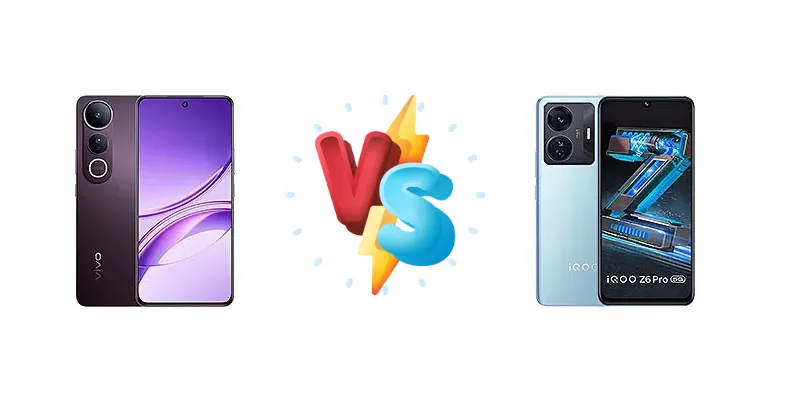
The vivo V50 Lite and iQOO Z6 Pro represent distinct approaches to the competitive mid-range smartphone market. The V50 Lite focuses on balanced features and extended battery life, while the iQOO Z6 Pro prioritizes raw processing power with the Snapdragon 778G. This comparison dissects their key differences to help you choose the right device for your needs.
🏆 Quick Verdict
For the average user prioritizing sustained performance and a smoother experience, the iQOO Z6 Pro emerges as the winner. Its Snapdragon 778G chipset offers a noticeable advantage in demanding tasks and gaming, despite the V50 Lite’s impressive battery endurance and faster charging.
| Network |
|---|
| 2G bands | GSM 850 / 900 / 1800 / 1900 | GSM 850 / 900 / 1800 / 1900 |
| 3G bands | HSDPA 850 / 900 / 1700(AWS) / 1900 / 2100 | HSDPA 850 / 900 / 2100 |
| 4G bands | 1, 2, 3, 4, 5, 7, 8, 19, 20, 28, 38, 39, 40, 41 | 1, 3, 5, 8, 38, 40, 41 |
| 5G bands | 1, 3, 5, 7, 8, 20, 28, 38, 40, 41, 77, 78 SA/NSA | 1, 3, 5, 8, 41, 77, 78 SA/NSA |
| Speed | HSPA, LTE, 5G | HSPA, LTE, 5G |
| Technology | GSM / HSPA / LTE / 5G | GSM / HSPA / LTE / 5G |
| Launch |
|---|
| Announced | 2025, March 20 | 2022, April 27 |
| Status | Available. Released 2025, March 25 | Available. Released 2022, May 03 |
| Body |
|---|
| Build | Glass front, plastic back, plastic frame | Glass front, plastic frame, plastic back |
| Dimensions | 163.8 x 76.3 x 7.8 mm (6.45 x 3.00 x 0.31 in) | 159.7 x 73.6 x 8.5 mm (6.29 x 2.90 x 0.33 in) |
| SIM | Nano-SIM + Nano-SIM | Nano-SIM + Nano-SIM |
| Weight | 197 g (6.95 oz) | 180 g (6.35 oz) |
| Display |
|---|
| Protection | Mohs level 4 | Panda Glass |
| Resolution | 1080 x 2392 pixels (~388 ppi density) | 1080 x 2404 pixels, 20:9 ratio (~409 ppi density) |
| Size | 6.77 inches, 110.9 cm2 (~88.7% screen-to-body ratio) | 6.44 inches, 100.0 cm2 (~85.1% screen-to-body ratio) |
| Type | AMOLED, 120Hz, 1300 nits (HBM), 1800 nits (peak) | AMOLED, 90Hz, HDR10+, 1300 nits (peak) |
| Platform |
|---|
| CPU | Octa-core (2x2.4 GHz Cortex-A76 & 6x2.0 GHz Cortex-A55) | Octa-core (1x2.4 GHz Cortex-A78 & 3x2.2 GHz Cortex-A78 & 4x1.9 GHz Cortex-A55) |
| Chipset | Mediatek Dimensity 6300 (6 nm) | Qualcomm SM7325 Snapdragon 778G 5G (6 nm) |
| GPU | Mali-G57 MC2 | Adreno 642L |
| OS | Android 15, Funtouch 15 | Android 12, Funtouch 12 |
| Memory |
|---|
| Card slot | No | No |
| Internal | 256GB 8GB RAM, 256GB 12GB RAM, 512GB 12GB RAM | 128GB 6GB RAM, 128GB 8GB RAM, 256GB 12GB RAM |
| Main Camera |
|---|
| Dual | 50 MP, f/1.8, (wide), 1/1.95", 0.8µm, PDAF
8 MP, f/2.2, 120˚ (ultrawide) | - |
| Features | Ring-LED flash, panorama, HDR | Dual-LED dual-tone flash, HDR, panorama |
| Single | - | 16 MP, f/2.0, (wide) |
| Triple | - | 64 MP, f/1.8, 26mm (wide), PDAF
8 MP, f/2.2, 117˚ (ultrawide)
2 MP (macro) |
| Video | Yes | 4K@30fps, 1080p@30/60fps, gyro-EIS |
| Selfie camera |
|---|
| Single | 32 MP, f/2.5, (wide) | 16 MP, f/2.0, (wide) |
| Video | Yes | 1080p@30fps |
| Sound |
|---|
| 3.5mm jack | - | No |
| 35mm jack | No | No |
| Loudspeaker | Yes, with stereo speakers | Yes |
| | - | 24-bit/192kHz audio |
| Comms |
|---|
| Bluetooth | 5.4, A2DP, LE | 5.2, A2DP, LE |
| NFC | Yes (market/region dependent) | No |
| Positioning | GPS, GLONASS, GALILEO, BDS, QZSS | GPS, GLONASS, GALILEO, BDS |
| Radio | No | No |
| USB | USB Type-C 2.0, OTG | USB Type-C 2.0, OTG |
| WLAN | Wi-Fi 802.11 a/b/g/n/ac, dual-band | Wi-Fi 802.11 a/b/g/n/ac/6, dual-band, Wi-Fi Direct |
| Features |
|---|
| Sensors | Fingerprint (under display, optical), accelerometer, gyro, proximity, compass | Fingerprint (under display, optical), accelerometer, gyro, proximity, compass |
| Battery |
|---|
| Charging | 90W wired, 50% in 23 min, 100% in 52 min
6W reverse wired | 66W wired, 50% in 18 min |
| Type | Si/C Li-Ion 6500 mAh | 4700 mAh |
| Misc |
|---|
| Colors | Phantom Black, Titanium Gold, Fantasy Purple, Silk Green | Phantom Dusk, Legion Sky |
| Models | V2440 | - |
| Price | € 259.00 / $ 391.16 | About 300 EUR |
| EU LABEL |
|---|
| Battery | 61:19h endurance, 1000 cycles | - |
| Energy | Class B | - |
| Free fall | Class A (270 falls) | - |
| Repairability | Class C | - |
vivo V50 Lite
- Exceptional battery life (61:19h endurance)
- 90W fast charging with 6W reverse charging
- Potentially longer battery lifespan (1000 cycles)
- Less powerful processor compared to the Snapdragon 778G
- Likely less capable camera system
vivo iQOO Z6 Pro
- More powerful Snapdragon 778G chipset
- Superior multi-core performance
- Faster charging speed (50% in 18 minutes)
- Likely shorter battery life compared to the V50 Lite
- No reverse wired charging
Display Comparison
Display specifications are not provided, so we must infer. Both devices likely feature FHD+ LCD panels, common in this price bracket. However, the iQOO Z6 Pro, being positioned as a slightly more premium device, may benefit from a higher peak brightness and potentially a slightly more refined color calibration. The V50 Lite’s focus on battery life might mean a slightly more conservative display brightness setting by default.
Camera Comparison
Camera details are absent, so we must rely on brand positioning. iQOO typically emphasizes camera performance, suggesting the Z6 Pro may have a larger main sensor and more sophisticated image processing algorithms. The V50 Lite likely features a competent camera setup for everyday photography, but may lack the advanced features and low-light capabilities of the Z6 Pro. Without specific sensor sizes or aperture information, it’s difficult to make a definitive judgment, but the iQOO Z6 Pro is likely to offer a more versatile and higher-quality camera experience.
Performance
The core difference lies in the chipsets. The iQOO Z6 Pro’s Qualcomm Snapdragon 778G 5G (6nm) boasts a Cortex-A78 prime core clocked at 2.4 GHz, alongside three additional A78 cores at 2.2 GHz. This configuration provides a significant advantage in multi-core performance compared to the vivo V50 Lite’s Mediatek Dimensity 6300 (6nm) which uses two Cortex-A76 cores at 2.4 GHz and six Cortex-A55 cores at 2.0 GHz. While both are 6nm chips, the architectural advantage of the Snapdragon 778G’s A78 cores translates to faster application loading times and smoother multitasking. The iQOO Z6 Pro will likely exhibit less frame rate stuttering in graphically intensive games. The Dimensity 6300 is still a capable chip, but geared towards efficiency rather than outright speed.
Battery Life
The vivo V50 Lite shines in battery endurance, boasting a claimed 61:19h of usage. While the iQOO Z6 Pro’s battery capacity is unknown, the V50 Lite’s 1000 cycle battery longevity suggests a focus on long-term battery health. However, the iQOO Z6 Pro compensates with faster charging – 66W wired, reaching 50% in 18 minutes – compared to the V50 Lite’s 90W, which takes 23 minutes for 50% and 52 minutes for a full charge. The V50 Lite also offers 6W reverse wired charging, a feature absent on the Z6 Pro. The faster charging of the Z6 Pro is convenient, but the V50 Lite’s overall endurance is a significant advantage for heavy users.
Buying Guide
Buy the vivo V50 Lite if you need exceptional battery life and prioritize efficient power management for all-day use. It’s ideal for users who primarily browse, stream content, and engage in light social media. Buy the vivo iQOO Z6 Pro if you prefer a more responsive and powerful device capable of handling demanding games, multitasking, and resource-intensive applications. It’s the better choice for power users and mobile gamers.
Frequently Asked Questions
❓ Will the Snapdragon 778G in the iQOO Z6 Pro handle demanding games like Genshin Impact at high settings?
Yes, the Snapdragon 778G is a capable chipset for gaming. While it won't deliver flagship-level performance, it should comfortably run Genshin Impact at medium to high settings with stable frame rates. Expect some minor frame drops during intense combat scenarios, but overall, the gaming experience should be enjoyable.
❓ How does the Dimensity 6300 in the vivo V50 Lite perform with prolonged video streaming?
The Dimensity 6300 is well-suited for video streaming. Its efficient architecture and 6nm process contribute to good thermal management, preventing overheating during extended viewing sessions. However, it may exhibit slightly longer loading times for high-resolution videos compared to the iQOO Z6 Pro.
❓ Is the 90W charging on the V50 Lite significantly faster in real-world use than the 66W on the Z6 Pro?
While the V50 Lite boasts 90W charging, the difference in real-world charging speed isn't as dramatic as the wattage suggests. The Z6 Pro’s 66W charging is still very fast, reaching 50% in 18 minutes. The V50 Lite takes 23 minutes for 50%, so the difference is noticeable, but not massive. The V50 Lite’s advantage lies in the inclusion of 6W reverse wired charging.