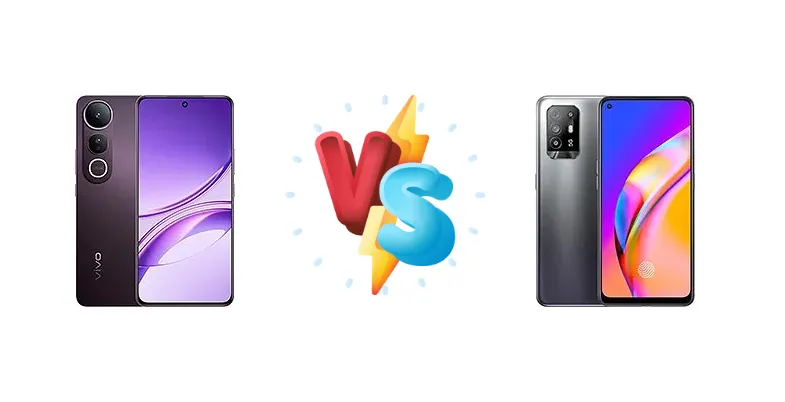
The vivo V50 Lite and Oppo F19 Pro+ 5G represent compelling options in the competitive mid-range 5G smartphone market. While both leverage Mediatek Dimensity chipsets, they diverge significantly in charging technology and battery endurance, creating a clear trade-off for potential buyers. This comparison dissects these differences to determine which device best suits your priorities.
🏆 Quick Verdict
For the average user prioritizing long-lasting battery life and incredibly fast charging, the vivo V50 Lite emerges as the winner. Its 61:19h endurance and 90W charging significantly outperform the Oppo F19 Pro+ 5G, despite the latter’s slightly older, but still capable, chipset.
| Network |
|---|
| 2G bands | GSM 850 / 900 / 1800 / 1900 | GSM 850 / 900 / 1800 / 1900 - SIM 1 & SIM 2 |
| 3G bands | HSDPA 850 / 900 / 1700(AWS) / 1900 / 2100 | HSDPA 850 / 900 / 2100 |
| 4G bands | 1, 2, 3, 4, 5, 7, 8, 19, 20, 28, 38, 39, 40, 41 | 1, 3, 5, 7, 8, 38, 40, 41 |
| 5G bands | 1, 3, 5, 7, 8, 20, 28, 38, 40, 41, 77, 78 SA/NSA | 1, 41, 77, 78 SA/NSA |
| Speed | HSPA, LTE, 5G | HSPA, LTE-A, 5G |
| Technology | GSM / HSPA / LTE / 5G | GSM / HSPA / LTE / 5G |
| Launch |
|---|
| Announced | 2025, March 20 | 2021, March 08 |
| Status | Available. Released 2025, March 25 | Available. Released 2021, March 17 |
| Body |
|---|
| Build | Glass front, plastic back, plastic frame | - |
| Dimensions | 163.8 x 76.3 x 7.8 mm (6.45 x 3.00 x 0.31 in) | 160.1 x 73.4 x 7.8 mm (6.30 x 2.89 x 0.31 in) |
| SIM | Nano-SIM + Nano-SIM | Dual SIM (Nano-SIM, dual stand-by) |
| Weight | 197 g (6.95 oz) | 173 g (6.10 oz) |
| Display |
|---|
| Protection | Mohs level 4 | Corning Gorilla Glass 5 |
| Resolution | 1080 x 2392 pixels (~388 ppi density) | 1080 x 2400 pixels, 20:9 ratio (~409 ppi density) |
| Size | 6.77 inches, 110.9 cm2 (~88.7% screen-to-body ratio) | 6.43 inches, 99.8 cm2 (~84.9% screen-to-body ratio) |
| Type | AMOLED, 120Hz, 1300 nits (HBM), 1800 nits (peak) | Super AMOLED, 430 nits (typ), 800 nits (peak) |
| Platform |
|---|
| CPU | Octa-core (2x2.4 GHz Cortex-A76 & 6x2.0 GHz Cortex-A55) | Octa-core (2x2.4 GHz Cortex-A76 & 6x2.0 GHz Cortex-A55) |
| Chipset | Mediatek Dimensity 6300 (6 nm) | Mediatek MT6853 Dimensity 800U (7 nm) |
| GPU | Mali-G57 MC2 | Mali-G57 MC3 |
| OS | Android 15, Funtouch 15 | Android 11, upgradable to Android 12, ColorOS 12 |
| Memory |
|---|
| Card slot | No | microSDXC (dedicated slot) |
| Internal | 256GB 8GB RAM, 256GB 12GB RAM, 512GB 12GB RAM | 128GB 8GB RAM |
| | - | UFS 2.1 |
| Main Camera |
|---|
| Dual | 50 MP, f/1.8, (wide), 1/1.95", 0.8µm, PDAF
8 MP, f/2.2, 120˚ (ultrawide) | - |
| Features | Ring-LED flash, panorama, HDR | LED flash, HDR, panorama |
| Quad | - | 48 MP, f/1.7, 25mm (wide), 1/2.0", 0.8µm, PDAF
8 MP, f/2.2, 16mm, 119˚ (ultrawide), 1/4.0", 1.12µm
2 MP, f/2.4, (macro)
2 MP, f/2.4, (depth) |
| Single | - | 16 MP, f/2.4, 26mm (wide), 1/3.09", 1.0µm |
| Video | Yes | 4K@30fps, 1080p@30/120fps; gyro-EIS, HDR |
| Selfie camera |
|---|
| Features | - | HDR |
| Single | 32 MP, f/2.5, (wide) | 16 MP, f/2.4, 26mm (wide), 1/3.09", 1.0µm |
| Video | Yes | 1080p@30fps |
| Sound |
|---|
| 3.5mm jack | - | Yes |
| 35mm jack | No | - |
| Loudspeaker | Yes, with stereo speakers | Yes |
| Comms |
|---|
| Bluetooth | 5.4, A2DP, LE | 5.1, A2DP, LE, aptX HD |
| NFC | Yes (market/region dependent) | No |
| Positioning | GPS, GLONASS, GALILEO, BDS, QZSS | GPS, GLONASS, GALILEO, BDS |
| Radio | No | Unspecified |
| USB | USB Type-C 2.0, OTG | USB Type-C 2.0, OTG |
| WLAN | Wi-Fi 802.11 a/b/g/n/ac, dual-band | Wi-Fi 802.11 a/b/g/n/ac, dual-band, Wi-Fi Direct |
| Features |
|---|
| Sensors | Fingerprint (under display, optical), accelerometer, gyro, proximity, compass | Fingerprint (under display, optical), accelerometer, gyro, proximity, compass |
| Battery |
|---|
| Charging | 90W wired, 50% in 23 min, 100% in 52 min
6W reverse wired | 50W wired, 100% in 48 min (advertised) |
| Type | Si/C Li-Ion 6500 mAh | Li-Po 4310 mAh, non-removable |
| Misc |
|---|
| Colors | Phantom Black, Titanium Gold, Fantasy Purple, Silk Green | Fluid Black, Space Silver, Cosmo Blue |
| Models | V2440 | CPH2213 |
| Price | € 259.00 / $ 391.16 | ₹ 25,990 |
| EU LABEL |
|---|
| Battery | 61:19h endurance, 1000 cycles | - |
| Energy | Class B | - |
| Free fall | Class A (270 falls) | - |
| Repairability | Class C | - |
vivo V50 Lite
- Incredibly fast 90W charging
- Exceptional 61:19h battery endurance
- More efficient 6nm Dimensity 6300 chipset
- Camera specifications unknown
- Display details unavailable
Oppo F19 Pro+ 5G
- Proven Dimensity 800U chipset performance
- Oppo’s ColorOS software experience
- Established brand reputation
- Slower 50W charging
- Inferior battery endurance (estimated)
- Older 7nm chipset process
Display Comparison
Display specifications are not provided, so a direct comparison is impossible. However, given the market positioning, we can infer that both devices likely feature LCD or AMOLED panels with FHD+ resolution. The absence of details like refresh rate or peak brightness makes it difficult to assess visual quality. The V50 Lite, being a newer device, *may* benefit from improved panel technology, but this remains speculative.
Camera Comparison
Camera details are absent, making a comprehensive comparison impossible. However, given the price bracket, both phones likely feature multi-camera setups with a primary sensor, ultrawide, and potentially a macro lens. The quality of image processing and sensor size will be key differentiators. Without specific sensor information, it’s difficult to determine which phone captures superior images. We can assume Oppo’s experience in camera technology might give the F19 Pro+ 5G a slight advantage in image quality, but this is not guaranteed.
Performance
Both the vivo V50 Lite and Oppo F19 Pro+ 5G utilize an octa-core CPU configuration with 2x2.4 GHz Cortex-A76 and 6x2.0 GHz Cortex-A55 cores. However, the underlying chipsets differ: the V50 Lite employs the Mediatek Dimensity 6300 (6nm), while the F19 Pro+ 5G uses the Dimensity 800U (7nm). The 6nm process of the Dimensity 6300 *should* offer improved power efficiency compared to the 7nm Dimensity 800U, potentially offsetting the 800U’s slightly higher theoretical performance. Real-world performance differences will likely be subtle, with the 800U potentially exhibiting a slight edge in demanding tasks, but the V50 Lite’s efficiency could translate to cooler operation and sustained performance.
Battery Life
The vivo V50 Lite boasts a significant advantage in battery endurance with a tested 61:19h runtime, compared to an unspecified runtime for the Oppo F19 Pro+ 5G. This is further bolstered by the V50 Lite’s 90W wired charging, capable of reaching 50% charge in just 23 minutes and 100% in 52 minutes. The Oppo F19 Pro+ 5G’s 50W charging, while still fast, takes a comparatively longer 48 minutes to reach a full charge. The V50 Lite also includes 6W reverse wired charging, a feature absent in the F19 Pro+ 5G, adding to its versatility.
Buying Guide
Buy the vivo V50 Lite if you need exceptional battery life and the convenience of ultra-fast charging, making it ideal for heavy users and travelers. Buy the Oppo F19 Pro+ 5G if you prioritize a proven chipset with a track record of solid performance and are less concerned with maximizing battery runtime or charging speed. The F19 Pro+ 5G may also appeal to those who prefer Oppo’s ColorOS software experience.
Frequently Asked Questions
❓ How does the 6nm Dimensity 6300 in the vivo V50 Lite compare to the 7nm Dimensity 800U in the Oppo F19 Pro+ 5G for gaming?
While the Dimensity 800U has a slight theoretical performance advantage, the 6nm process of the Dimensity 6300 in the V50 Lite should result in better thermal efficiency. This means the V50 Lite is likely to sustain higher performance for longer periods during gaming sessions without significant throttling, potentially offering a smoother experience overall.
❓ Is the 90W charging on the vivo V50 Lite safe for the battery's long-term health?
vivo implements intelligent charging algorithms with its 90W SuperVOOC technology. These algorithms dynamically adjust the charging speed to minimize heat and prevent overcharging, protecting the battery's longevity. The V50 Lite is also rated for 1000 charge cycles, indicating a commitment to battery durability.
❓ Does the Oppo F19 Pro+ 5G support carrier aggregation for faster 5G speeds?
The Dimensity 800U chipset *does* support carrier aggregation, allowing the F19 Pro+ 5G to combine multiple 5G bands for potentially faster download and upload speeds, provided your carrier supports this feature. However, actual speeds will vary based on network conditions and carrier support.