
vivo V50 Lite vs. OnePlus Nord CE 2 Lite 5G: A Deep Dive into Budget 5G Contenders
| Phones Images | |||||
|---|---|---|---|---|---|
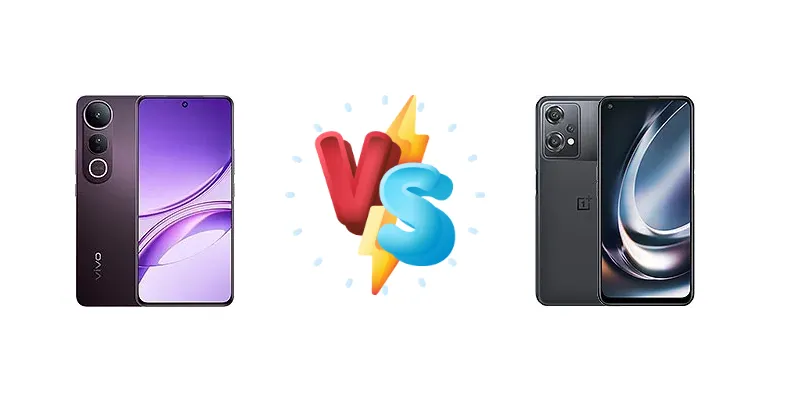
|
🏆 Quick Verdict
For the average user prioritizing all-day battery life and incredibly fast charging, the vivo V50 Lite is the clear winner. Its 90W charging and impressive 61:19h endurance significantly outperform the OnePlus Nord CE 2 Lite 5G, despite the latter's Qualcomm chipset.
| PHONES | ||
|---|---|---|
| Phone Names | vivo V50 Lite | OnePlus Nord CE 2 Lite 5G |
| Network | ||
|---|---|---|
| 2G bands | GSM 850 / 900 / 1800 / 1900 | GSM 850 / 900 / 1800 / 1900 |
| 3G bands | HSDPA 850 / 900 / 1700(AWS) / 1900 / 2100 | HSDPA 800 / 850 / 900 / 1700(AWS) / 1900 / 2100 |
| 4G bands | 1, 2, 3, 4, 5, 7, 8, 19, 20, 28, 38, 39, 40, 41 | 1, 2, 3, 4, 5, 7, 8, 12, 13, 17, 18, 19, 20, 26, 28, 38, 39, 40, 41, 66 - Europe |
| 5G bands | 1, 3, 5, 7, 8, 20, 28, 38, 40, 41, 77, 78 SA/NSA | 1, 3, 5, 7, 8, 20, 28, 38, 40, 41, 66, 77, 78 SA/NSA - Europe |
| Speed | HSPA, LTE, 5G | HSPA, LTE, 5G |
| Technology | GSM / HSPA / LTE / 5G | GSM / HSPA / LTE / 5G |
| Launch | ||
|---|---|---|
| Announced | 2025, March 20 | 2022, April 28 |
| Status | Available. Released 2025, March 25 | Available. Released 2022, April 30 |
| Body | ||
|---|---|---|
| Build | Glass front, plastic back, plastic frame | Glass front, plastic frame, plastic back |
| Dimensions | 163.8 x 76.3 x 7.8 mm (6.45 x 3.00 x 0.31 in) | 164.3 x 75.6 x 8.5 mm (6.47 x 2.98 x 0.33 in) |
| SIM | Nano-SIM + Nano-SIM | Nano-SIM + Nano-SIM |
| Weight | 197 g (6.95 oz) | 195 g (6.88 oz) |
| Display | ||
|---|---|---|
| Protection | Mohs level 4 | - |
| Resolution | 1080 x 2392 pixels (~388 ppi density) | 1080 x 2412 pixels, 20:9 ratio (~401 ppi density) |
| Size | 6.77 inches, 110.9 cm2 (~88.7% screen-to-body ratio) | 6.59 inches, 104.5 cm2 (~84.1% screen-to-body ratio) |
| Type | AMOLED, 120Hz, 1300 nits (HBM), 1800 nits (peak) | IPS LCD, 120Hz |
| Platform | ||
|---|---|---|
| CPU | Octa-core (2x2.4 GHz Cortex-A76 & 6x2.0 GHz Cortex-A55) | Octa-core (2x2.2 GHz Kryo 660 Gold & 6x1.7 GHz Kryo 660 Silver) |
| Chipset | Mediatek Dimensity 6300 (6 nm) | Qualcomm SM6375 Snapdragon 695 5G (6 nm) |
| GPU | Mali-G57 MC2 | Adreno 619 |
| OS | Android 15, Funtouch 15 | Android 12, upgradable to Android 13, OxygenOS 13 |
| Memory | ||
|---|---|---|
| Card slot | No | microSDXC (uses shared SIM slot) |
| Internal | 256GB 8GB RAM, 256GB 12GB RAM, 512GB 12GB RAM | 128GB 6GB RAM, 128GB 8GB RAM |
| Main Camera | ||
|---|---|---|
| Dual | 50 MP, f/1.8, (wide), 1/1.95", 0.8µm, PDAF 8 MP, f/2.2, 120˚ (ultrawide) | - |
| Features | Ring-LED flash, panorama, HDR | LED flash, HDR, panorama |
| Triple | - | 64 MP, f/1.7, 26mm (wide), 0.7µm, PDAF 2 MP (macro) Auxiliary lens |
| Video | Yes | 1080p@30fps |
| Selfie camera | ||
|---|---|---|
| Features | - | HDR |
| Single | 32 MP, f/2.5, (wide) | 16 MP, f/2.0, (wide), 1/3.0", 1.0µm |
| Video | Yes | 1080p@30fps |
| Sound | ||
|---|---|---|
| 3.5mm jack | - | Yes |
| 35mm jack | No | Yes |
| Loudspeaker | Yes, with stereo speakers | Yes |
| Comms | ||
|---|---|---|
| Bluetooth | 5.4, A2DP, LE | 5.2, A2DP, LE, aptX HD |
| NFC | Yes (market/region dependent) | Yes (market/region dependent) |
| Positioning | GPS, GLONASS, GALILEO, BDS, QZSS | GPS, GLONASS, GALILEO, BDS, QZSS |
| Radio | No | Unspecified |
| USB | USB Type-C 2.0, OTG | USB Type-C 2.0, OTG |
| WLAN | Wi-Fi 802.11 a/b/g/n/ac, dual-band | Wi-Fi 802.11 a/b/g/n/ac, dual-band, Wi-Fi Direct |
| Features | ||
|---|---|---|
| Sensors | Fingerprint (under display, optical), accelerometer, gyro, proximity, compass | Fingerprint (side-mounted), accelerometer, gyro, proximity, compass |
| Battery | ||
|---|---|---|
| Charging | 90W wired, 50% in 23 min, 100% in 52 min 6W reverse wired | 33W wired |
| Type | Si/C Li-Ion 6500 mAh | Li-Po 5000 mAh |
| Misc | ||
|---|---|---|
| Colors | Phantom Black, Titanium Gold, Fantasy Purple, Silk Green | Black Dusk, Blue Tide |
| Models | V2440 | CPH2381, CPH2409 |
| Price | € 259.00 / $ 391.16 | About 220 EUR |
| SAR | - | 1.19 W/kg (head) 0.71 W/kg (body) |
| EU LABEL | ||
|---|---|---|
| Battery | 61:19h endurance, 1000 cycles | - |
| Energy | Class B | - |
| Free fall | Class A (270 falls) | - |
| Repairability | Class C | - |
vivo V50 Lite
- Incredibly fast 90W charging
- Exceptional battery endurance (61:19h)
- Potentially stronger multi-core CPU performance with Dimensity 6300
- Software experience (Funtouch OS) may not appeal to all users
- Camera performance is unknown and potentially average
OnePlus Nord CE 2 Lite 5G
- Well-established brand reputation (OnePlus)
- Smooth software experience (OxygenOS)
- Qualcomm 5G modem for reliable connectivity
- Significantly slower charging (33W)
- Lower battery endurance compared to vivo V50 Lite
- CPU architecture is older generation
Display Comparison
Display specifications are not provided, so a direct comparison is limited. However, given the price bracket, both likely utilize LCD panels. The focus here shifts to software optimization. OnePlus' OxygenOS is known for its customization options and generally accurate color calibration. Vivo's Funtouch OS has improved significantly, but historically has been more prone to aggressive color boosting. Bezels are likely comparable, and neither phone is expected to feature high refresh rate panels.
Camera Comparison
Camera details are absent beyond the presence of sensors. Assuming typical configurations for this price point, the OnePlus Nord CE 2 Lite 5G likely has a slight advantage due to Qualcomm’s image signal processor (ISP) generally offering better noise reduction and dynamic range. However, the vivo V50 Lite could compensate with more aggressive software processing. The prevalence of 2MP macro lenses on both devices renders them largely irrelevant; image quality will be significantly better from the main sensor, and its size and aperture are unknown.
Performance
The vivo V50 Lite’s Mediatek Dimensity 6300 (6nm) and the OnePlus Nord CE 2 Lite 5G’s Qualcomm Snapdragon 695 5G (6nm) represent a fascinating architectural clash. The Dimensity 6300 boasts a more modern CPU core configuration – 2x2.4 GHz Cortex-A76 and 6x2.0 GHz Cortex-A55 – compared to the Snapdragon 695’s 2x2.2 GHz Kryo 660 Gold and 6x1.7 GHz Kryo 660 Silver. This suggests a potential edge in multi-core performance for the vivo, particularly in tasks that can leverage all eight cores. While the Snapdragon 695 benefits from Qualcomm’s optimized 5G modem, the Dimensity 6300’s newer architecture may offer better efficiency. The impact of RAM speed (likely LPDDR4X on both) is less significant than the chipset differences.
Battery Life
The vivo V50 Lite’s battery endurance of 61:19h is a standout feature, indicating exceptional power efficiency. This is coupled with a blistering 90W wired charging capability, achieving 50% charge in just 23 minutes and a full charge in 52 minutes. The OnePlus Nord CE 2 Lite 5G’s 33W charging is significantly slower by comparison. While the battery capacity isn’t specified for either device, the V50 Lite’s superior endurance and charging speed clearly position it as the winner in this category. The 6W reverse wired charging on the V50 Lite is a useful addition for topping up accessories.
Buying Guide
Buy the vivo V50 Lite if you need a phone that can easily last a full day and recharge in under an hour, making it ideal for travelers or heavy users. Buy the OnePlus Nord CE 2 Lite 5G if you prioritize a well-known brand with a generally smooth software experience and are less concerned with maximizing battery life or charging speed. The Nord CE 2 Lite is a solid all-rounder, but the V50 Lite excels in key areas.