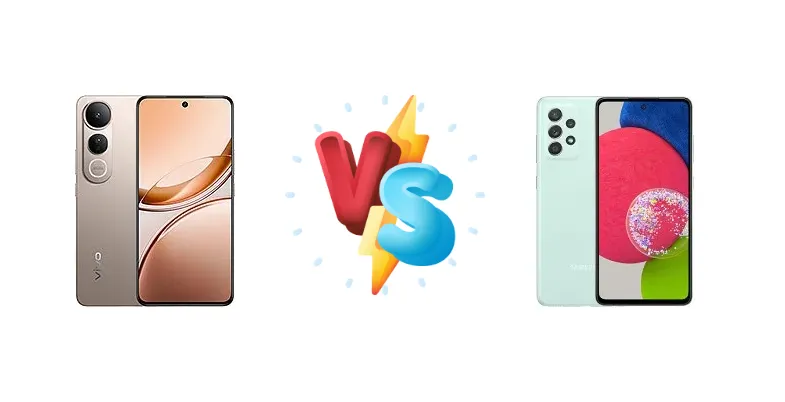
The Samsung Galaxy A52s 5G, while an older model, remains a popular choice due to its balanced feature set and 5G connectivity. The newer vivo V50 Lite 4G aims to disrupt the market with incredibly fast charging, but sacrifices 5G in the process. This comparison dissects the strengths and weaknesses of each device to determine which offers the best value for your money.
🏆 Quick Verdict
For most users, the Samsung Galaxy A52s 5G remains the superior choice. Its Snapdragon 778G chipset delivers significantly better performance, and the 5G connectivity offers future-proofing. However, the vivo V50 Lite 4G’s 90W charging is a game-changer for those prioritizing speed and convenience.
| Network |
|---|
| 2G bands | GSM 850 / 900 / 1800 / 1900 | GSM 850 / 900 / 1800 / 1900 |
| 3G bands | HSDPA 850 / 900 / 2100 | HSDPA 850 / 900 / 1700(AWS) / 1900 / 2100 |
| 4G bands | 1, 3, 5, 7, 8, 20, 28, 38, 40, 41 | 1, 2, 3, 4, 5, 7, 8, 12, 17, 20, 26, 28, 32, 38, 40, 41, 66 |
| 5G bands | - | 1, 3, 5, 7, 8, 20, 28, 38, 40, 41, 66, 78 SA/NSA/Sub6 |
| Speed | HSPA, LTE | HSPA 42.2/5.76 Mbps, LTE Cat18 1200/150 Mbps, 5G |
| Technology | GSM / HSPA / LTE | GSM / HSPA / LTE / 5G |
| Launch |
|---|
| Announced | 2025, March 17 | 2021, August 17 |
| Status | Available. Released 2025, March | Available. Released 2021, September 01 |
| Body |
|---|
| Build | Glass front, plastic back, plastic frame | Glass front (Gorilla Glass 5), plastic back |
| Dimensions | 163.8 x 76.3 x 7.8 mm (6.45 x 3.00 x 0.31 in) | 159.9 x 75.1 x 8.4 mm (6.30 x 2.96 x 0.33 in) |
| SIM | Nano-SIM + Nano-SIM | · Nano-SIM· Nano-SIM + Nano-SIM |
| Weight | 196 g (6.91 oz) | 189 g (6.67 oz) |
| | - | IP67 dust/water resistant (up to 1m for 30 min) |
| Display |
|---|
| Protection | Mohs level 4 | Corning Gorilla Glass 5 |
| Resolution | 1080 x 2392 pixels (~388 ppi density) | 1080 x 2400 pixels, 20:9 ratio (~405 ppi density) |
| Size | 6.77 inches, 110.9 cm2 (~88.7% screen-to-body ratio) | 6.5 inches, 102.0 cm2 (~84.9% screen-to-body ratio) |
| Type | AMOLED, 120Hz, 1300 nits (HBM), 1800 nits (peak) | Super AMOLED, 120Hz, 800 nits (HBM) |
| Platform |
|---|
| CPU | Octa-core (4x2.8 GHz Cortex-A73 & 4x1.9 GHz Cortex-A53) | Octa-core (1x2.4 GHz Cortex-A78 & 3x2.2 GHz Cortex-A78 & 4x1.9 GHz Cortex-A55) |
| Chipset | Qualcomm SM6225 Snapdragon 685 (6 nm) | Qualcomm SM7325 Snapdragon 778G 5G (6 nm) |
| GPU | Adreno 610 | Adreno 642L |
| OS | Android 15, Funtouch 15 | Android 11, upgradable to Android 14, One UI 6 |
| Memory |
|---|
| Card slot | Unspecified | microSDXC (uses shared SIM slot) |
| Internal | 128GB 8GB RAM, 256GB 8GB RAM | 128GB 4GB RAM, 128GB 6GB RAM, 128GB 8GB RAM, 256GB 6GB RAM, 256GB 8GB RAM |
| Main Camera |
|---|
| Dual | 50 MP, f/1.8, (wide), 1/1.95", 0.8µm, PDAF
Auxiliary lens | - |
| Features | Ring-LED flash, panorama, HDR | LED flash, panorama, HDR |
| Quad | - | 64 MP, f/1.8, 26mm (wide), 1/1.7", 0.8µm, PDAF, OIS
12 MP, f/2.2, 123˚ (ultrawide), 1.12µm
5 MP (macro)
Auxiliary lens |
| Single | - | 32 MP, f/2.2, 26mm (wide), 1/2.8", 0.8µm |
| Video | 1080p@30fps | 4K@30fps, 1080p@30/60fps; gyro-EIS |
| Selfie camera |
|---|
| Features | - | HDR |
| Single | 32 MP, f/2.5, (wide) | 32 MP, f/2.2, 26mm (wide), 1/2.8", 0.8µm |
| Video | 1080p@30fps | 4K@30fps, 1080p@30/60fps |
| Sound |
|---|
| 3.5mm jack | - | Yes |
| 35mm jack | No | Yes |
| Loudspeaker | Yes, with stereo speakers | Yes, with stereo speakers |
| Comms |
|---|
| Bluetooth | 5.0, A2DP, LE | 5.0, A2DP, LE |
| NFC | Yes | Yes (market/region dependent) |
| Positioning | GPS, GLONASS, GALILEO, BDS, QZSS | GPS, GLONASS, GALILEO, BDS, QZSS |
| Radio | No | No |
| USB | USB Type-C 2.0, OTG | USB Type-C 2.0, OTG |
| WLAN | Wi-Fi 802.11 a/b/g/n/ac, dual-band | Wi-Fi 802.11 a/b/g/n/ac/6, dual-band, Wi-Fi Direct |
| Features |
|---|
| Sensors | Fingerprint (under display, optical), accelerometer, gyro, proximity, compass | Fingerprint (under display, optical), accelerometer, gyro, compass |
| | - | Virtual Proximity Sensing |
| Battery |
|---|
| Charging | 90W wired, 50% in 27 min, 100% in 58 min
6W reverse wired | 25W wired |
| Type | Si/C Li-Ion 6500 mAh | Li-Ion 4500 mAh |
| Misc |
|---|
| Colors | Blue/Silver, Violet, Gold | Awesome Black, Awesome White, Awesome Purple, Awesome Mint |
| Models | V2441 | SM-A528B, SM-A528B/DS, SM-A528N |
| Price | € 177.65 | £ 112.98 / € 249.47 |
| SAR | - | 0.72 W/kg (head) |
| SAR EU | - | 0.88 W/kg (head) 0.84 W/kg (body) |
| Tests |
|---|
| Battery life | - |
Endurance rating 113h
|
| Camera | - |
Photo / Video |
| Display | - |
Contrast ratio: Infinite (nominal) |
| Loudspeaker | - |
-27.5 LUFS (Good)
|
| Performance | - |
AnTuTu: 429675 (v8), 506432(v9)
GeekBench: 11060 (v4.4), 2801 (v5.1)
GFXBench: 28fps (ES 3.1 onscreen) |
| EU LABEL |
|---|
| Battery | 57:35h endurance, 1000 cycles | - |
| Energy | Class B | - |
| Free fall | Class A (270 falls) | - |
| Repairability | Class B | - |
vivo V50 Lite 4G
- Superior processor performance with Snapdragon 778G 5G
- 5G connectivity for faster data speeds and future-proofing
- Brighter display for better outdoor visibility
- Slower charging speed (25W)
- Older model, potentially limited software update support
Samsung Galaxy A52s 5G
- Blazing-fast 90W wired charging
- 6W reverse wired charging
- Potentially lower price point
- Less powerful Snapdragon 685 processor
- Lacks 5G connectivity
- Display brightness likely lower than A52s 5G
Display Comparison
The Samsung Galaxy A52s 5G boasts a brighter display, reaching a measured 800 nits, crucial for outdoor visibility. While the vivo V50 Lite 4G’s display specs are not provided, it’s likely lower in peak brightness. The A52s 5G also benefits from an 'Infinite' contrast ratio, suggesting a superior AMOLED panel. This translates to richer colors and deeper blacks, enhancing the viewing experience for media consumption. The lack of detailed display information for the vivo V50 Lite 4G makes a direct comparison difficult, but the A52s 5G clearly holds an advantage in this area.
Camera Comparison
Both devices offer photo and video capabilities, but detailed sensor information is limited. The A52s 5G likely features a more sophisticated camera system, given Samsung’s history in mobile photography. Without specific sensor sizes or aperture details for the vivo V50 Lite 4G, it’s difficult to assess its low-light performance. The A52s 5G’s image processing algorithms are likely more refined, resulting in better dynamic range and detail. The presence of Optical Image Stabilization (OIS) on the A52s 5G (a common feature in this segment) would further enhance image quality, particularly in video recording.
Performance
The core difference lies in the chipsets. The Samsung Galaxy A52s 5G’s Snapdragon 778G 5G (6nm) is a significantly more powerful processor than the vivo V50 Lite 4G’s Snapdragon 685 (6nm). The 778G features a Cortex-A78 prime core clocked at 2.4 GHz, alongside three additional A78 cores, offering a substantial performance boost over the V50 Lite’s Cortex-A73 based CPU. This translates to smoother multitasking, faster app loading times, and a more responsive gaming experience. While both are 6nm chips, the architectural differences favor the 778G. The A52s 5G also benefits from potentially faster RAM (LPDDR5 vs. likely LPDDR4X in the V50 Lite), further enhancing performance.
Battery Life
The Samsung Galaxy A52s 5G has an endurance rating of 113 hours, indicating solid battery life. However, the vivo V50 Lite 4G attempts to overcome a potentially smaller battery with its groundbreaking 90W wired charging. This allows for a 50% charge in just 27 minutes and a full charge in 58 minutes – a massive advantage over the A52s 5G’s 25W charging. The V50 Lite also offers 6W reverse wired charging, a feature absent on the A52s 5G. While the A52s 5G offers longer overall runtime, the V50 Lite’s charging speed is a compelling feature for users who prioritize convenience.
Buying Guide
Buy the vivo V50 Lite 4G if you prioritize incredibly fast charging and don't require 5G connectivity. It's ideal for users who frequently find themselves needing to top up their battery quickly. Buy the Samsung Galaxy A52s 5G if you value overall performance, 5G support, and a brighter display, making it better suited for gaming, streaming, and future network compatibility.
Frequently Asked Questions
❓ Is the Snapdragon 685 in the vivo V50 Lite 4G capable of handling demanding games like PUBG or Genshin Impact?
While the Snapdragon 685 is a capable chip for everyday tasks, it will likely struggle with graphically intensive games like PUBG or Genshin Impact at higher settings. You'll likely need to lower the graphics settings and frame rate to achieve a playable experience. The Snapdragon 778G in the A52s 5G offers a much smoother gaming experience.
❓ How much faster is the 90W charging on the vivo V50 Lite 4G compared to the 25W charging on the Samsung Galaxy A52s 5G in real-world use?
The difference is substantial. The vivo V50 Lite 4G can go from 0% to 50% in just 27 minutes, and fully charge in under an hour. The Samsung Galaxy A52s 5G will take considerably longer – likely over two hours for a full charge. This makes the V50 Lite ideal for users who frequently need a quick power boost.
❓ Does the lack of 5G on the vivo V50 Lite 4G significantly impact its usability in 2024?
It depends on your location and carrier. If 5G coverage is widespread in your area and you have a 5G data plan, you'll miss out on the faster speeds offered by the A52s 5G. However, if 5G is limited or unavailable, the difference will be negligible. 4G LTE remains a perfectly viable network for most users.