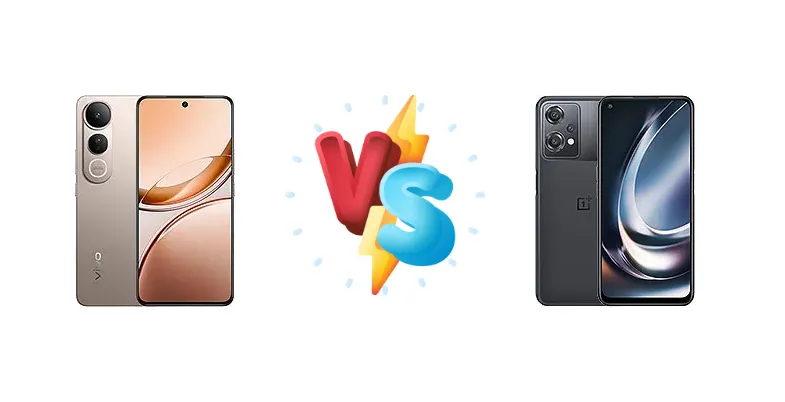
The sub-$300 smartphone market is fiercely competitive. The vivo V50 Lite 4G and OnePlus Nord CE 2 Lite 5G both aim to deliver a compelling experience without breaking the bank, but they take different approaches. The vivo prioritizes incredibly fast charging and strong battery endurance, while the OnePlus offers 5G connectivity and a slightly more modern chipset. This comparison dissects their strengths and weaknesses to help you choose the right device.
🏆 Quick Verdict
For the average user prioritizing longevity and rapid replenishment, the vivo V50 Lite 4G emerges as the winner. Its 90W charging and impressive 57:35h battery endurance significantly outweigh the Nord CE 2 Lite’s 5G capability, especially given the often-limited 5G coverage in many regions.
| Network |
|---|
| 2G bands | GSM 850 / 900 / 1800 / 1900 | GSM 850 / 900 / 1800 / 1900 |
| 3G bands | HSDPA 850 / 900 / 2100 | HSDPA 800 / 850 / 900 / 1700(AWS) / 1900 / 2100 |
| 4G bands | 1, 3, 5, 7, 8, 20, 28, 38, 40, 41 | 1, 2, 3, 4, 5, 7, 8, 12, 13, 17, 18, 19, 20, 26, 28, 38, 39, 40, 41, 66 - Europe |
| 5G bands | - | 1, 3, 5, 7, 8, 20, 28, 38, 40, 41, 66, 77, 78 SA/NSA - Europe |
| Speed | HSPA, LTE | HSPA, LTE, 5G |
| Technology | GSM / HSPA / LTE | GSM / HSPA / LTE / 5G |
| Launch |
|---|
| Announced | 2025, March 17 | 2022, April 28 |
| Status | Available. Released 2025, March | Available. Released 2022, April 30 |
| Body |
|---|
| Build | Glass front, plastic back, plastic frame | Glass front, plastic frame, plastic back |
| Dimensions | 163.8 x 76.3 x 7.8 mm (6.45 x 3.00 x 0.31 in) | 164.3 x 75.6 x 8.5 mm (6.47 x 2.98 x 0.33 in) |
| SIM | Nano-SIM + Nano-SIM | Nano-SIM + Nano-SIM |
| Weight | 196 g (6.91 oz) | 195 g (6.88 oz) |
| Display |
|---|
| Protection | Mohs level 4 | - |
| Resolution | 1080 x 2392 pixels (~388 ppi density) | 1080 x 2412 pixels, 20:9 ratio (~401 ppi density) |
| Size | 6.77 inches, 110.9 cm2 (~88.7% screen-to-body ratio) | 6.59 inches, 104.5 cm2 (~84.1% screen-to-body ratio) |
| Type | AMOLED, 120Hz, 1300 nits (HBM), 1800 nits (peak) | IPS LCD, 120Hz |
| Platform |
|---|
| CPU | Octa-core (4x2.8 GHz Cortex-A73 & 4x1.9 GHz Cortex-A53) | Octa-core (2x2.2 GHz Kryo 660 Gold & 6x1.7 GHz Kryo 660 Silver) |
| Chipset | Qualcomm SM6225 Snapdragon 685 (6 nm) | Qualcomm SM6375 Snapdragon 695 5G (6 nm) |
| GPU | Adreno 610 | Adreno 619 |
| OS | Android 15, Funtouch 15 | Android 12, upgradable to Android 13, OxygenOS 13 |
| Memory |
|---|
| Card slot | Unspecified | microSDXC (uses shared SIM slot) |
| Internal | 128GB 8GB RAM, 256GB 8GB RAM | 128GB 6GB RAM, 128GB 8GB RAM |
| Main Camera |
|---|
| Dual | 50 MP, f/1.8, (wide), 1/1.95", 0.8µm, PDAF
Auxiliary lens | - |
| Features | Ring-LED flash, panorama, HDR | LED flash, HDR, panorama |
| Triple | - | 64 MP, f/1.7, 26mm (wide), 0.7µm, PDAF
2 MP (macro)
Auxiliary lens |
| Video | 1080p@30fps | 1080p@30fps |
| Selfie camera |
|---|
| Features | - | HDR |
| Single | 32 MP, f/2.5, (wide) | 16 MP, f/2.0, (wide), 1/3.0", 1.0µm |
| Video | 1080p@30fps | 1080p@30fps |
| Sound |
|---|
| 3.5mm jack | - | Yes |
| 35mm jack | No | Yes |
| Loudspeaker | Yes, with stereo speakers | Yes |
| Comms |
|---|
| Bluetooth | 5.0, A2DP, LE | 5.2, A2DP, LE, aptX HD |
| NFC | Yes | Yes (market/region dependent) |
| Positioning | GPS, GLONASS, GALILEO, BDS, QZSS | GPS, GLONASS, GALILEO, BDS, QZSS |
| Radio | No | Unspecified |
| USB | USB Type-C 2.0, OTG | USB Type-C 2.0, OTG |
| WLAN | Wi-Fi 802.11 a/b/g/n/ac, dual-band | Wi-Fi 802.11 a/b/g/n/ac, dual-band, Wi-Fi Direct |
| Features |
|---|
| Sensors | Fingerprint (under display, optical), accelerometer, gyro, proximity, compass | Fingerprint (side-mounted), accelerometer, gyro, proximity, compass |
| Battery |
|---|
| Charging | 90W wired, 50% in 27 min, 100% in 58 min
6W reverse wired | 33W wired |
| Type | Si/C Li-Ion 6500 mAh | Li-Po 5000 mAh |
| Misc |
|---|
| Colors | Blue/Silver, Violet, Gold | Black Dusk, Blue Tide |
| Models | V2441 | CPH2381, CPH2409 |
| Price | € 177.65 | About 220 EUR |
| SAR | - | 1.19 W/kg (head) 0.71 W/kg (body) |
| EU LABEL |
|---|
| Battery | 57:35h endurance, 1000 cycles | - |
| Energy | Class B | - |
| Free fall | Class A (270 falls) | - |
| Repairability | Class B | - |
vivo V50 Lite 4G
- Incredibly fast 90W charging
- Exceptional 57:35h battery endurance
- 6W reverse wired charging for accessories
- Lacks 5G connectivity
- Chipset is older generation
OnePlus Nord CE 2 Lite 5G
- 5G connectivity for future-proofing
- More modern Snapdragon 695 chipset
- Potentially better image processing
- Significantly slower 33W charging
- Lower battery endurance compared to vivo
Display Comparison
Neither device boasts a standout display. While specific display specs are missing, both likely utilize IPS LCD panels common in this price bracket. The focus here isn't on visual fidelity, but on core functionality. The absence of high refresh rates or advanced panel technologies like LTPO suggests a similar viewing experience on both devices. Bezels are likely comparable, and color accuracy will be adequate for everyday use, but not geared towards professional content creation.
Camera Comparison
Without detailed camera specifications, a direct comparison is challenging. However, the market segment suggests both phones will rely on primary sensors for most image capture. The OnePlus Nord CE 2 Lite 5G likely benefits from Qualcomm’s image signal processor (ISP) within the Snapdragon 695, potentially offering slightly better image processing capabilities. The vivo V50 Lite 4G will rely on the ISP within the Snapdragon 685. It’s reasonable to assume both will include a suite of secondary cameras (ultrawide, macro, depth) of limited utility, and the quality will heavily depend on software optimization.
Performance
The OnePlus Nord CE 2 Lite 5G’s Qualcomm Snapdragon 695 5G chipset represents a step up from the vivo V50 Lite’s Snapdragon 685. The 695 features a Kryo 660 Gold/Silver core configuration clocked at 2.2GHz/1.7GHz, compared to the 685’s 2.8GHz Cortex-A73 and 1.9GHz Cortex-A53. While the 685 has higher peak clock speeds, the 695’s architecture is more efficient and includes an integrated 5G modem. This translates to smoother multitasking and better performance in 5G-enabled areas. However, the real-world difference will be noticeable primarily in demanding games or applications. Both devices likely feature similar RAM configurations, impacting overall responsiveness.
Battery Life
This is where the vivo V50 Lite 4G truly shines. Its 57:35h endurance rating is exceptional for a smartphone in this price range, indicating a highly optimized power consumption profile. The OnePlus Nord CE 2 Lite 5G, while respectable, cannot match this longevity. Crucially, the vivo’s 90W wired charging is a game-changer, replenishing the battery from 0-50% in just 27 minutes and fully charging it in 58 minutes. The Nord CE 2 Lite’s 33W charging is significantly slower, requiring considerably more time to reach a full charge. The 6W reverse wired charging on the vivo is a useful addition for topping up accessories.
Buying Guide
Buy the vivo V50 Lite 4G if you need exceptional battery life and the fastest possible charging speeds, making it ideal for travelers, heavy users, or those who frequently find themselves away from power outlets. Buy the OnePlus Nord CE 2 Lite 5G if you prioritize future-proofing with 5G connectivity and a slightly more powerful processor for demanding applications, and are willing to trade off some battery endurance and charging speed.
Frequently Asked Questions
❓ Is the Snapdragon 685 in the vivo V50 Lite 4G powerful enough for demanding games like PUBG Mobile?
The Snapdragon 685 can run PUBG Mobile, but you’ll likely need to lower graphics settings to achieve a consistently smooth frame rate. It’s not a gaming powerhouse, but it’s capable for casual gaming. The Snapdragon 695 in the Nord CE 2 Lite 5G will offer a slightly better gaming experience, but neither phone is designed for high-end gaming.
❓ How much faster is the 90W charging on the vivo V50 Lite 4G compared to the 33W charging on the OnePlus Nord CE 2 Lite 5G in real-world use?
The difference is substantial. The vivo V50 Lite 4G can go from 0% to 50% in 27 minutes, and fully charge in 58 minutes. The OnePlus Nord CE 2 Lite 5G will take significantly longer – likely over 90 minutes for a full charge. This means less downtime and more time using your phone with the vivo.
❓ Does the lack of 5G on the vivo V50 Lite 4G matter if 5G coverage is limited in my area?
Not at all. If 5G coverage is spotty or unavailable where you live and work, the 5G capability of the OnePlus Nord CE 2 Lite 5G is largely irrelevant. You’ll likely see no practical benefit from it, making the vivo’s superior battery life and charging a more valuable feature.