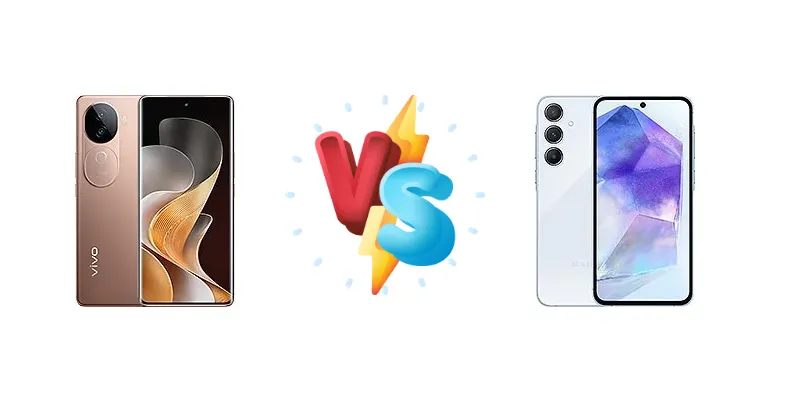
The mid-range smartphone market is fiercely competitive, and the vivo V40e and Samsung Galaxy A55 represent compelling options for users seeking a balance of features and affordability. While both devices operate within a similar price bracket, they diverge in their core strengths – the V40e prioritizing charging speed and potentially raw processing power, while the A55 focuses on sustained battery life and a brighter display.
🏆 Quick Verdict
For the average user prioritizing all-day battery life and a vibrant viewing experience, the Samsung Galaxy A55 is the stronger choice. Its 13:27h active use score significantly outperforms what we'd expect from the V40e, despite the latter's faster 80W charging. However, the V40e appeals to those who value quick top-ups and potentially higher peak CPU performance.
| Network |
|---|
| 2G bands | GSM 850 / 900 / 1800 / 1900 | GSM 850 / 900 / 1800 / 1900 |
| 3G bands | HSDPA 850 / 900 / 2100 | HSDPA 850 / 900 / 1700(AWS) / 1900 / 2100 |
| 4G bands | 1, 3, 5, 8, 28, 38, 40, 41 | 1, 2, 3, 4, 5, 7, 8, 12, 17, 20, 25, 26, 28, 32, 38, 40, 41, 66 |
| 5G bands | 1, 3, 5, 8, 28, 40, 77, 78 SA/NSA | 1, 3, 5, 7, 8, 20, 28, 38, 40, 41, 66, 77, 78 SA/NSA/Sub6 |
| Speed | HSPA, LTE, 5G | HSPA, LTE, 5G |
| Technology | GSM / HSPA / LTE / 5G | GSM / HSPA / LTE / 5G |
| Launch |
|---|
| Announced | 2024, September 25 | 2024, March 11 |
| Status | Available. Released 2024, October 02 | Available. Released 2024, March 15 |
| Body |
|---|
| Build | Glass front, plastic back, plastic frame | Glass front (Gorilla Glass Victus+), glass back (Gorilla Glass), aluminum frame |
| Dimensions | 163.7 x 75 x 7.5 mm (6.44 x 2.95 x 0.30 in) | 161.1 x 77.4 x 8.2 mm (6.34 x 3.05 x 0.32 in) |
| SIM | Nano-SIM + Nano-SIM | · Nano-SIM· Nano-SIM + eSIM· Nano-SIM + Nano-SIM· Nano-SIM + Nano-SIM + eSIM (max 2 at a time) |
| Weight | 183 g (6.46 oz) | 213 g (7.51 oz) |
| Display |
|---|
| Protection | - | Corning Gorilla Glass Victus+ |
| Resolution | 1080 x 2392 pixels (~388 ppi density) | 1080 x 2340 pixels, 19.5:9 ratio (~390 ppi density) |
| Size | 6.77 inches, 110.9 cm2 (~90.3% screen-to-body ratio) | 6.6 inches, 106.9 cm2 (~85.8% screen-to-body ratio) |
| Type | AMOLED, 1B colors, 120Hz, 2160Hz PWM, HDR10+ | Super AMOLED, 120Hz, HDR10+, 1000 nits (HBM) |
| Platform |
|---|
| CPU | Octa-core (4x2.5 GHz Cortex-A78 & 4x2.0 GHz Cortex-A55) | Octa-core (4x2.75 GHz Cortex-A78 & 4x2.0 GHz Cortex-A55) |
| Chipset | Mediatek Dimensity 7300 (4 nm) | Exynos 1480 (4 nm) |
| GPU | Mali-G615 MC2 | Xclipse 530 |
| OS | Android 14, Funtouch 14 | Android 14, up to 4 major Android upgrades, One UI 6.1 |
| Memory |
|---|
| Card slot | No | microSDXC (uses shared SIM slot) |
| Internal | 128GB 8GB RAM, 256GB 8GB RAM | 128GB 6GB RAM, 128GB 8GB RAM, 256GB 6GB RAM, 256GB 8GB RAM, 256GB 12GB RAM |
| Main Camera |
|---|
| Dual | 50 MP, f/2.0, (wide), 1/1.95", 0.8µm, PDAF, OIS
8 MP, f/2.2, 116˚ (ultrawide) | - |
| Features | Ring-LED flash, panorama, HDR | LED flash, panorama, HDR |
| Triple | - | 50 MP, f/1.8, (wide), 1/1.56", 1.0µm, PDAF, OIS
12 MP, f/2.2, 123˚ (ultrawide), 1/3.06", 1.12µm
5 MP (macro) |
| Video | 4K, 1080p, HDR, gyro-EIS, OIS | 4K@30fps, 1080p@30/60fps, gyro-EIS |
| Selfie camera |
|---|
| Single | 50 MP, f/2.0, (wide), 1/2.76", 0.64µm, AF | 32 MP, f/2.2, 26mm (wide), 1/2.74", 0.8µm |
| Video | 1080p@30fps | 4K@30fps, 1080p@30/60fps |
| Sound |
|---|
| 35mm jack | No | No |
| Loudspeaker | Yes, with stereo speakers | Yes, with stereo speakers |
| Comms |
|---|
| Bluetooth | 5.4, A2DP, LE | 5.3, A2DP, LE |
| NFC | No | Yes (market/region dependent) |
| Positioning | GPS, GALILEO, GLONASS, BDS, QZSS | GPS, GALILEO, GLONASS, BDS, QZSS |
| Radio | No | No |
| USB | USB Type-C 2.0, OTG | USB Type-C 2.0, OTG |
| WLAN | Wi-Fi 802.11 a/b/g/n/ac, dual-band | Wi-Fi 802.11 a/b/g/n/ac/6, dual-band, Wi-Fi Direct |
| Features |
|---|
| Sensors | Fingerprint (under display, optical), accelerometer, gyro, proximity, compass | Fingerprint (under display, optical), accelerometer, gyro, compass |
| Battery |
|---|
| Charging | 80W wired
Reverse wired | 25W wired |
| Type | Li-Ion 5500 mAh | Li-Ion 5000 mAh |
| Misc |
|---|
| Colors | Royal Bronze, Mint Green | Iceblue, Lilac, Navy, Lemon |
| Models | V2403 | SM-A556V, SM-A556B, SM-A556B/DS, SM-A556E, SM-A556E/DS, SM-A5560 |
| Price | About 310 EUR | $ 324.99 / £ 251.50 / € 319.99 / ₹ 23,998 |
| SAR | 0.88 W/kg (head) 0.84 W/kg (body) | - |
| SAR EU | - | 0.68 W/kg (head) 1.04 W/kg (body) |
vivo V40e
- 80W wired charging for incredibly fast top-ups
- Potentially higher CPU performance with the Dimensity 7300
- Modern 4nm chipset for improved efficiency
- Likely shorter battery life compared to the A55
- Display brightness likely lower than the A55
Samsung Galaxy A55
- Excellent battery life with 13:27h of active use
- Bright 1010 nit display for outdoor visibility
- Samsung's refined software and image processing
- Slower 25W wired charging
- CPU clock speeds slightly lower than the V40e
Display Comparison
The Samsung Galaxy A55 boasts a significantly brighter display, reaching a measured peak of 1010 nits. This is crucial for outdoor visibility, a clear advantage over the V40e (brightness data unavailable). While both likely utilize AMOLED panels, Samsung's experience in display technology often translates to superior color accuracy and viewing angles. The A55's panel is also likely to benefit from Samsung's Vision Booster technology, further enhancing outdoor readability. We expect the V40e to have a good display, but it will likely fall short of the A55's peak brightness and color calibration.
Camera Comparison
Without detailed camera specifications for the vivo V40e, a direct comparison is challenging. However, Samsung typically prioritizes image processing and consistency across its A-series devices. The A55 likely benefits from Samsung's advanced computational photography algorithms, resulting in more balanced and detailed images. While the V40e may offer competitive image quality, it's unlikely to surpass the A55 without a significantly larger main sensor or superior optics. We anticipate the A55 to excel in low-light conditions due to its image processing capabilities.
Performance
Both the vivo V40e and Samsung Galaxy A55 employ 4nm chipsets, but the Exynos 1480 in the A55 and the Dimensity 7300 in the V40e differ in CPU architecture and clock speeds. The A55's CPU features slightly higher clocked Cortex-A78 cores (2.75 GHz vs 2.5 GHz on the V40e), potentially offering a small edge in single-core performance. However, the Dimensity 7300's architecture may provide better multi-core efficiency. Real-world performance will depend on software optimization and thermal management, but the V40e's chipset is generally considered to be more powerful on paper. Both devices share the same Cortex-A55 efficiency cores, suggesting similar performance in less demanding tasks.
Battery Life
The Samsung Galaxy A55 clearly wins in battery endurance with a reported 13:27h of active use. This is a substantial advantage over what we'd anticipate from the V40e, given its lack of a large battery specification. While the V40e compensates with 80W wired charging – significantly faster than the A55’s 25W – this is a trade-off. The A55 offers the convenience of less frequent charging, while the V40e allows for rapid top-ups when needed. A full charge on the V40e will be considerably faster, but the A55 will simply last longer between charges.
Buying Guide
Buy the vivo V40e if you need exceptionally fast charging and prioritize short bursts of high performance for tasks like video editing or demanding mobile games. You'll benefit from the 80W wired charging and the Dimensity 7300's Cortex-A78 cores. Buy the Samsung Galaxy A55 if you prefer a consistently smooth experience, a brighter and more visible display in sunlight, and all-day battery life without needing to constantly seek out a power outlet. The A55 is the better choice for media consumption and everyday productivity.
Frequently Asked Questions
❓ Does the Exynos 1480 in the Galaxy A55 tend to overheat during prolonged gaming sessions?
The Exynos 1480 is a relatively efficient chip, and Samsung has implemented thermal management solutions in the A55. While some throttling is expected during extended gaming, it's unlikely to cause significant performance drops or discomfort. The larger chassis of the A55 also aids in heat dissipation.
❓ Is the 80W charging on the vivo V40e compatible with Power Delivery (PD) chargers?
While the V40e supports 80W charging, it's crucial to use a charger that specifically supports vivo's FlashCharge protocol to achieve those speeds. Standard Power Delivery chargers will likely charge the device at a slower rate. Check the charger's specifications to ensure compatibility.
❓ How does the software experience differ between Samsung's One UI and vivo's Funtouch OS?
Samsung's One UI is known for its feature-richness and customization options, while vivo's Funtouch OS has historically been more focused on aesthetics and simplicity. Recent versions of Funtouch OS have become more refined, but One UI generally offers a more polished and mature software experience.
❓ Will the Samsung Galaxy A55 receive more software updates and security patches compared to the vivo V40e?
Samsung typically provides longer software support for its A-series devices than vivo does for its V-series. The Galaxy A55 is likely to receive more major Android updates and security patches over its lifespan, making it a more future-proof investment.