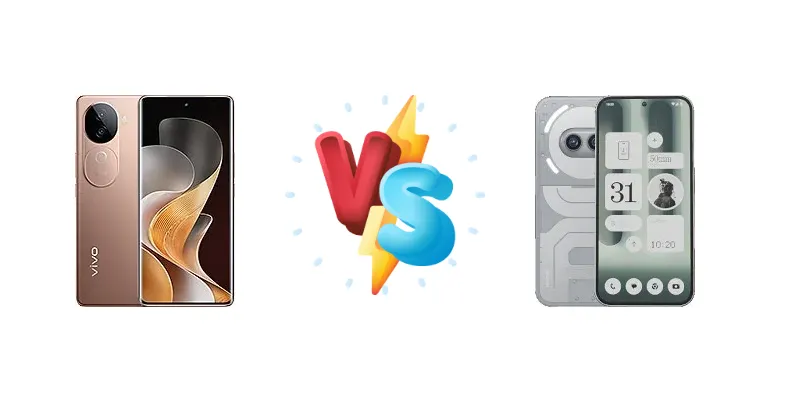
The mid-range smartphone market is fiercely competitive, and the vivo V40e and Nothing Phone (2a) Plus both aim to deliver a premium experience without the flagship price tag. The V40e focuses on rapid charging and a proven chipset, while the Nothing Phone (2a) Plus emphasizes display quality and a longer-lasting battery. This comparison dissects their key differences to help you choose the right device.
🏆 Quick Verdict
For the average user prioritizing all-day battery life and a brighter, more vibrant display, the Nothing Phone (2a) Plus is the stronger choice. Its 16:34 active use score and 1097 nits peak brightness significantly outperform the V40e, despite the V40e's faster 80W charging.
| Network |
|---|
| 2G bands | GSM 850 / 900 / 1800 / 1900 | GSM 850 / 900 / 1800 / 1900 |
| 3G bands | HSDPA 850 / 900 / 2100 | HSDPA 800 / 850 / 900 / 1700(AWS) / 1900 / 2100 |
| 4G bands | 1, 3, 5, 8, 28, 38, 40, 41 | 1, 3, 4, 5, 7, 8, 18, 19, 20, 26, 28, 38, 39, 40, 41, 42, 66 |
| 5G bands | 1, 3, 5, 8, 28, 40, 77, 78 SA/NSA | 1, 3, 5, 7, 8, 20, 28, 38, 40, 41, 66, 77, 78 SA/NSA |
| Speed | HSPA, LTE, 5G | HSPA, LTE, 5G |
| Technology | GSM / HSPA / LTE / 5G | GSM / HSPA / LTE / 5G |
| Launch |
|---|
| Announced | 2024, September 25 | 2024, July 31 |
| Status | Available. Released 2024, October 02 | Available. Released 2024, August 03 |
| Body |
|---|
| Build | Glass front, plastic back, plastic frame | Glass front (Gorilla Glass 5), plastic frame, plastic back |
| Dimensions | 163.7 x 75 x 7.5 mm (6.44 x 2.95 x 0.30 in) | 161.7 x 76.3 x 8.5 mm (6.37 x 3.00 x 0.33 in) |
| SIM | Nano-SIM + Nano-SIM | Nano-SIM + Nano-SIM |
| Weight | 183 g (6.46 oz) | 190 g (6.70 oz) |
| Display |
|---|
| Protection | - | Corning Gorilla Glass 5 |
| Resolution | 1080 x 2392 pixels (~388 ppi density) | 1080 x 2412 pixels, 20:9 ratio (~395 ppi density) |
| Size | 6.77 inches, 110.9 cm2 (~90.3% screen-to-body ratio) | 6.7 inches, 107.5 cm2 (~87.1% screen-to-body ratio) |
| Type | AMOLED, 1B colors, 120Hz, 2160Hz PWM, HDR10+ | AMOLED, 1B colors, 120Hz, 2160Hz PWM, HDR10+, 700 nits (typ), 1100 nits (HBM), 1300 nits (peak) |
| Platform |
|---|
| CPU | Octa-core (4x2.5 GHz Cortex-A78 & 4x2.0 GHz Cortex-A55) | Octa-core (2x3.0 GHz Cortex-A715 & 6x 2.0 GHz Cortex-A510) |
| Chipset | Mediatek Dimensity 7300 (4 nm) | Mediatek Dimensity 7350 Pro (4 nm) |
| GPU | Mali-G615 MC2 | Mali-G610 MC4 |
| OS | Android 14, Funtouch 14 | Android 14, up to 3 major Android upgrades, Nothing OS 3.0 |
| Memory |
|---|
| Card slot | No | No |
| Internal | 128GB 8GB RAM, 256GB 8GB RAM | 256GB 8GB RAM, 256GB 12GB RAM |
| Main Camera |
|---|
| Dual | 50 MP, f/2.0, (wide), 1/1.95", 0.8µm, PDAF, OIS
8 MP, f/2.2, 116˚ (ultrawide) | 50 MP, f/1.9, 24mm (wide), 1/1.57", 1.0µm, PDAF, OIS
50 MP, f/2.2, 114˚ (ultrawide), 1/2.76", 0.64µm |
| Features | Ring-LED flash, panorama, HDR | LED flash, panorama, HDR |
| Video | 4K, 1080p, HDR, gyro-EIS, OIS | 4K@30fps, 1080p@60/120fps, gyro-EIS |
| Selfie camera |
|---|
| Features | - | HDR |
| Single | 50 MP, f/2.0, (wide), 1/2.76", 0.64µm, AF | 50 MP, f/2.2, (wide), 1/2.76" |
| Video | 1080p@30fps | 4K@30fps |
| Sound |
|---|
| 35mm jack | No | No |
| Loudspeaker | Yes, with stereo speakers | Yes, with stereo speakers |
| Comms |
|---|
| Bluetooth | 5.4, A2DP, LE | 5.3, A2DP, LE |
| NFC | No | Yes, 360˚ |
| Positioning | GPS, GALILEO, GLONASS, BDS, QZSS | GPS, GALILEO, GLONASS, BDS, QZSS |
| Radio | No | No |
| USB | USB Type-C 2.0, OTG | USB Type-C 2.0, OTG |
| WLAN | Wi-Fi 802.11 a/b/g/n/ac, dual-band | Wi-Fi 802.11 a/b/g/n/ac/6, dual-band, Wi-Fi Direct |
| Features |
|---|
| Sensors | Fingerprint (under display, optical), accelerometer, gyro, proximity, compass | Fingerprint (under display, optical), accelerometer, gyro, proximity, compass |
| Battery |
|---|
| Charging | 80W wired
Reverse wired | 50W wired, 50% in 21 min, 100% in 56 min |
| Type | Li-Ion 5500 mAh | 5000 mAh |
| Misc |
|---|
| Colors | Royal Bronze, Mint Green | Black, Grey |
| Models | V2403 | A142P |
| Price | About 310 EUR | € 269.90 / ₹ 22,599 |
| SAR | 0.88 W/kg (head) 0.84 W/kg (body) | - |
vivo V40e
- 80W wired charging offers incredibly fast top-ups.
- Mediatek Dimensity 7300 is a capable performer for everyday tasks.
- Reverse wired charging provides added convenience.
- Battery life is likely shorter than the Nothing Phone (2a) Plus.
- Display brightness and quality are likely inferior to the Nothing Phone (2a) Plus.
Nothing Phone (2a) Plus
- Excellent 16:34 hour active use battery life.
- 1097 nits peak brightness delivers a vibrant viewing experience.
- Dimensity 7350 Pro offers improved CPU performance.
- 50W charging is slower than the V40e’s 80W.
- Software experience may not appeal to all users.
Display Comparison
The Nothing Phone (2a) Plus boasts a clear advantage in display technology, achieving a measured peak brightness of 1097 nits. While the V40e’s display specs are not provided, this brightness level suggests superior outdoor visibility and HDR content playback on the Nothing Phone. The absence of LTPO technology on either device means refresh rate scaling isn't present, but the higher peak brightness is a tangible benefit for users consuming media or working outdoors. The Nothing Phone's display is likely to offer a more immersive and visually appealing experience.
Camera Comparison
Without detailed camera specifications for the vivo V40e, a direct comparison is limited. However, the market positioning of both devices suggests a focus on versatile camera systems rather than outright flagship-level imaging. The Nothing Phone (2a) Plus likely benefits from Nothing’s image processing algorithms, aiming for a natural and balanced look. The absence of information regarding sensor size and OIS on the V40e makes it difficult to assess its low-light performance or video stabilization capabilities. Users prioritizing camera quality should seek detailed camera samples before making a decision.
Performance
Both phones utilize Mediatek’s 4nm Dimensity series, but the Nothing Phone (2a) Plus features the Dimensity 7350 Pro, a step up from the V40e’s Dimensity 7300. The 7350 Pro employs a more modern CPU architecture with 2x3.0 GHz Cortex-A715 cores versus the V40e’s 4x2.5 GHz Cortex-A78 cores, promising improved single-core performance. While both have 6x2.0 GHz efficiency cores, the architectural improvements in the 7350 Pro translate to better responsiveness and smoother multitasking. The V40e’s Cortex-A78 cores, while capable, are a generation behind. This difference will be most noticeable in demanding applications and gaming.
Battery Life
The Nothing Phone (2a) Plus delivers a compelling 16:34 hours of active use, a significant advantage over what we’d expect from the V40e given its unspecified battery capacity. While the V40e compensates with 80W wired charging – capable of quickly topping up the battery – the Nothing Phone’s longevity reduces the need for frequent charging. The Nothing Phone (2a) Plus reaches 50% charge in 21 minutes and 100% in 56 minutes with its 50W charging, a reasonable trade-off for the extended battery life. The V40e’s faster charging is ideal for quick boosts, but the Nothing Phone’s endurance is more practical for all-day use.
Buying Guide
Buy the vivo V40e if you prioritize extremely fast charging and frequently top up your phone throughout the day. Its 80W wired charging is a significant advantage for those who dislike waiting. Buy the Nothing Phone (2a) Plus if you value a superior display experience, longer battery life between charges, and a cleaner software experience, even if it means slightly slower charging speeds.
Frequently Asked Questions
❓ Does the Dimensity 7350 Pro in the Nothing Phone (2a) Plus get noticeably hotter than the Dimensity 7300 during extended gaming sessions?
While both chips are built on a 4nm process, the 7350 Pro's higher clock speeds and more complex architecture *could* lead to slightly higher temperatures under sustained load. However, Nothing's thermal management system is likely designed to mitigate this, and real-world performance will depend on the game and ambient temperature. The V40e may throttle sooner to maintain temperatures.
❓ How does the 50W charging on the Nothing Phone (2a) Plus compare to the 80W charging on the vivo V40e in terms of actual usability?
While 80W is faster on paper, the Nothing Phone (2a) Plus’s 50W still delivers a 50% charge in 21 minutes, which is reasonably quick. The V40e’s advantage is most pronounced when charging from very low percentages, but the Nothing Phone’s superior battery life means you’ll likely need to utilize that fast charging less often.
❓ Is the software experience on the Nothing Phone (2a) Plus significantly different from the typical Android experience found on the vivo V40e?
Yes. Nothing OS is known for its minimalist design and focus on usability, offering a cleaner and more streamlined experience compared to vivo’s Funtouch OS, which often includes pre-installed apps and a more customized interface. Users who prefer a near-stock Android experience will likely favor the Nothing Phone (2a) Plus.