
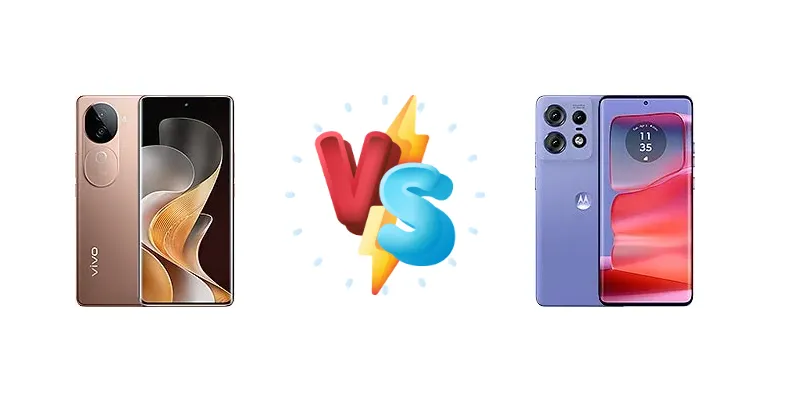
Motorola Edge 50 Pro vs vivo V40e: Which Mid-Range Champion Reigns Supreme?
| Phones Images | |||||
|---|---|---|---|---|---|
|
🏆 Quick Verdict
For the average user prioritizing fast charging and sustained performance, the Motorola Edge 50 Pro is the clear winner. Its 125W charging and Snapdragon 7 Gen 3 chipset offer a significant advantage, despite the vivo V40e’s respectable specs. However, the V40e remains a viable option for budget-conscious buyers.
| PHONES | ||
|---|---|---|
| Phone Names | vivo V40e | Motorola Edge 50 Pro |
| Network | ||
|---|---|---|
| 2G bands | GSM 850 / 900 / 1800 / 1900 | GSM 850 / 900 / 1800 / 1900 |
| 3G bands | HSDPA 850 / 900 / 2100 | HSDPA 850 / 900 / 1700(AWS) / 1900 / 2100 |
| 4G bands | 1, 3, 5, 8, 28, 38, 40, 41 | 1, 2, 3, 4, 5, 7, 8, 12, 13, 17, 18, 19, 20, 26, 28, 32, 38, 39, 40, 41, 43, 48, 66 |
| 5G bands | 1, 3, 5, 8, 28, 40, 77, 78 SA/NSA | 1, 2, 3, 5, 7, 8, 20, 26, 28, 38, 40, 41, 66, 77, 78 SA/NSA/Sub6 |
| Speed | HSPA, LTE, 5G | HSPA, LTE, 5G |
| Technology | GSM / HSPA / LTE / 5G | GSM / HSPA / LTE / 5G |
| Launch | ||
|---|---|---|
| Announced | 2024, September 25 | 2024, April 03 |
| Status | Available. Released 2024, October 02 | Available. Released 2024, April 08 |
| Body | ||
|---|---|---|
| Build | Glass front, plastic back, plastic frame | Glass front, plastic back or silicone polymer back (eco leather), aluminum frame |
| Dimensions | 163.7 x 75 x 7.5 mm (6.44 x 2.95 x 0.30 in) | 161.2 x 72.4 x 8.2 mm (6.35 x 2.85 x 0.32 in) |
| SIM | Nano-SIM + Nano-SIM | · Nano-SIM + eSIM· Nano-SIM + Nano-SIM |
| Weight | 183 g (6.46 oz) | 186 g (6.56 oz) |
| Display | ||
|---|---|---|
| Protection | - | Corning Gorilla Glass (unspecified version) |
| Resolution | 1080 x 2392 pixels (~388 ppi density) | 1220 x 2712 pixels, 20:9 ratio (~446 ppi density) |
| Size | 6.77 inches, 110.9 cm2 (~90.3% screen-to-body ratio) | 6.7 inches, 107.4 cm2 (~92.0% screen-to-body ratio) |
| Type | AMOLED, 1B colors, 120Hz, 2160Hz PWM, HDR10+ | P-OLED, 1B colors, 144Hz, HDR10+, 2000 nits (peak) |
| Platform | ||
|---|---|---|
| CPU | Octa-core (4x2.5 GHz Cortex-A78 & 4x2.0 GHz Cortex-A55) | Octa-core (1x2.63 GHz Cortex-A715 & 4x2.4 GHz Cortex-A715 & 3x1.8 GHz Cortex-A510) |
| Chipset | Mediatek Dimensity 7300 (4 nm) | Qualcomm SM7550-AB Snapdragon 7 Gen 3 (4 nm) |
| GPU | Mali-G615 MC2 | Adreno 720 |
| OS | Android 14, Funtouch 14 | Android 14, up to 3 major Android upgrades |
| Memory | ||
|---|---|---|
| Card slot | No | No |
| Internal | 128GB 8GB RAM, 256GB 8GB RAM | 128GB 8GB RAM, 256GB 8GB RAM, 256GB 12GB RAM, 512GB 12GB RAM |
| Main Camera | ||
|---|---|---|
| Dual | 50 MP, f/2.0, (wide), 1/1.95", 0.8µm, PDAF, OIS 8 MP, f/2.2, 116˚ (ultrawide) | - |
| Features | Ring-LED flash, panorama, HDR | Laser AF, LED flash, panorama, HDR |
| Triple | - | 50 MP, f/1.4, 25mm (wide), 1/1.55", 1.0µm, multi-directional PDAF, OIS 10 MP, f/2.0, 67mm (telephoto), 1/3.94", 1.0µm, PDAF, OIS, 3x optical zoom 13 MP, f/2.2, 16mm, 120˚ (ultrawide), 1/3.0", 1.12µm, PDAF |
| Video | 4K, 1080p, HDR, gyro-EIS, OIS | 4K@30fps, 1080p@30/60/120/240fps, 10-bit HDR10+, gyro-EIS |
| Selfie camera | ||
|---|---|---|
| Features | - | HDR |
| Single | 50 MP, f/2.0, (wide), 1/2.76", 0.64µm, AF | 50 MP, f/1.9, 21mm (wide), 0.64µm, AF |
| Video | 1080p@30fps | 4K@30fps, 1080p@30/60fps |
| Sound | ||
|---|---|---|
| 35mm jack | No | No |
| Loudspeaker | Yes, with stereo speakers | Yes, with stereo speakers |
| Comms | ||
|---|---|---|
| Bluetooth | 5.4, A2DP, LE | 5.4, A2DP, LE |
| NFC | No | Yes |
| Positioning | GPS, GALILEO, GLONASS, BDS, QZSS | GPS, GLONASS, GALILEO, BDS, QZSS, NavIC |
| Radio | No | No |
| USB | USB Type-C 2.0, OTG | USB Type-C 3.1, OTG, DisplayPort 1.4 |
| WLAN | Wi-Fi 802.11 a/b/g/n/ac, dual-band | Wi-Fi 802.11 a/b/g/n/ac/6e, tri-band, Wi-Fi Direct |
| Features | ||
|---|---|---|
| Sensors | Fingerprint (under display, optical), accelerometer, gyro, proximity, compass | Fingerprint (under display, optical), accelerometer, gyro, proximity, compass |
| Battery | ||
|---|---|---|
| Charging | 80W wired Reverse wired | 125W wired, 100% in 18 min 50W wireless 10W reverse wireless |
| Type | Li-Ion 5500 mAh | Li-Po 4500 mAh |
| Misc | ||
|---|---|---|
| Colors | Royal Bronze, Mint Green | Luxe Lavender, Black Beauty, Moonlight Pearl, Vanilla Cream |
| Models | V2403 | XT2403-2 |
| Price | About 310 EUR | € 410.57 / $ 399.00 / £ 369.99 / ₹ 22,995 |
| SAR | 0.88 W/kg (head) 0.84 W/kg (body) | 1.08 W/kg (head) 1.08 W/kg (body) |
vivo V40e
- Faster 80W wired charging
- Potentially more affordable price
- Reliable MediaTek Dimensity 7300 chipset
- Less powerful chipset compared to Snapdragon 7 Gen 3
- Missing wireless charging capabilities
- Limited display brightness information
Motorola Edge 50 Pro
- Ultra-fast 125W wired charging (18 min full charge)
- Brighter 1295 nit display
- More modern Snapdragon 7 Gen 3 chipset
- Likely higher price point
- Battery capacity not explicitly stated
- May not be as readily available in all markets
Display Comparison
The Motorola Edge 50 Pro boasts a significantly brighter display, reaching a measured 1295 nits, which translates to superior visibility in direct sunlight. While the vivo V40e’s display specifications are not provided, the Edge 50 Pro’s brightness advantage is substantial. The Edge 50 Pro’s panel likely benefits from its positioning as a more premium device, potentially incorporating features like LTPO for adaptive refresh rates, though this isn’t confirmed. The lack of display details for the V40e makes a direct comparison of color accuracy and refresh rate difficult, but the Edge 50 Pro clearly leads in peak brightness.
Camera Comparison
Without detailed camera specifications for the vivo V40e, a direct comparison is limited. However, the Motorola Edge 50 Pro is expected to feature a more sophisticated camera system, likely with a larger main sensor and optical image stabilization (OIS). The Edge 50 Pro’s image processing capabilities, powered by the Snapdragon 7 Gen 3’s ISP, will likely deliver superior dynamic range and low-light performance. The presence of OIS on the Edge 50 Pro is a significant advantage for capturing sharp, stable photos and videos. We can assume the V40e will include standard camera features, but the Edge 50 Pro is positioned to offer a more refined photographic experience.
Performance
The Motorola Edge 50 Pro’s Qualcomm Snapdragon 7 Gen 3 (4nm) chipset represents a more modern architecture than the vivo V40e’s MediaTek Dimensity 7300 (4nm). The Snapdragon 7 Gen 3 utilizes a 1x Cortex-A715 prime core alongside four Cortex-A715 performance cores and three Cortex-A510 efficiency cores, while the Dimensity 7300 employs a 4x Cortex-A78 and 4x Cortex-A55 configuration. This architectural difference suggests the Snapdragon 7 Gen 3 will offer better multi-core performance and improved efficiency. The Edge 50 Pro’s chipset is likely paired with faster LPDDR5x RAM, further enhancing responsiveness. While both are 4nm chips, the Snapdragon’s newer core design and potential RAM speed advantage give it the edge in sustained performance and gaming.
Battery Life
The Motorola Edge 50 Pro’s 125W wired charging is a game-changer, achieving a full charge in just 18 minutes. This is significantly faster than the vivo V40e’s 80W charging. The Edge 50 Pro also includes 50W wireless charging and 10W reverse wireless charging, features absent in the V40e. While the Edge 50 Pro’s battery capacity isn’t specified, its active use score of 11:59h demonstrates excellent battery life. The combination of fast charging and efficient power management makes the Edge 50 Pro the clear winner in this category, despite any potential mAh differences.
Buying Guide
Buy the vivo V40e if you need a reliable daily driver with decent performance and 80W charging, and prioritize value for money. You'll appreciate its balanced feature set if you don't demand the absolute fastest processing speeds. Buy the Motorola Edge 50 Pro if you prefer a more premium experience with significantly faster 125W wired and 50W wireless charging, a brighter display, and a chipset geared towards more demanding tasks like gaming and video editing.