
vivo V40 vs. Samsung Galaxy S24 FE: A Deep Dive into Mid-Range Power
| Phones Images | |||||
|---|---|---|---|---|---|
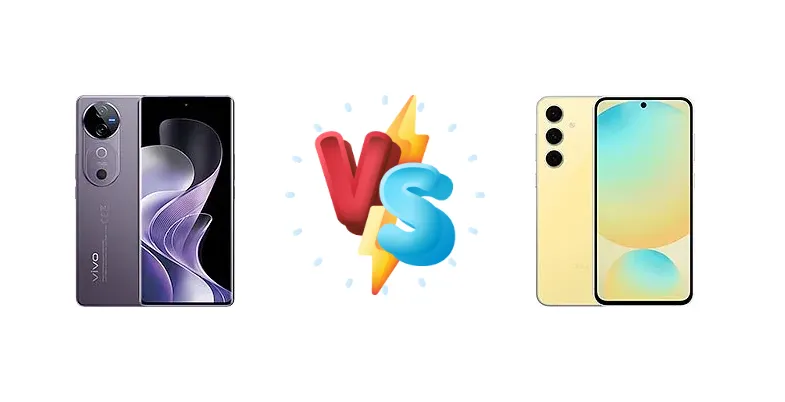
|
🏆 Quick Verdict
For the average user prioritizing long-term battery life and a more established ecosystem, the Samsung Galaxy S24 FE is the better choice. Its significantly longer battery endurance (42:00h vs 15:06h) and 2000 charge cycles outweigh the V40’s faster charging, despite the V40’s respectable performance.
| PHONES | ||
|---|---|---|
| Phone Names | vivo V40 | Samsung Galaxy S24 FE |
| Network | ||
|---|---|---|
| 2G bands | GSM 850 / 900 / 1800 / 1900 | GSM 850 / 900 / 1800 / 1900 |
| 3G bands | HSDPA 850 / 900 / 1700(AWS) / 1900 / 2100 - International | HSDPA 850 / 900 / 1700(AWS) / 1900 / 2100 |
| 4G bands | 1, 2, 3, 4, 5, 7, 8, 12, 13, 17, 18, 19, 20, 26, 28, 32, 38, 39, 40, 41, 66 - International | 1, 2, 3, 4, 5, 7, 8, 12, 17, 18, 19, 20, 25, 26, 28, 32, 38, 40, 41, 66 - International |
| 5G bands | 1, 2, 3, 5, 7, 8, 20, 26, 28, 38, 40, 41, 66, 75, 77, 78 SA/NSA - International | 1, 2, 3, 5, 7, 8, 12, 20, 25, 26, 28, 38, 40, 41, 66, 75, 77, 78 SA/NSA/Sub6 - International |
| Speed | HSPA, LTE, 5G | HSPA, LTE, 5G |
| Technology | GSM / HSPA / LTE / 5G | GSM / HSPA / LTE / 5G |
| Launch | ||
|---|---|---|
| Announced | 2024, June 17 | 2024, September 26 |
| Status | Available. Released 2024, July 03 | Available. Released 2024, October 03 |
| Body | ||
|---|---|---|
| Build | Glass front, plastic frame, glass back | Glass front (Gorilla Glass Victus+), glass back (Gorilla Glass Victus+), aluminum frame |
| Dimensions | 164.2 x 75 x 7.6 mm (6.46 x 2.95 x 0.30 in) | 162 x 77.3 x 8 mm (6.38 x 3.04 x 0.31 in) |
| SIM | · Nano-SIM + Nano-SIM + eSIM (max 2 at a time)· Nano-SIM + Nano-SIM | · Nano-SIM· Nano-SIM + Nano-SIM· Nano-SIM + eSIM· eSIM + eSIM |
| Weight | 190 g (6.70 oz) | 213 g (7.51 oz) |
| Display | ||
|---|---|---|
| Protection | Schott Xensation Alpha | Corning Gorilla Glass Victus+, Mohs level 5 |
| Resolution | 1260 x 2800 pixels, 20:9 ratio (~453 ppi density) | 1080 x 2340 pixels, 19.5:9 ratio (~385 ppi density) |
| Size | 6.78 inches, 111.0 cm2 (~90.1% screen-to-body ratio) | 6.7 inches, 110.2 cm2 (~88.0% screen-to-body ratio) |
| Type | AMOLED, HDR10+, 120Hz, 2160Hz PWM, 4500 nits (peak) | Dynamic AMOLED 2X, 120Hz, HDR10+, 1900 nits (peak) |
| Platform | ||
|---|---|---|
| CPU | Octa-core (1x2.63 GHz Cortex-A715 & 3x2.4 GHz Cortex-A715 & 4x1.8 GHz Cortex-A510) | 10-core (1x3.1 GHz + 2x2.9 GHz + 3x2.6 GHz + 4x1.95 GHz) |
| Chipset | Qualcomm SM7550-AB Snapdragon 7 Gen 3 (4 nm) | Exynos 2400e (4 nm) |
| GPU | Adreno 720 | Xclipse 940 |
| OS | Android 14, Funtouch 14 | Android 14, up to 7 major Android upgrades, One UI 8.0 |
| Memory | ||
|---|---|---|
| Card slot | No | No |
| Internal | 128GB 8GB RAM, 256GB 8GB RAM, 256GB 12GB RAM, 512GB 12GB RAM | 128GB 8GB RAM, 256GB 8GB RAM, 512GB 8GB RAM |
| Main Camera | ||
|---|---|---|
| Dual | 50 MP, f/1.9, 24mm (wide), 1/1.56", 1.0µm, PDAF, OIS 50 MP, f/2.0, 15mm, 119˚ (ultrawide), 1/2.76", 0.64µm, AF | - |
| Features | Zeiss optics, Ring-LED flash, panorama, HDR | LED flash, HDR, panorama |
| Triple | - | 50 MP, f/1.8, 24mm (wide), 1/1.57", 1.0µm, dual pixel PDAF, OIS 8 MP, f/2.4, 75mm (telephoto), 1/4.4", 1.0µm, PDAF, OIS, 3x optical zoom 12 MP, f/2.2, 13mm, 123˚ (ultrawide), 1/3.0", 1.12µm |
| Video | 4K@30fps, 1080p@30fps, gyro-EIS, OIS | 8K@30fps, 4K@30/60/120fps, 1080p@30/60/120/240fps |
| Selfie camera | ||
|---|---|---|
| Features | HDR | - |
| Single | 50 MP, f/2.0, 21mm (wide), 1/2.76", 0.64µm, AF | 10 MP, f/2.4, 26mm (wide), 1/3.0", 1.22µm |
| Video | 4K@30fps, 1080p@30fps | 4K@30/60fps, 1080p@30/60fps; gyro-EIS |
| Sound | ||
|---|---|---|
| 35mm jack | No | No |
| Loudspeaker | Yes, with stereo speakers | Yes, with stereo speakers |
| Comms | ||
|---|---|---|
| Bluetooth | 5.4, A2DP, LE | 5.3, A2DP, LE |
| NFC | Yes (market/region dependent) | Yes |
| Positioning | GPS, GALILEO, GLONASS, QZSS, BDS, NavIC | GPS, GLONASS, GALILEO, BDS |
| Radio | No | Unspecified |
| USB | USB Type-C 2.0, OTG | USB Type-C 3.2, OTG |
| WLAN | Wi-Fi 802.11 a/b/g/n/ac/6, dual-band | Wi-Fi 802.11 a/b/g/n/ac/6e, dual-band or tri-band (market/region dependent), Wi-Fi Direct |
| Features | ||
|---|---|---|
| Sensors | Fingerprint (under display, optical), accelerometer, gyro, proximity, compass | Fingerprint (under display, optical), accelerometer, gyro, compass |
| Battery | ||
|---|---|---|
| Charging | 80W wired, PD Reverse wired | 25W wired, PD, QC2, 50% in 30 min 15W wireless Reverse wireless |
| Type | Si/C Li-Ion 5500 mAh | 4700 mAh |
| Misc | ||
|---|---|---|
| Colors | Stellar Silver (Titanium Grey), Nebula Purple (Lotus Purple), Ganges Blue, Moonlight White, Sunglow Peach | Blue, Graphite, Gray, Mint, Yellow |
| Models | V2348 | SM-S721B, SM-S721B/DS, SM-S721U1, SM-S721U, SM-S721W, SM-S7210, SM-S721N |
| Price | ₹ 36,999 | $ 249.74 / C$ 498.99 / £ 335.00 / € 387.00 / ₹ 34,180 |
| SAR | 0.97 W/kg (head) 0.90 W/kg (body) | 0.94 W/kg (head) 0.71 W/kg (body) |
| SAR EU | 0.97 W/kg (head) 1.14 W/kg (body) | 0.86 W/kg (head) 1.29 W/kg (body) |
| EU LABEL | ||
|---|---|---|
| Battery | - | 42:00h endurance, 2000 cycles |
| Energy | - | Class B |
| Free fall | - | Class A (270 falls) |
| Repairability | - | Class C |
vivo V40
- Faster 80W wired charging
- Potentially better thermal efficiency with Snapdragon 7 Gen 3
- Streamlined user experience (typical of vivo)
- Significantly shorter battery life (15:06h)
- Limited battery cycle lifespan
- Lack of wireless charging
Samsung Galaxy S24 FE
- Exceptional battery life (42:00h)
- 2000 charge cycles for long-term reliability
- Wireless and reverse wireless charging
- Slower 25W wired charging
- Potential for thermal throttling with Exynos 2400e
- Samsung’s One UI can be resource-intensive
Display Comparison
Both devices boast impressive displays, with the Samsung Galaxy S24 FE achieving a slightly higher peak brightness of 1372 nits compared to the vivo V40’s 1353 nits. While the difference is minimal, it could be noticeable in direct sunlight. Neither specification details panel technology (LTPO, AMOLED), but given the price points, both are likely to utilize AMOLED panels. The lack of refresh rate information is a key omission, but both are expected to offer at least 120Hz for smooth scrolling. Bezels and color accuracy are not specified, making a direct comparison impossible without hands-on testing.
Camera Comparison
Camera specifications are limited. Without details on sensor sizes, aperture, or image stabilization (OIS), a definitive camera comparison is impossible. The absence of information suggests neither phone prioritizes a groundbreaking camera system. The focus should be on image processing algorithms. Samsung typically favors vibrant, saturated images, while vivo often aims for more natural tones. The presence of a 2MP macro camera on the V40 is likely a marketing feature with limited practical utility, given the inherent limitations of such small sensors.
Performance
The Samsung Galaxy S24 FE’s Exynos 2400e, a 10-core processor with a peak clock speed of 3.1 GHz, appears more powerful on paper than the vivo V40’s Snapdragon 7 Gen 3. The Snapdragon 7 Gen 3 utilizes an octa-core configuration with a peak of 2.63 GHz. However, the Exynos 2400e has faced criticism regarding thermal throttling, potentially limiting sustained performance. The Snapdragon 7 Gen 3’s 4nm process node suggests better efficiency, potentially mitigating throttling. The S24 FE’s CPU configuration (1+2+3+4) is more complex than the V40’s (1+3+4), indicating a focus on multi-tasking. RAM speed (LPDDR5x) is not specified for either device, hindering a complete performance assessment.
Battery Life
The Samsung Galaxy S24 FE dominates in battery endurance, offering a remarkable 42:00h of usage, supported by a claimed 2000 charge cycles. This is a significant advantage over the vivo V40’s 15:06h active use score. While the V40 boasts 80W wired charging (PD), allowing for rapid top-ups, the S24 FE’s 25W charging with 50% charge in 30 minutes is adequate. The S24 FE also offers 15W wireless and reverse wireless charging, features absent on the V40. The larger battery capacity of the S24 FE, combined with the efficient Exynos chip, translates to a substantially longer-lasting experience.
Buying Guide
Buy the vivo V40 if you prioritize quick charging speeds (80W) and a more streamlined user experience, and frequently engage in shorter bursts of intensive tasks. Buy the Samsung Galaxy S24 FE if you value exceptional battery longevity, a more mature software experience with longer update support, and a broader feature set, even if it means slower charging and potentially more thermal throttling under sustained load.