
vivo V40 vs Oppo Find X7 Ultra: A Deep Dive into Performance and Battery Life
| Phones Images | |||||
|---|---|---|---|---|---|
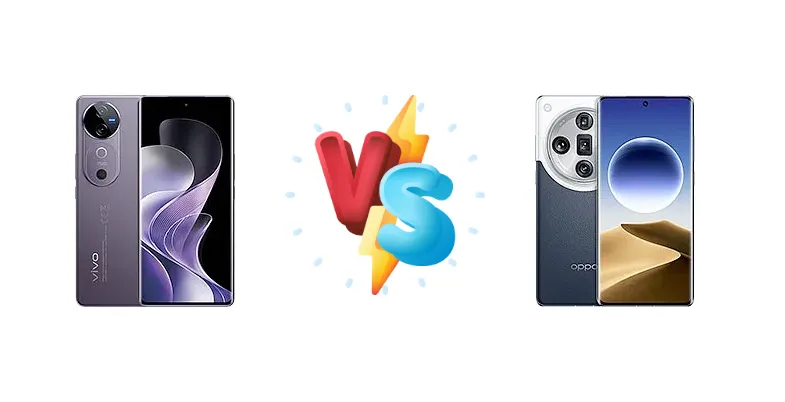
|
🏆 Quick Verdict
For the average user prioritizing all-day battery life and a smooth experience, the vivo V40 emerges as the winner. Its 15:06h active use score significantly outperforms the Find X7 Ultra’s 12:47h, and the Snapdragon 7 Gen 3 provides ample power for most tasks. However, power users demanding the absolute best performance will find the Oppo Find X7 Ultra’s Snapdragon 8 Gen 3 a compelling choice.
| PHONES | ||
|---|---|---|
| Phone Names | vivo V40 | Oppo Find X7 Ultra |
| Network | ||
|---|---|---|
| 2G bands | GSM 850 / 900 / 1800 / 1900 | GSM 850 / 900 / 1800 / 1900 |
| 3G bands | HSDPA 850 / 900 / 1700(AWS) / 1900 / 2100 - International | HSDPA 800 / 850 / 900 / 1700(AWS) / 1900 / 2100 |
| 4G bands | 1, 2, 3, 4, 5, 7, 8, 12, 13, 17, 18, 19, 20, 26, 28, 32, 38, 39, 40, 41, 66 - International | 1, 2, 3, 4, 5, 7, 8, 12, 17, 18, 19, 20, 26, 28, 34, 38, 39, 40, 41, 66 |
| 5G bands | 1, 2, 3, 5, 7, 8, 20, 26, 28, 38, 40, 41, 66, 75, 77, 78 SA/NSA - International | 1, 2, 3, 5, 7, 8, 20, 28, 38, 40, 41, 66, 77, 78, 79 SA/NSA |
| Speed | HSPA, LTE, 5G | HSPA, LTE, 5G |
| Technology | GSM / HSPA / LTE / 5G | GSM / CDMA / HSPA / CDMA2000 / LTE / 5G |
| Launch | ||
|---|---|---|
| Announced | 2024, June 17 | 2024, January 08 |
| Status | Available. Released 2024, July 03 | Available. Released 2024, January 12 |
| Body | ||
|---|---|---|
| Build | Glass front, plastic frame, glass back | Glass front (Gorilla Glass Victus 2), glass back (Gorilla Glass) or eco leather back, aluminum frame |
| Dimensions | 164.2 x 75 x 7.6 mm (6.46 x 2.95 x 0.30 in) | 164.3 x 76.2 x 9.5 mm (6.47 x 3.00 x 0.37 in) |
| SIM | · Nano-SIM + Nano-SIM + eSIM (max 2 at a time)· Nano-SIM + Nano-SIM | Nano-SIM + Nano-SIM |
| Weight | 190 g (6.70 oz) | 221 g (7.80 oz) |
| Display | ||
|---|---|---|
| Protection | Schott Xensation Alpha | Corning Gorilla Glass Victus 2 |
| Resolution | 1260 x 2800 pixels, 20:9 ratio (~453 ppi density) | 1440 x 3168 pixels (~510 ppi density) |
| Size | 6.78 inches, 111.0 cm2 (~90.1% screen-to-body ratio) | 6.82 inches, 113.0 cm2 (~90.3% screen-to-body ratio) |
| Type | AMOLED, HDR10+, 120Hz, 2160Hz PWM, 4500 nits (peak) | LTPO AMOLED, 1B colors, 120Hz, Dolby Vision, HDR10+, 1600 nits (typ), 2600 nits (HBM), 4500 nits (peak) |
| Platform | ||
|---|---|---|
| CPU | Octa-core (1x2.63 GHz Cortex-A715 & 3x2.4 GHz Cortex-A715 & 4x1.8 GHz Cortex-A510) | Octa-core (1x3.3 GHz Cortex-X4 & 3x3.2 GHz Cortex-A720 & 2x3.0 GHz Cortex-A720 & 2x2.3 GHz Cortex-A520) |
| Chipset | Qualcomm SM7550-AB Snapdragon 7 Gen 3 (4 nm) | Qualcomm SM8650-AB Snapdragon 8 Gen 3 (4 nm) |
| GPU | Adreno 720 | Adreno 750 |
| OS | Android 14, Funtouch 14 | Android 14, up to 4 major Android upgrades, ColorOS 14 |
| Memory | ||
|---|---|---|
| Card slot | No | No |
| Internal | 128GB 8GB RAM, 256GB 8GB RAM, 256GB 12GB RAM, 512GB 12GB RAM | 256GB 12GB RAM, 256GB 16GB RAM, 512GB 16GB RAM |
| Main Camera | ||
|---|---|---|
| Dual | 50 MP, f/1.9, 24mm (wide), 1/1.56", 1.0µm, PDAF, OIS 50 MP, f/2.0, 15mm, 119˚ (ultrawide), 1/2.76", 0.64µm, AF | - |
| Features | Zeiss optics, Ring-LED flash, panorama, HDR | Laser AF, color spectrum sensor, Hasselblad Color Calibration, LED flash, HDR, panorama |
| Quad | - | 50 MP, f/1.8, 23mm (wide), 1.0"-type, 1.6µm, dual pixel PDAF, OIS 50 MP, f/2.6, 65mm (periscope telephoto), 1/1.56", 1.0µm, 2.8x optical zoom, multi-directional PDAF (25cm - ∞), OIS 50 MP, f/4.3, 135mm (periscope telephoto), 1/2.51", 0.7µm, 6x optical zoom, dual pixel PDAF (35cm - ∞), OIS 50 MP, f/2.0, 14mm, 123˚ (ultrawide), 1/1.95", 1.0µm, PDAF |
| Video | 4K@30fps, 1080p@30fps, gyro-EIS, OIS | 4K@30/60fps, 1080p@30/60/240fps; gyro-EIS; HDR, 10‑bit video, Dolby Vision |
| Selfie camera | ||
|---|---|---|
| Features | HDR | Panorama |
| Single | 50 MP, f/2.0, 21mm (wide), 1/2.76", 0.64µm, AF | 32 MP, f/2.4, 21mm (wide), 1/2.74", 0.8µm, PDAF |
| Video | 4K@30fps, 1080p@30fps | 4K@30/60fps, 1080p@30fps, gyro-EIS |
| Sound | ||
|---|---|---|
| 35mm jack | No | No |
| Loudspeaker | Yes, with stereo speakers | Yes, with stereo speakers |
| Comms | ||
|---|---|---|
| Bluetooth | 5.4, A2DP, LE | 5.4, A2DP, LE, aptX HD, LHDC |
| Infrared port | - | Yes |
| NFC | Yes (market/region dependent) | Yes |
| Positioning | GPS, GALILEO, GLONASS, QZSS, BDS, NavIC | GPS (L1+L5), BDS (B1I+B1c+B2a), GALILEO (E1+E5a), QZSS (L1+L5), GLONASS |
| Radio | No | No |
| USB | USB Type-C 2.0, OTG | USB Type-C 3.2, OTG |
| WLAN | Wi-Fi 802.11 a/b/g/n/ac/6, dual-band | Wi-Fi 802.11 a/b/g/n/ac/6e/7, dual-band, Wi-Fi Direct |
| Features | ||
|---|---|---|
| Sensors | Fingerprint (under display, optical), accelerometer, gyro, proximity, compass | Fingerprint (under display, optical), accelerometer, gyro, proximity, compass |
| Battery | ||
|---|---|---|
| Charging | 80W wired, PD Reverse wired | 100W wired, PD, 50% in 10 min, 100% in 26 min 50W wireless 10W reverse wireless |
| Type | Si/C Li-Ion 5500 mAh | 5000 mAh |
| Misc | ||
|---|---|---|
| Colors | Stellar Silver (Titanium Grey), Nebula Purple (Lotus Purple), Ganges Blue, Moonlight White, Sunglow Peach | Black, Dark Blue, Light Brown |
| Models | V2348 | PHY110, PHY120 |
| Price | ₹ 36,999 | $ 546.64 |
| SAR | 0.97 W/kg (head) 0.90 W/kg (body) | - |
| SAR EU | 0.97 W/kg (head) 1.14 W/kg (body) | - |
vivo V40
- Exceptional battery life (15:06h active use)
- Bright display (1353 nits)
- More power-efficient chipset
- Less powerful processor than the Find X7 Ultra
- Lacks wireless charging
Oppo Find X7 Ultra
- Top-tier performance with Snapdragon 8 Gen 3
- Faster 100W wired charging
- Wireless and reverse wireless charging
- Shorter battery life (12:47h active use)
- Higher price point
Display Comparison
The vivo V40 boasts a display capable of reaching 1353 nits of peak brightness, exceeding the Oppo Find X7 Ultra’s 1165 nits. This translates to better visibility in direct sunlight for the V40. While both utilize 4nm chipsets, the display brightness difference is a tangible benefit for outdoor users. We lack panel technology details (LTPO, PWM frequency) but the higher peak brightness gives the V40 an edge in usability. Bezels and color accuracy are assumed to be comparable given both brands’ focus on display quality, but without specific measurements, it’s difficult to definitively state.
Camera Comparison
Without detailed camera specifications, a direct comparison is limited. However, Oppo’s ‘Ultra’ branding typically signifies a focus on camera innovation, potentially including larger sensors and more advanced image processing. The Find X7 Ultra likely benefits from a more sophisticated camera system, despite the lack of specific sensor details. The V40, while likely capable, is positioned as a more balanced device, and its camera system is likely tuned for consistent, reliable results rather than pushing the boundaries of mobile photography. We can assume both phones will offer a range of shooting modes, but the Find X7 Ultra is likely to excel in low-light conditions and offer more advanced features.
Performance
The core difference lies in the chipsets: the vivo V40 utilizes the Qualcomm SM7550-AB Snapdragon 7 Gen 3, while the Oppo Find X7 Ultra is equipped with the SM8650-AB Snapdragon 8 Gen 3. The 8 Gen 3 features a Cortex-X4 prime core clocked at 3.3 GHz, significantly faster than the V40’s 2.63 GHz Cortex-A715. This architectural advantage, coupled with the more powerful Adreno GPU in the 8 Gen 3, results in substantially higher performance in demanding tasks like gaming and video editing. The Find X7 Ultra’s CPU configuration (1x3.3GHz, 3x3.2GHz, 2x3.0GHz, 2x2.3GHz) is more complex and powerful than the V40’s (1x2.63GHz, 3x2.4GHz, 4x1.8GHz). Both utilize 4nm fabrication, but the 8 Gen 3’s architecture is designed for sustained peak performance.
Battery Life
The vivo V40’s active use score of 15:06h is a clear win over the Oppo Find X7 Ultra’s 12:47h. This suggests the Snapdragon 7 Gen 3 is more power-efficient, or the V40’s software optimization is more effective. While the Find X7 Ultra offers faster charging at 100W (0-100% in 26 minutes) compared to the V40’s 80W, the V40’s longer battery life mitigates the need for frequent top-ups. The Find X7 Ultra also adds 50W wireless charging and 10W reverse wireless charging, features absent on the V40.
Buying Guide
Buy the vivo V40 if you need exceptional battery life, a bright and vibrant display for everyday use, and a smooth, responsive experience without the premium flagship price tag. Buy the Oppo Find X7 Ultra if you prioritize uncompromising performance for demanding games and applications, faster charging speeds, and are willing to trade some battery life for that extra power.