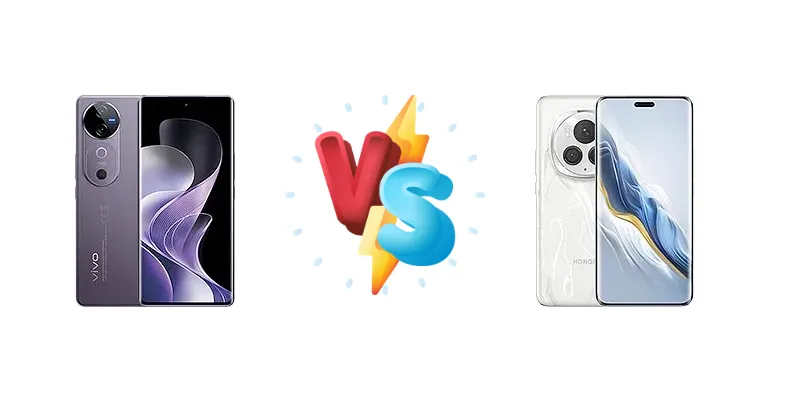
The vivo V40 and Honor Magic6 Pro represent distinct approaches to the modern smartphone. The V40 aims for a strong mid-range experience with a focus on efficiency, while the Magic6 Pro throws down the gauntlet with flagship-level processing power and a premium display. This comparison dissects their key differences to help you determine which device best suits your needs.
🏆 Quick Verdict
For the average user prioritizing raw performance and a brighter, more vibrant display, the Honor Magic6 Pro is the clear winner. However, the vivo V40 offers excellent battery life and a capable processor at a potentially lower price point, making it a compelling option for budget-conscious buyers.
| Network |
|---|
| 2G bands | GSM 850 / 900 / 1800 / 1900 | GSM 850 / 900 / 1800 / 1900 |
| 3G bands | HSDPA 850 / 900 / 1700(AWS) / 1900 / 2100 - International | HSDPA 800 / 850 / 900 / 1700(AWS) / 1900 / 2100 |
| 4G bands | 1, 2, 3, 4, 5, 7, 8, 12, 13, 17, 18, 19, 20, 26, 28, 32, 38, 39, 40, 41, 66 - International | LTE |
| 5G bands | 1, 2, 3, 5, 7, 8, 20, 26, 28, 38, 40, 41, 66, 75, 77, 78 SA/NSA - International | SA/NSA |
| Speed | HSPA, LTE, 5G | HSPA, LTE, 5G |
| Technology | GSM / HSPA / LTE / 5G | GSM / CDMA / HSPA / CDMA2000 / LTE / 5G |
| Launch |
|---|
| Announced | 2024, June 17 | 2024, January 11 |
| Status | Available. Released 2024, July 03 | Available. Released 2024, January 18 |
| Body |
|---|
| Build | Glass front, plastic frame, glass back | Glass front (NanoCrystal Shield), glass back or silicone polymer back (eco leather) |
| Dimensions | 164.2 x 75 x 7.6 mm (6.46 x 2.95 x 0.30 in) | 162.5 x 75.8 x 8.9 mm (6.40 x 2.98 x 0.35 in) |
| SIM | · Nano-SIM + Nano-SIM + eSIM (max 2 at a time)· Nano-SIM + Nano-SIM | · Nano-SIM + eSIM· Nano-SIM + Nano-SIM |
| Weight | 190 g (6.70 oz) | 225 g or 229 g (7.94 oz) |
| Display |
|---|
| Protection | Schott Xensation Alpha | NanoCrystal Shield |
| Resolution | 1260 x 2800 pixels, 20:9 ratio (~453 ppi density) | 1280 x 2800 pixels, 19.5:9 ratio (~453 ppi density) |
| Size | 6.78 inches, 111.0 cm2 (~90.1% screen-to-body ratio) | 6.8 inches, 112.8 cm2 (~91.6% screen-to-body ratio) |
| Type | AMOLED, HDR10+, 120Hz, 2160Hz PWM, 4500 nits (peak) | LTPO OLED, 1B colors, 120Hz, Dolby Vision, HDR, 1600 nits (HBM), 5000 nits (peak) |
| Platform |
|---|
| CPU | Octa-core (1x2.63 GHz Cortex-A715 & 3x2.4 GHz Cortex-A715 & 4x1.8 GHz Cortex-A510) | Octa-core (1x3.3 GHz Cortex-X4 & 3x3.2 GHz Cortex-A720 & 2x3.0 GHz Cortex-A720 & 2x2.3 GHz Cortex-A520) |
| Chipset | Qualcomm SM7550-AB Snapdragon 7 Gen 3 (4 nm) | Qualcomm SM8650-AB Snapdragon 8 Gen 3 (4 nm) |
| GPU | Adreno 720 | Adreno 750 |
| OS | Android 14, Funtouch 14 | Android 14, up to 4 major Android upgrades, MagicOS 8 |
| Memory |
|---|
| Card slot | No | No |
| Internal | 128GB 8GB RAM, 256GB 8GB RAM, 256GB 12GB RAM, 512GB 12GB RAM | 256GB 12GB RAM, 256GB 16GB RAM, 512GB 12GB RAM, 512GB 16GB RAM, 1TB 16GB RAM |
| Main Camera |
|---|
| Dual | 50 MP, f/1.9, 24mm (wide), 1/1.56", 1.0µm, PDAF, OIS
50 MP, f/2.0, 15mm, 119˚ (ultrawide), 1/2.76", 0.64µm, AF | - |
| Features | Zeiss optics, Ring-LED flash, panorama, HDR | Laser AF, color spectrum sensor, LED flash, HDR, panorama |
| Triple | - | 50 MP, f/1.4-2.0, 23mm (wide), 1/1.3", 1.2µm, PDAF, OIS
180 MP, f/2.6, (periscope telephoto), 1/1.49", 0.56µm, PDAF, OIS, 2.5x optical zoom
50 MP, f/2.0, 13mm, 122˚ (ultrawide), 1/2.88", 0.61µm, AF |
| Video | 4K@30fps, 1080p@30fps, gyro-EIS, OIS | 4K@24/30/60fps, 1080p@30/60/120/240fps, gyro-EIS, OIS, HDR, 10-bit video |
| Selfie camera |
|---|
| Features | HDR | - |
| Single | 50 MP, f/2.0, 21mm (wide), 1/2.76", 0.64µm, AF | 50 MP, f/2.0, 22mm (wide), 1/2.93", 0.6µm, AF
TOF 3D, (depth/biometrics sensor) |
| Video | 4K@30fps, 1080p@30fps | 4K@30fps, 1080p@30/60fps, gyro-EIS |
| Sound |
|---|
| 35mm jack | No | No |
| Loudspeaker | Yes, with stereo speakers | Yes, with stereo speakers |
| Comms |
|---|
| Bluetooth | 5.4, A2DP, LE | 5.3, A2DP, LE, aptX HD |
| Infrared port | - | Yes |
| NFC | Yes (market/region dependent) | Yes |
| Positioning | GPS, GALILEO, GLONASS, QZSS, BDS, NavIC | GPS (L1+L5), GLONASS, BDS (B1I+B1c+B2a), GALILEO (E1+E5a) |
| Radio | No | No |
| USB | USB Type-C 2.0, OTG | USB Type-C 3.2, DisplayPort 1.2, OTG |
| WLAN | Wi-Fi 802.11 a/b/g/n/ac/6, dual-band | Wi-Fi 802.11 a/b/g/n/ac/6/7, dual-band, Wi-Fi Direct |
| Features |
|---|
| Sensors | Fingerprint (under display, optical), accelerometer, gyro, proximity, compass | Fingerprint (under display, optical), Face ID, accelerometer, gyro, proximity, compass |
| Battery |
|---|
| Charging | 80W wired, PD
Reverse wired | 80W wired
66W wireless
Reverse wireless
5W reverse wired |
| Type | Si/C Li-Ion 5500 mAh | Si/C Li-Ion 5600 mAh |
| Misc |
|---|
| Colors | Stellar Silver (Titanium Grey), Nebula Purple (Lotus Purple), Ganges Blue, Moonlight White, Sunglow Peach | Black, Green, Blue, Purple, White |
| Models | V2348 | BVL-AN16, BVL-N49 |
| Price | ₹ 36,999 | € 455.54 / $ 899.00 / £ 598.99 |
| SAR | 0.97 W/kg (head) 0.90 W/kg (body) | - |
| SAR EU | 0.97 W/kg (head) 1.14 W/kg (body) | - |
vivo V40
- Excellent battery life (15:06h active use)
- Efficient Snapdragon 7 Gen 3 chipset
- 80W wired charging with PD
- Less powerful processor than the Magic6 Pro
- Lower peak display brightness
Honor Magic6 Pro
- Flagship Snapdragon 8 Gen 3 performance
- Significantly brighter display (1578 nits)
- 66W wireless and 5W reverse wireless charging
- Slightly shorter battery life (14:06h active use)
- Potentially higher price
Display Comparison
The Honor Magic6 Pro boasts a significantly brighter display, reaching a measured 1578 nits compared to the vivo V40’s 1353 nits. This translates to superior visibility in direct sunlight. While both utilize 4nm chipsets, the Magic6 Pro’s display is likely to consume more power due to its higher brightness. Details regarding panel technology (LTPO, refresh rate) are missing, but the brightness difference is a key differentiator. The V40’s display is still very good, but the Magic6 Pro offers a more premium viewing experience.
Camera Comparison
Without detailed camera specifications, a direct comparison is limited. However, given the positioning of these devices, it’s reasonable to assume the Honor Magic6 Pro will feature a more sophisticated camera system. The Snapdragon 8 Gen 3’s ISP (Image Signal Processor) is significantly more advanced than the one found in the Snapdragon 7 Gen 3, enabling better image processing, noise reduction, and dynamic range. While the V40 will likely produce good images in ideal conditions, the Magic6 Pro should excel in challenging lighting scenarios and offer more advanced features like 8K video recording. We can expect the Magic6 Pro to have a larger main sensor and more advanced optical image stabilization (OIS).
Performance
The core difference lies in the chipsets: the vivo V40 utilizes the Qualcomm SM7550-AB Snapdragon 7 Gen 3, while the Honor Magic6 Pro is powered by the flagship SM8650-AB Snapdragon 8 Gen 3. The 8 Gen 3 features a Cortex-X4 prime core clocked at 3.3 GHz, a substantial upgrade over the V40’s 2.63 GHz Cortex-A715. This architectural leap, combined with the more advanced Cortex-A720 performance cores, results in significantly faster processing speeds and improved graphics performance on the Magic6 Pro. The V40’s Snapdragon 7 Gen 3 is still a capable chip, but it won’t match the Magic6 Pro in demanding tasks. The Magic6 Pro’s larger cache and more efficient architecture will also contribute to better sustained performance under load.
Battery Life
The vivo V40 achieves an impressive 15:06h of active use, slightly surpassing the Honor Magic6 Pro’s 14:06h. This suggests the Snapdragon 7 Gen 3 is more power-efficient. Both phones support 80W wired charging, but the Magic6 Pro adds 66W wireless and 5W reverse wired charging, offering greater versatility. While the Magic6 Pro’s larger display and more powerful processor will consume more power, the wireless charging capabilities provide a convenient alternative. The V40’s longer battery life is a significant advantage for users who prioritize endurance.
Buying Guide
Buy the vivo V40 if you need exceptional battery life for all-day use and prioritize a smooth, responsive experience for everyday tasks without demanding gaming or intensive applications. Buy the Honor Magic6 Pro if you prefer uncompromising performance for gaming, content creation, and multitasking, and value a significantly brighter and more visually impressive display.
Frequently Asked Questions
❓ Does the Snapdragon 7 Gen 3 in the vivo V40 struggle with graphically intensive games like Genshin Impact?
While the Snapdragon 7 Gen 3 is a capable chip, it won't deliver the same level of performance as the Snapdragon 8 Gen 3 in the Honor Magic6 Pro. Genshin Impact will be playable on the V40, but you may need to lower graphics settings to maintain a smooth frame rate. The Magic6 Pro will handle the game at higher settings with ease.
❓ How much faster is the 80W charging on both phones in real-world usage?
Both phones offer 80W wired charging, meaning a full charge from 0-100% will likely take around 30-40 minutes. The Honor Magic6 Pro’s addition of 66W wireless charging provides a convenient alternative, but wired charging is always faster. The V40’s PD support ensures compatibility with a wider range of chargers.
❓ Is the difference in display brightness noticeable in everyday use, or only in direct sunlight?
The difference in peak brightness is most noticeable in direct sunlight, where the Magic6 Pro’s display will remain much more readable. However, the higher brightness also contributes to a more vibrant and immersive viewing experience even indoors, particularly when viewing HDR content.
❓ Given the battery life difference, is the Honor Magic6 Pro’s battery likely to require more frequent charging?
Yes, the Honor Magic6 Pro’s more powerful processor and brighter display will consume more power, resulting in slightly more frequent charging compared to the vivo V40. However, the 66W wireless charging option offers a convenient way to top up the battery throughout the day.