
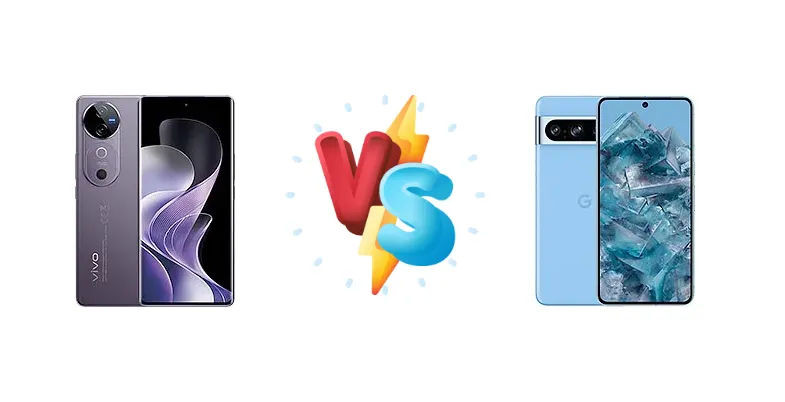
vivo V40 vs Google Pixel 8 Pro: A Battery Life and Performance Showdown
| Phones Images | |||||
|---|---|---|---|---|---|
|
🏆 Quick Verdict
For users prioritizing all-day battery life and rapid charging, the vivo V40 is the clear winner, offering 15:06h of active use. However, the Google Pixel 8 Pro excels in display quality, camera versatility, and software experience, making it the better choice for those valuing a holistic premium package.
| PHONES | ||
|---|---|---|
| Phone Names | vivo V40 | Google Pixel 8 Pro |
| Network | ||
|---|---|---|
| 2G bands | GSM 850 / 900 / 1800 / 1900 | GSM 850 / 900 / 1800 / 1900 |
| 3G bands | HSDPA 850 / 900 / 1700(AWS) / 1900 / 2100 - International | HSDPA 800 / 850 / 900 / 1700(AWS) / 1900 / 2100 |
| 4G bands | 1, 2, 3, 4, 5, 7, 8, 12, 13, 17, 18, 19, 20, 26, 28, 32, 38, 39, 40, 41, 66 - International | 1, 2, 3, 4, 5, 7, 8, 12, 13, 14, 17, 18, 19, 20, 25, 26, 28, 29, 30, 38, 39, 40, 41, 46, 48, 66, 71 - G1MNW |
| 5G bands | 1, 2, 3, 5, 7, 8, 20, 26, 28, 38, 40, 41, 66, 75, 77, 78 SA/NSA - International | 1, 2, 3, 5, 7, 8, 12, 20, 25, 26, 28, 29, 30, 38, 40, 41, 48, 66, 70, 71, 77, 78, 257, 258, 260, 261 SA/NSA/Sub6/mmWave - G1MNW |
| Speed | HSPA, LTE, 5G | HSPA, LTE, 5G |
| Technology | GSM / HSPA / LTE / 5G | GSM / HSPA / LTE / 5G |
| Launch | ||
|---|---|---|
| Announced | 2024, June 17 | 2023, October 04 |
| Status | Available. Released 2024, July 03 | Available. Released 2023, October 12 |
| Body | ||
|---|---|---|
| Build | Glass front, plastic frame, glass back | Glass front (Gorilla Glass Victus 2), glass back (Gorilla Glass Victus 2), aluminum frame |
| Dimensions | 164.2 x 75 x 7.6 mm (6.46 x 2.95 x 0.30 in) | 162.6 x 76.5 x 8.8 mm (6.40 x 3.01 x 0.35 in) |
| SIM | · Nano-SIM + Nano-SIM + eSIM (max 2 at a time)· Nano-SIM + Nano-SIM | Nano-SIM + eSIM |
| Weight | 190 g (6.70 oz) | 213 g (7.51 oz) |
| Display | ||
|---|---|---|
| Protection | Schott Xensation Alpha | Corning Gorilla Glass Victus 2 |
| Resolution | 1260 x 2800 pixels, 20:9 ratio (~453 ppi density) | 1344 x 2992 pixels, 20:9 ratio (~489 ppi density) |
| Size | 6.78 inches, 111.0 cm2 (~90.1% screen-to-body ratio) | 6.7 inches, 108.7 cm2 (~87.4% screen-to-body ratio) |
| Type | AMOLED, HDR10+, 120Hz, 2160Hz PWM, 4500 nits (peak) | LTPO OLED, 120Hz, HDR10+, 1600 nits (HBM), 2400 nits (peak) |
| Platform | ||
|---|---|---|
| CPU | Octa-core (1x2.63 GHz Cortex-A715 & 3x2.4 GHz Cortex-A715 & 4x1.8 GHz Cortex-A510) | Nona-core (1x3.0 GHz Cortex-X3 & 4x2.45 GHz Cortex-A715 & 4x2.15 GHz Cortex-A510) |
| Chipset | Qualcomm SM7550-AB Snapdragon 7 Gen 3 (4 nm) | Google Tensor G3 (4 nm) |
| GPU | Adreno 720 | Immortalis-G715s MC10 |
| OS | Android 14, Funtouch 14 | Android 14, upgradable to Android 16, up to 7 major Android upgrades |
| Memory | ||
|---|---|---|
| Card slot | No | No |
| Internal | 128GB 8GB RAM, 256GB 8GB RAM, 256GB 12GB RAM, 512GB 12GB RAM | 128GB 12GB RAM, 256GB 12GB RAM, 512GB 12GB RAM, 1TB 12GB RAM |
| Main Camera | ||
|---|---|---|
| Dual | 50 MP, f/1.9, 24mm (wide), 1/1.56", 1.0µm, PDAF, OIS 50 MP, f/2.0, 15mm, 119˚ (ultrawide), 1/2.76", 0.64µm, AF | - |
| Features | Zeiss optics, Ring-LED flash, panorama, HDR | Multi-zone Laser AF, Dual-LED flash, Pixel Shift, Ultra-HDR, panorama, Best Take, Zoom Enhance |
| Triple | - | 50 MP, f/1.7, 25mm (wide), 1/1.31", 1.2µm, dual pixel PDAF, OIS 48 MP, f/2.8, 113mm (periscope telephoto), 1/2.55", 0.7µm, dual pixel PDAF, OIS, 5x optical zoom 48 MP, f/2.0, 126˚ (ultrawide), 1/2.0", 0.8µm, dual pixel PDAF |
| Video | 4K@30fps, 1080p@30fps, gyro-EIS, OIS | 4K@30/60fps, 1080p@24/30/60/120/240fps; gyro-EIS, OIS, 10-bit HDR |
| Selfie camera | ||
|---|---|---|
| Features | HDR | HDR, panorama |
| Single | 50 MP, f/2.0, 21mm (wide), 1/2.76", 0.64µm, AF | 10.5 MP, f/2.2, 20mm (ultrawide), 1/3.1", 1.22µm, PDAF |
| Video | 4K@30fps, 1080p@30fps | 4K@24/30/60fps, 1080p@30/60fps |
| Sound | ||
|---|---|---|
| 35mm jack | No | No |
| Loudspeaker | Yes, with stereo speakers | Yes, with stereo speakers |
| Comms | ||
|---|---|---|
| Bluetooth | 5.4, A2DP, LE | 5.3, A2DP, LE, aptX HD |
| NFC | Yes (market/region dependent) | Yes |
| Positioning | GPS, GALILEO, GLONASS, QZSS, BDS, NavIC | GPS (L1+L5), GLONASS (G1), GALILEO (E1+E5a), QZSS (L1+L5) |
| Radio | No | No |
| USB | USB Type-C 2.0, OTG | USB Type-C 3.2 |
| WLAN | Wi-Fi 802.11 a/b/g/n/ac/6, dual-band | Wi-Fi 802.11 a/b/g/n/ac/6e/7, tri-band, Wi-Fi Direct |
| Features | ||
|---|---|---|
| Sensors | Fingerprint (under display, optical), accelerometer, gyro, proximity, compass | Fingerprint (under display, optical), accelerometer, gyro, proximity, compass, barometer, thermometer (skin temperature) |
| Battery | ||
|---|---|---|
| Charging | 80W wired, PD Reverse wired | 30W wired, PD3.0, PPS, 50% in 30 min 23W wireless Reverse wireless Bypass charging |
| Type | Si/C Li-Ion 5500 mAh | Li-Ion 5050 mAh |
| Misc | ||
|---|---|---|
| Colors | Stellar Silver (Titanium Grey), Nebula Purple (Lotus Purple), Ganges Blue, Moonlight White, Sunglow Peach | Obsidian, Porcelain, Bay, Mint |
| Models | V2348 | GC3VE, G1MNW |
| Price | ₹ 36,999 | € 362.00 / $ 289.97 / £ 329.95 / ₹ 54,999 |
| SAR | 0.97 W/kg (head) 0.90 W/kg (body) | - |
| SAR EU | 0.97 W/kg (head) 1.14 W/kg (body) | - |
vivo V40
- Exceptional battery life (15:06h active use)
- Ultra-fast 80W wired charging
- Potentially more affordable price point
- Performance may be lower than the Pixel 8 Pro
- Camera specifications are unknown
Google Pixel 8 Pro
- Brighter and potentially smoother display
- Powerful Tensor G3 chip with AI capabilities
- Superior camera system and image processing
- Shorter battery life (11:14h active use)
- Slower 30W wired charging
Display Comparison
The Pixel 8 Pro boasts a brighter display, reaching 1600 nits compared to the vivo V40’s 1353 nits. While both utilize a 4nm process, the Pixel 8 Pro’s panel likely benefits from more advanced calibration and potentially LTPO technology (not specified in the data, but standard for this class) for variable refresh rates, contributing to a smoother and more power-efficient experience. The higher peak brightness of the Pixel 8 Pro will be particularly noticeable in direct sunlight, enhancing outdoor visibility. However, the V40’s brightness is still very respectable.
Camera Comparison
The provided data highlights the Pixel 8 Pro’s strength in camera capabilities, though specifics are limited. While the V40’s camera specs are absent, the Pixel 8 Pro’s reputation and Google’s computational photography expertise suggest a significant advantage in image processing and overall image quality. The Pixel 8 Pro likely features a larger main sensor and more sophisticated image stabilization (OIS) than the V40. The Pixel 8 Pro’s camera is known for its excellent dynamic range and accurate color reproduction, while the V40’s camera performance remains an unknown quantity without further details.
Performance
The Google Pixel 8 Pro’s Tensor G3, with its nona-core CPU featuring a Cortex-X3 prime core clocked at 3.0 GHz, offers a theoretical performance advantage over the vivo V40’s Snapdragon 7 Gen 3. The X3 core is designed for peak performance, while the 7 Gen 3 focuses on efficiency. The Snapdragon 7 Gen 3’s octa-core configuration (1x2.63 GHz Cortex-A715, 3x2.4 GHz Cortex-A715, 4x1.8 GHz Cortex-A510) is well-suited for everyday tasks and moderate gaming. Both chips are built on a 4nm process, but the Tensor G3’s architecture is optimized for Google’s AI and machine learning tasks, potentially providing a smoother experience with features like Magic Eraser and real-time translation. The Pixel 8 Pro's CPU configuration suggests a stronger focus on sustained performance, while the V40 prioritizes power efficiency.
Battery Life
The vivo V40 demonstrably outperforms the Pixel 8 Pro in battery life, achieving 15:06 hours of active use compared to the Pixel 8 Pro’s 11:14 hours. This difference is substantial and suggests the Snapdragon 7 Gen 3’s efficiency, combined with potentially a larger battery capacity (not specified), contributes to the V40’s endurance. The V40 also supports significantly faster 80W wired charging, allowing for quicker top-ups compared to the Pixel 8 Pro’s 30W charging. The Pixel 8 Pro offers wireless charging (23W) and reverse wireless charging, along with 'Bypass Charging' which is a useful feature for extending battery lifespan, but it cannot match the V40’s charging speed.
Buying Guide
Buy the vivo V40 if you need a phone that reliably lasts through a full day of heavy use and can be quickly topped up with its 80W charging. It’s ideal for travelers, commuters, or anyone who dislikes battery anxiety. Buy the Google Pixel 8 Pro if you prefer a top-tier camera system, a brighter and more vibrant display, and the seamless integration of Google’s AI features, even if it means sacrificing some battery endurance.