
Asus ROG Phone 8 Pro vs. vivo V40: A Deep Dive into Gaming and Battery Life
| Phones Images | |||||
|---|---|---|---|---|---|
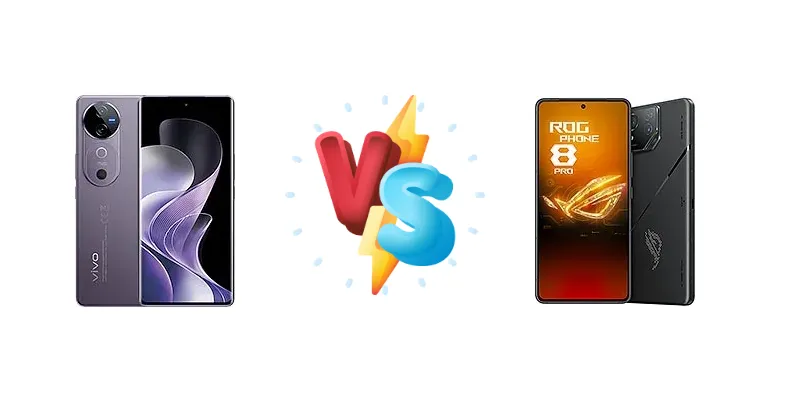
|
🏆 Quick Verdict
For the average user prioritizing longevity and everyday usability, the vivo V40 emerges as the winner. Its 15:06h active use battery score and efficient Snapdragon 7 Gen 3 chipset offer a compelling package. However, gamers and power users will find the ROG Phone 8 Pro’s Snapdragon 8 Gen 3 and superior display worth the trade-offs.
| PHONES | ||
|---|---|---|
| Phone Names | vivo V40 | Asus ROG Phone 8 Pro |
| Network | ||
|---|---|---|
| 2G bands | GSM 850 / 900 / 1800 / 1900 | GSM 850 / 900 / 1800 / 1900 |
| 3G bands | HSDPA 850 / 900 / 1700(AWS) / 1900 / 2100 - International | HSDPA 850 / 900 / 1700(AWS) / 1800 / 1900 / 2100 - International |
| 4G bands | 1, 2, 3, 4, 5, 7, 8, 12, 13, 17, 18, 19, 20, 26, 28, 32, 38, 39, 40, 41, 66 - International | 1, 2, 3, 4, 5, 7, 8, 12, 17, 18, 19, 20, 25, 26, 28, 32, 34, 38, 39, 40, 41, 42, 43, 48, 66 - International |
| 5G bands | 1, 2, 3, 5, 7, 8, 20, 26, 28, 38, 40, 41, 66, 75, 77, 78 SA/NSA - International | 1, 2, 3, 5, 7, 8, 12, 18, 20, 25, 26, 28, 38, 40, 41, 48, 66, 77, 78, 79 SA/NSA/Sub6 - International |
| Speed | HSPA, LTE, 5G | HSPA, LTE (Up to 7CA), 5G |
| Technology | GSM / HSPA / LTE / 5G | GSM / CDMA / HSPA / LTE / 5G |
| Launch | ||
|---|---|---|
| Announced | 2024, June 17 | 2024, January 08 |
| Status | Available. Released 2024, July 03 | Available. Released 2024, January 18 |
| Body | ||
|---|---|---|
| Build | Glass front, plastic frame, glass back | Glass front (Gorilla Glass Victus 2), glass back (Gorilla Glass), aluminum frame |
| Dimensions | 164.2 x 75 x 7.6 mm (6.46 x 2.95 x 0.30 in) | 163.8 x 76.8 x 8.9 mm (6.45 x 3.02 x 0.35 in) |
| SIM | · Nano-SIM + Nano-SIM + eSIM (max 2 at a time)· Nano-SIM + Nano-SIM | Nano-SIM + Nano-SIM |
| Weight | 190 g (6.70 oz) | 225 g (7.94 oz) |
| Display | ||
|---|---|---|
| Protection | Schott Xensation Alpha | Corning Gorilla Glass Victus 2 |
| Resolution | 1260 x 2800 pixels, 20:9 ratio (~453 ppi density) | 1080 x 2400 pixels, 20:9 ratio (~388 ppi density) |
| Size | 6.78 inches, 111.0 cm2 (~90.1% screen-to-body ratio) | 6.78 inches, 111.0 cm2 (~88.2% screen-to-body ratio) |
| Type | AMOLED, HDR10+, 120Hz, 2160Hz PWM, 4500 nits (peak) | LTPO AMOLED, 1B colors, 165Hz, HDR10, 1600 nits (HBM), 2500 nits (peak) |
| Platform | ||
|---|---|---|
| CPU | Octa-core (1x2.63 GHz Cortex-A715 & 3x2.4 GHz Cortex-A715 & 4x1.8 GHz Cortex-A510) | Octa-core (1x3.3 GHz Cortex-X4 & 3x3.2 GHz Cortex-A720 & 2x3.0 GHz Cortex-A720 & 2x2.3 GHz Cortex-A520) |
| Chipset | Qualcomm SM7550-AB Snapdragon 7 Gen 3 (4 nm) | Qualcomm SM8650-AB Snapdragon 8 Gen 3 (4 nm) |
| GPU | Adreno 720 | Adreno 750 |
| OS | Android 14, Funtouch 14 | Android 14, up to 2 major Android upgrades |
| Memory | ||
|---|---|---|
| Card slot | No | No |
| Internal | 128GB 8GB RAM, 256GB 8GB RAM, 256GB 12GB RAM, 512GB 12GB RAM | 512GB 16GB RAM, 1TB 24GB RAM |
| Main Camera | ||
|---|---|---|
| Dual | 50 MP, f/1.9, 24mm (wide), 1/1.56", 1.0µm, PDAF, OIS 50 MP, f/2.0, 15mm, 119˚ (ultrawide), 1/2.76", 0.64µm, AF | - |
| Features | Zeiss optics, Ring-LED flash, panorama, HDR | LED flash, HDR, panorama |
| Triple | - | 50 MP, f/1.9, 24mm (wide), 1/1.56", 1.0µm, PDAF, gimbal OIS 32 MP, f/2.4, (telephoto), 1/3.2", 0.7µm, PDAF, OIS, 3x optical zoom 13 MP, f/2.2, 13mm, 120˚ (ultrawide) |
| Video | 4K@30fps, 1080p@30fps, gyro-EIS, OIS | 8K@24fps, 4K@30/60fps, 1080p@30/60/120/240fps, 720p@480fps; gyro-EIS, HDR10+ |
| Selfie camera | ||
|---|---|---|
| Features | HDR | Panorama, HDR |
| Single | 50 MP, f/2.0, 21mm (wide), 1/2.76", 0.64µm, AF | 32 MP, f/2.5, 22mm (wide), 1/3.2", 0.7µm |
| Video | 4K@30fps, 1080p@30fps | 1080p@30fps |
| Sound | ||
|---|---|---|
| 35mm jack | No | Yes |
| Loudspeaker | Yes, with stereo speakers | Yes, with stereo speakers |
| Comms | ||
|---|---|---|
| Bluetooth | 5.4, A2DP, LE | 5.4, A2DP, LE, aptX HD, aptX Adaptive, aptX Lossless |
| NFC | Yes (market/region dependent) | Yes |
| Positioning | GPS, GALILEO, GLONASS, QZSS, BDS, NavIC | GPS (L1+L5), BDS (B1I+B1c+B2a), GALILEO (E1+E5a), QZSS (L1+L5), NavIC (L5), GLONASS |
| Radio | No | No |
| USB | USB Type-C 2.0, OTG | USB Type-C (side), DisplayPort 1.4; USB Type-C (bottom), OTG |
| WLAN | Wi-Fi 802.11 a/b/g/n/ac/6, dual-band | Wi-Fi 802.11 a/b/g/n/ac/6e/7, tri-band, Wi-Fi Direct |
| Features | ||
|---|---|---|
| Sensors | Fingerprint (under display, optical), accelerometer, gyro, proximity, compass | Fingerprint (under display, optical), accelerometer, gyro, proximity, compass |
| Battery | ||
|---|---|---|
| Charging | 80W wired, PD Reverse wired | 65W wired, PD3.0, PPS, QC5, 100% in 39 min - International 30W wired, PD3.0, PPS - India 15W wireless (Qi) 10W reverse wired |
| Type | Si/C Li-Ion 5500 mAh | 5500 mAh |
| Misc | ||
|---|---|---|
| Colors | Stellar Silver (Titanium Grey), Nebula Purple (Lotus Purple), Ganges Blue, Moonlight White, Sunglow Peach | Phantom Black |
| Models | V2348 | AI2401, AI2401_A, AI2401_D |
| Price | ₹ 36,999 | $ 1,157.98 / £ 1,693.75 / € 632.66 |
| SAR | 0.97 W/kg (head) 0.90 W/kg (body) | - |
| SAR EU | 0.97 W/kg (head) 1.14 W/kg (body) | - |
vivo V40
- Exceptional battery life (15:06h active use)
- Fast 80W wired charging
- Efficient Snapdragon 7 Gen 3 chipset
- Less powerful processor compared to the ROG Phone 8 Pro
- Lower peak display brightness
Asus ROG Phone 8 Pro
- Flagship Snapdragon 8 Gen 3 performance
- Significantly brighter display (1765 nits)
- Versatile charging options (wired, wireless, reverse)
- Shorter battery life (14:43h active use)
- Potentially higher price point
Display Comparison
The Asus ROG Phone 8 Pro boasts a significantly brighter display, reaching a measured 1765 nits, compared to the vivo V40’s 1353 nits. This translates to superior visibility in direct sunlight. While both utilize a 4nm chipset, the ROG Phone’s display is likely to benefit from a higher refresh rate (not specified in the data, but standard for ROG phones) and potentially LTPO technology for adaptive refresh rates, conserving battery. The V40’s display, while still bright, is geared towards efficiency rather than outright visual dominance.
Camera Comparison
The provided data lacks specific camera details for both devices. However, given the ROG Phone 8 Pro’s positioning, it likely features a more advanced camera system with larger sensors and more sophisticated image processing. The vivo V40, while potentially offering a good camera experience, will likely focus on computational photography to enhance image quality. Without sensor size or aperture information, a definitive comparison is impossible, but the ROG Phone’s brand history suggests a greater emphasis on camera capabilities.
Performance
The core difference lies in the chipsets: the ROG Phone 8 Pro’s Snapdragon 8 Gen 3 (Octa-core, up to 3.3 GHz) is a flagship processor designed for demanding tasks, including high-end gaming. The vivo V40’s Snapdragon 7 Gen 3 (Octa-core, up to 2.63 GHz) is a capable mid-range chip, offering excellent performance for everyday use and moderate gaming. The ROG Phone’s CPU architecture – featuring a Cortex-X4 prime core – provides a substantial performance advantage. While both are built on a 4nm process, the 8 Gen 3’s larger cache and more powerful GPU will deliver a smoother experience in graphically intensive applications.
Battery Life
The vivo V40’s 15:06h active use score demonstrates its exceptional battery efficiency, slightly outperforming the ROG Phone 8 Pro’s 14:43h. However, the ROG Phone compensates with significantly faster charging: 65W wired (international) or 30W (India) versus the V40’s 80W. The ROG Phone also offers 15W wireless charging and 10W reverse wireless charging, features absent in the V40’s specifications. The V40’s 80W charging, while fast, may not fully offset the ROG Phone’s charging versatility and the potential for quicker top-ups during short breaks.
Buying Guide
Buy the vivo V40 if you need a phone that reliably lasts a full day and beyond, with a focus on media consumption and everyday tasks. It’s ideal for users who value battery life above all else. Buy the Asus ROG Phone 8 Pro if you prioritize peak gaming performance, a brighter and more responsive display, and are willing to manage a slightly shorter battery life with faster charging capabilities.