
vivo V40 Pro vs Xiaomi 14T Pro: A Deep Dive into Mediatek's Flagship Showdown
| Phones Images | |||||
|---|---|---|---|---|---|
|
🏆 Quick Verdict
For most users, the Xiaomi 14T Pro emerges as the stronger contender. Its significantly faster 120W charging, coupled with the more powerful Dimensity 9300+ chipset, provides a noticeable advantage in daily usability and performance, despite a slightly shorter battery life score.
| PHONES | ||
|---|---|---|
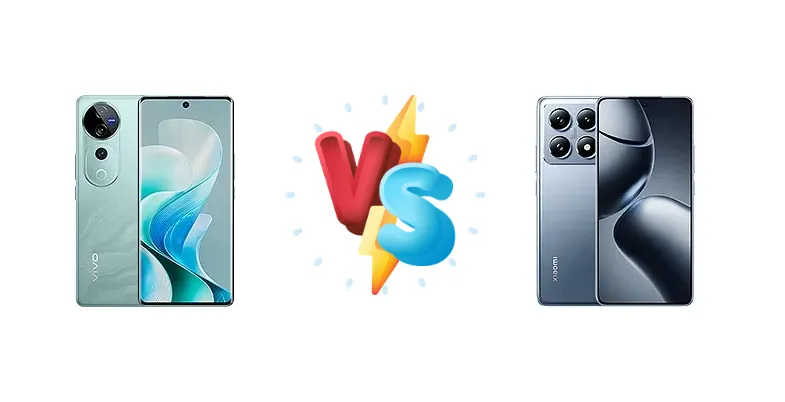
| Phone Names | vivo V40 Pro | Xiaomi 14T Pro |
| Network | ||
|---|---|---|
| 2G bands | GSM 850 / 900 / 1800 / 1900 | GSM 850 / 900 / 1800 / 1900 |
| 3G bands | HSDPA 850 / 900 / 1700(AWS) / 1900 / 2100 - International | HSDPA 800 / 850 / 900 / 1700(AWS) / 1900 / 2100 |
| 4G bands | 1, 3, 4, 5, 7, 8, 18, 19, 26, 28, 38, 39, 40, 41 - India | 1, 2, 3, 4, 5, 7, 8, 12, 13, 17, 18, 19, 20, 25, 26, 28, 32, 38, 39, 40, 41, 42, 48, 66 |
| 5G bands | 1, 3, 5, 8, 28, 40, 77, 78 SA/NSA - India | 1, 2, 3, 5, 7, 8, 12, 20, 25, 26, 28, 38, 40, 41, 48, 66, 75, 77, 78 SA/NSA |
| Speed | HSPA, LTE, 5G | HSPA, LTE, 5G |
| Technology | GSM / HSPA / LTE / 5G | GSM / HSPA / LTE / 5G |
| Launch | ||
|---|---|---|
| Announced | 2024, August 07 | 2024, September 26 |
| Status | Available. Released 2024, August 23 | Available. Released 2024, September 26 |
| Body | ||
|---|---|---|
| Build | Glass front, glass back | Glass front (Gorilla Glass 5), aluminum frame, glass back (Panda X) |
| Dimensions | 164.4 x 75.1 x 7.6 mm (6.47 x 2.96 x 0.30 in) | 160.4 x 75.1 x 8.4 mm (6.31 x 2.96 x 0.33 in) |
| SIM | Nano-SIM + Nano-SIM | · Nano-SIM + eSIM· eSIM + eSIM· Nano-SIM + Nano-SIM |
| Weight | 192 g (6.77 oz) | 209 g (7.37 oz) |
| Display | ||
|---|---|---|
| Protection | Schott Xensation Alpha | Corning Gorilla Glass 5 |
| Resolution | 1260 x 2800 pixels, 20:9 ratio (~453 ppi density) | 1220 x 2712 pixels, 20:9 ratio (~446 ppi density) |
| Size | 6.78 inches, 111.0 cm2 (~89.9% screen-to-body ratio) | 6.67 inches, 107.4 cm2 (~89.1% screen-to-body ratio) |
| Type | AMOLED, 1B colors, HDR10+, 120Hz, 2160Hz PWM, 4500 nits (peak) | AMOLED, 68B colors, 144Hz, 3840Hz PWM, Dolby Vision, HDR10+, 1600 nits (HBM), 4000 nits (peak) |
| Platform | ||
|---|---|---|
| CPU | Octa-core (1x3.35 GHz Cortex-X3 & 3x3.0 GHz Cortex-A715 & 4x2.0 GHz Cortex-A510) | Octa-core (1x3.4 GHz Cortex-X4 & 3x2.85 GHz Cortex-X4 & 4x2.0 GHz Cortex-A720) |
| Chipset | Mediatek Dimensity 9200+ (4 nm) | Mediatek Dimensity 9300+ (4 nm) |
| GPU | Immortalis-G715 MC11 | Immortalis-G720 MC12 |
| OS | Android 14, Funtouch 14 | Android 14, HyperOS |
| Memory | ||
|---|---|---|
| Card slot | No | No |
| Internal | 256GB 8GB RAM, 256GB 12GB RAM, 512GB 12GB RAM | 256GB 12GB RAM, 512GB 12GB RAM, 512GB 16GB RAM, 1TB 12GB RAM |
| Main Camera | ||
|---|---|---|
| Features | Zeiss optics, Ring-LED flash, panorama, HDR | Leica lens, Ultra HDR, LED flash, HDR, panorama |
| Triple | 50 MP, f/1.9, 24mm (wide), 1/1.56", 1.0µm, PDAF, OIS 50 MP, f/1.9, 50mm (telephoto), 1/2.51", 0.64µm, PDAF, OIS, 2x optical zoom 50 MP, f/2.0, 15mm, 119˚ (ultrawide), 1/2.76", 0.64µm, AF | 50 MP, f/1.6, 23mm (wide), 1/1.31", 1.2µm, PDAF, OIS 50 MP, f/2.0, 60mm (telephoto), 1/2.88", 0.61µm, PDAF, 2.6x optical zoom 12 MP, f/2.2, 15mm (ultrawide), 1/3.06", 1.12µm |
| Video | 4K@30/60fps, 1080p@30fps, gyro-EIS, OIS | 8K@24/30fps, 4K@24/30/60fps, 1080p@30/60/120/240/960fps, gyro-EIS, 10-bit Rec. 2020, HDR10+ |
| Selfie camera | ||
|---|---|---|
| Features | HDR | HDR |
| Single | 50 MP, f/2.0, 21mm (wide), 1/2.76", 0.64µm, AF | 32 MP, f/2.0, 25mm (wide), 1/3.44", 0.64µm |
| Video | 4K@30fps, 1080p@30fps | 4K@30fps, 1080p@30/60fps, HDR10+ |
| Sound | ||
|---|---|---|
| 35mm jack | No | No |
| Loudspeaker | Yes, with stereo speakers | Yes, with stereo speakers |
| Comms | ||
|---|---|---|
| Bluetooth | 5.3, A2DP, LE | 5.4, A2DP, LE, LHDC |
| Infrared port | - | Yes |
| NFC | Yes (market/region dependent) | Yes (market/region dependent) |
| Positioning | GPS, GALILEO, GLONASS, QZSS, BDS, NavIC | GPS (L1+L5), BDS (B1I+B1C+B2a+B2b), GALILEO (E1+E5a+E5b), QZSS (L1+L5), NavIC (L5), GLONASS |
| Radio | No | No |
| USB | USB Type-C 2.0, OTG | USB Type-C 2.0, OTG |
| WLAN | Wi-Fi 802.11 a/b/g/n/ac/6/7, dual-band | Wi-Fi 802.11 a/b/g/n/ac/6e/7, dual-band, Wi-Fi Direct |
| Features | ||
|---|---|---|
| Sensors | Fingerprint (under display, optical), accelerometer, gyro, proximity, compass | Fingerprint (under display, optical), accelerometer, gyro, proximity, compass |
| Battery | ||
|---|---|---|
| Charging | 80W wired, PD Reverse wired | 120W wired, PD3.0, QC4, 100% in 19 min 50W wireless, 100% in 45 min |
| Type | Si/C Li-Ion 5500 mAh | Li-Po 5000 mAh |
| Misc | ||
|---|---|---|
| Colors | Ganges Blue, Titanium Gray, Moonlight White | Titan Gray, Titan Blue, Titan Black |
| Models | V2347 | 2407FPN8EG |
| Price | ₹ 42,999 | $ 550.00 / £ 498.00 / € 539.99 |
| SAR | 0.99 W/kg (head) 0.99 W/kg (body) | - |
| SAR EU | - | 0.99 W/kg (head) 1.00 W/kg (body) |
vivo V40 Pro
- Slightly brighter display (1307 nits)
- Potentially longer battery life (13:45h active use)
- 80W wired charging with reverse wired charging
- Older Dimensity 9200+ chipset
- Slower charging speeds compared to Xiaomi
- No wireless charging
Xiaomi 14T Pro
- More powerful Dimensity 9300+ chipset
- Significantly faster 120W wired charging (19 minutes to full)
- 50W wireless charging
- Slightly dimmer display (1228 nits)
- Shorter battery life (12:32h active use)
- Potential for faster battery degradation due to faster charging
Display Comparison
Both the vivo V40 Pro and Xiaomi 14T Pro feature high-quality displays, but the vivo edges out the Xiaomi with a measured peak brightness of 1307 nits compared to the 14T Pro’s 1228 nits. While both are excellent for outdoor visibility, the extra brightness of the vivo provides a slight advantage in direct sunlight. Details regarding panel technology (LTPO or not) are missing, but both likely employ AMOLED panels given the brightness levels. Bezels appear comparable based on available imagery, and color accuracy is expected to be strong on both devices, typical of this price segment.
Camera Comparison
Without detailed camera specifications, a direct comparison is limited. However, the chipset’s ISP capabilities are relevant. The Dimensity 9300+ in the Xiaomi 14T Pro benefits from advancements in image processing compared to the 9200+ in the vivo V40 Pro. This suggests potentially better noise reduction, dynamic range, and overall image quality, especially in challenging lighting conditions. The absence of information regarding sensor size and OIS makes a definitive statement impossible, but the Xiaomi’s more powerful processor gives it an edge in computational photography.
Performance
The Xiaomi 14T Pro’s Dimensity 9300+ represents a generational leap over the vivo V40 Pro’s Dimensity 9200+. The 9300+ features a Cortex-X4 prime core clocked at 3.4 GHz, alongside three additional Cortex-X4 cores at 2.85 GHz, a configuration designed for sustained peak performance. The V40 Pro utilizes a Cortex-X3 at 3.35 GHz, and three A715 cores at 3.0 GHz. This architectural difference translates to a tangible performance advantage for the Xiaomi, particularly in CPU-intensive tasks. Both devices utilize a 4nm process, but the newer architecture of the 9300+ should offer improved efficiency. The Xiaomi’s LPDDR5x RAM is also expected to contribute to faster application loading and multitasking.
Battery Life
The vivo V40 Pro achieves an active use battery score of 13:45h, while the Xiaomi 14T Pro scores 12:32h. Despite the slightly lower score, the Xiaomi compensates with significantly faster charging. Its 120W wired charging can fully charge the device in just 19 minutes, a substantial improvement over the vivo’s 80W charging. The Xiaomi also adds 50W wireless charging, a feature absent on the vivo. The difference in charging speed is a major differentiator, catering to users who prioritize convenience and minimal downtime.
Buying Guide
Buy the vivo V40 Pro if you prioritize a slightly brighter display and value a more conservative approach to charging, potentially extending long-term battery health. Buy the Xiaomi 14T Pro if you demand the fastest possible charging speeds, need the extra processing power for demanding tasks, and appreciate the latest CPU architecture for future-proofing.